
Before Memmo my notes were scattered across PDFs. Now a workspace pulls everything into one place — I see exactly what's still left to study.
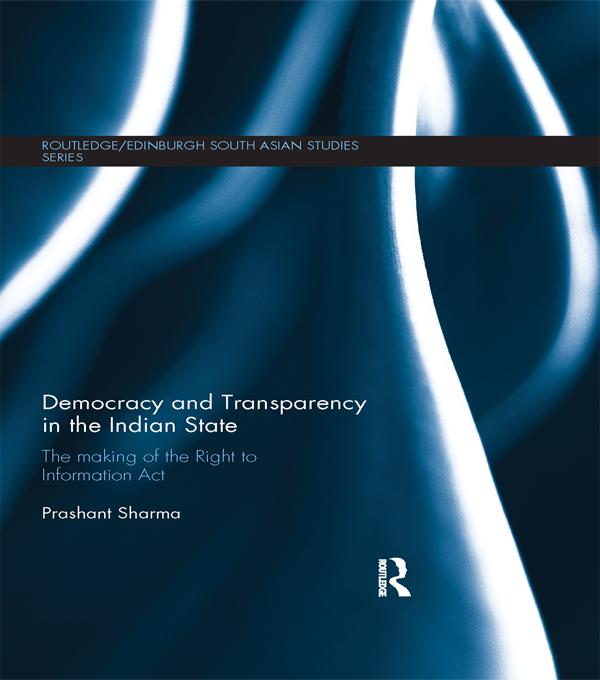
The enactment of the national Right to Information (RTI) Act in 2005 has been produced, consumed, and celebrated as an important event of democratic deepening in India both in terms of the process that led to its enactment (arising from a grassroots movement) and its outcome (fundamentally altering the citizen--state relationship). This book proposes that the explanatory factors underlying this event may be more complex than imagined thus far.
The book discusses how the leadership of the grassroots movement was embedded within the ruling elite and possessed the necessary resources as well as unparalleled access to spaces of power for the movement to be successful. It shows how the democratisation of the higher bureaucracy along with the launch of the economic liberalisation project meant that the urban, educated, high-caste, upper-middle class elite that provided critical support to the demand for an RTI Act was no longer vested in the state and had moved to the private sector. Mirroring this shift, the framing of the RTI Act during the 1990s saw its ambit reduced to the government, even as there was a concomitant push to privatise public goods and services. It goes on to investigate the Indian RTI Act within the global explosion of freedom of information laws over the last two decades, and shows how international pressures had a direct and causal impact both on its content and the timing of its enactment.
Taking the production of the RTI Act as a lens, the book argues that while there is much to celebrate in the consolidation of procedural democracy in India over the last six decades, existing social and political structures may limit the extent and forms of democratic deepening occurring in the near future. It will be of interest to those working in the fields of South Asian Law, Asian Politics, and Civil Society.
Before Memmo my notes were scattered across PDFs. Now a workspace pulls everything into one place — I see exactly what's still left to study.
Memmo's summaries are gold before exams. I don't have to re-read 800 pages two weeks before — just the important parts.
The AI chat has saved me the night before an exam more than once. I just keep asking until I get it — no waiting on a study group to reply.
The quizzes hit exactly what I need to know. Memmo tracks what I get stuck on — so I only practice what's worth it.
Flashcards with spaced repetition are magic. Memmo knows when I'm about to forget something and brings it back.
The AI podcasts are my favorite. I listen on my way to school and get a recap without sitting at a computer.

Handbok i kvalitativa metoder
281 kr

Hållbar utveckling: en introduktion för ingenjörer och andra problemlösare
334 kr

Brymans Samhällsvetenskapliga metoder
390 kr

Projektledning
491 kr

Den orättvisa hälsan: om socioekonomiska skillnader i hälsa och livslängd
326 kr

Vetenskapsteori för nybörjare
196 kr

Organizational Leadership
429 kr

På väg mot läraryrket
172 kr

Det sociala livet i skolan: Socialpsykologiska perspektiv
253 kr

Betygsättningens didaktik
151 kr

Personality
402 kr

Studying Leadership
404 kr

Managing Innovation
477 kr

Introduktion till samhällsvetenskaplig metod
347 kr

The Psychology of Sex and Gender
698 kr

Evidens och kunskap för socialt arbete
207 kr

Introduction to Leadership
605 kr