
Before Memmo my notes were scattered across PDFs. Now a workspace pulls everything into one place — I see exactly what's still left to study.
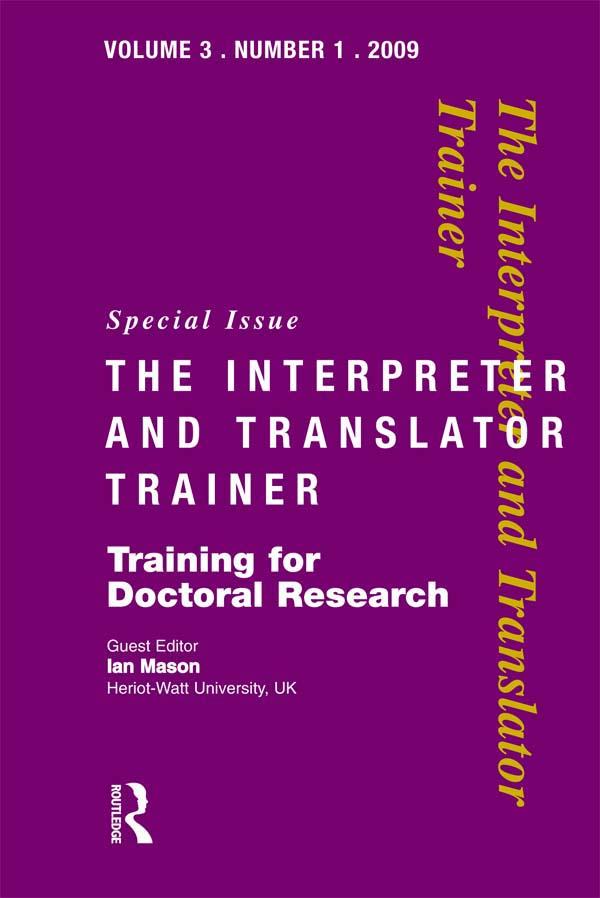
Following the rapid expansion of translation studies as an emergent (inter-)discipline over recent decades, demand for doctoral research opportunities is now growing fast in many countries. At the same time, doctoral training packages of a generic nature have been elaborated and refined at many universities, drawing on long traditions of doctoral research in established disciplines. A degree of consensus no doubt exists on such matters as the need for rigor, method and the generation of new knowledge. Beyond that, however, there are a host of issues specific to translation and interpreting studies that remain under-researched and under-discussed. Contributors to this special issue encourage reflection on a range of issues in ways that foster further debate and collaboration on the development of doctoral studies within the field. A number of concrete proposals are offered that could be adapted to local situations in different countries and academic settings. While some of the contributions adopt a mainly empirical stance, others adopt a broad perspective on training, citing examples of widely differing projects. Two contributors offer insights from personal experience of doctoral study while another describes the organization of doctoral work within the conceptual framework of a research group. All consider training from the angle of student needs and offer concrete suggestions for ensuring that doctoral candidates are equipped with the guidance, concepts, methods and tools required for success.
Before Memmo my notes were scattered across PDFs. Now a workspace pulls everything into one place — I see exactly what's still left to study.
Memmo's summaries are gold before exams. I don't have to re-read 800 pages two weeks before — just the important parts.
The AI chat has saved me the night before an exam more than once. I just keep asking until I get it — no waiting on a study group to reply.
The quizzes hit exactly what I need to know. Memmo tracks what I get stuck on — so I only practice what's worth it.
Flashcards with spaced repetition are magic. Memmo knows when I'm about to forget something and brings it back.
The AI podcasts are my favorite. I listen on my way to school and get a recap without sitting at a computer.

Handbok i kvalitativa metoder
281 kr

Hållbar utveckling: en introduktion för ingenjörer och andra problemlösare
334 kr

Brymans Samhällsvetenskapliga metoder
390 kr

Projektledning
491 kr

Den orättvisa hälsan: om socioekonomiska skillnader i hälsa och livslängd
326 kr

Vetenskapsteori för nybörjare
196 kr

Organizational Leadership
429 kr

På väg mot läraryrket
172 kr

Det sociala livet i skolan: Socialpsykologiska perspektiv
253 kr

Betygsättningens didaktik
151 kr

Personality
402 kr

Studying Leadership
404 kr

Managing Innovation
477 kr

Introduktion till samhällsvetenskaplig metod
347 kr

The Psychology of Sex and Gender
698 kr

Evidens och kunskap för socialt arbete
207 kr

Introduction to Leadership
605 kr