
Before Memmo my notes were scattered across PDFs. Now a workspace pulls everything into one place — I see exactly what's still left to study.
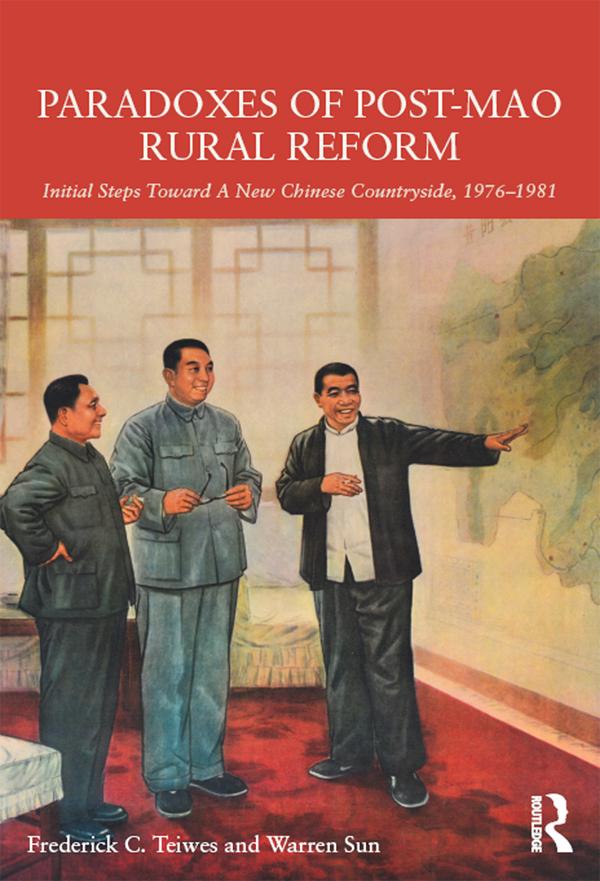
The decollectivization of Chinese agriculture in the early post-Mao period is widely recognized as a critical part of the overall reform program. But the political process leading to this outcome is poorly understood. A number of approaches have dominated the existing literature: 1) a power/policy struggle between Hua Guofeng’s alleged neo-Maoists and Deng Xiaoping’s reform coalition; 2) the power of the peasants; and 3) the leading role of provincial reformers. The first has no validity, while second and third must be viewed through more complex lenses.
This study provides a new interpretation challenging conventional wisdom. Its key finding is that a game changer emerged in spring 1980 at the time Deng replaced Hua as CCP leader, but the significant change in policy was not a product of any clash between these two leaders. Instead, Deng endorsed Zhao Ziyang’s policy initiative that shifted emphasis away from Hua’s pro-peasant policy of increased resources to the countryside, to a pro-state policy that reduced the rural burden on national coffers. To replace the financial resources, policy measures including household farming were implemented with considerable provincial variations. The major unexpected production increases in 1982 confirmed the arrival of decollectivization as the template on the ground. The dynamics of this policy change has never been adequately explained.
Paradoxes of Post-Mao Rural Reform offers a deep empirical study of critical developments involving politics from the highest levels in Beijing to China’s villages, and in the process challenges many broader accepted interpretations of the politics of reform. It is essential reading for students and scholars of contemporary Chinese political history.
Before Memmo my notes were scattered across PDFs. Now a workspace pulls everything into one place — I see exactly what's still left to study.
Memmo's summaries are gold before exams. I don't have to re-read 800 pages two weeks before — just the important parts.
The AI chat has saved me the night before an exam more than once. I just keep asking until I get it — no waiting on a study group to reply.
The quizzes hit exactly what I need to know. Memmo tracks what I get stuck on — so I only practice what's worth it.
Flashcards with spaced repetition are magic. Memmo knows when I'm about to forget something and brings it back.
The AI podcasts are my favorite. I listen on my way to school and get a recap without sitting at a computer.

Handbok i kvalitativa metoder
281 kr

Hållbar utveckling: en introduktion för ingenjörer och andra problemlösare
334 kr

Brymans Samhällsvetenskapliga metoder
390 kr

Projektledning
491 kr

Den orättvisa hälsan: om socioekonomiska skillnader i hälsa och livslängd
326 kr

Vetenskapsteori för nybörjare
196 kr

Organizational Leadership
429 kr

På väg mot läraryrket
172 kr

Det sociala livet i skolan: Socialpsykologiska perspektiv
253 kr

Betygsättningens didaktik
151 kr

Personality
402 kr

Studying Leadership
404 kr

Managing Innovation
477 kr

Introduktion till samhällsvetenskaplig metod
347 kr

The Psychology of Sex and Gender
698 kr

Evidens och kunskap för socialt arbete
207 kr

Introduction to Leadership
605 kr