
Before Memmo my notes were scattered across PDFs. Now a workspace pulls everything into one place — I see exactly what's still left to study.
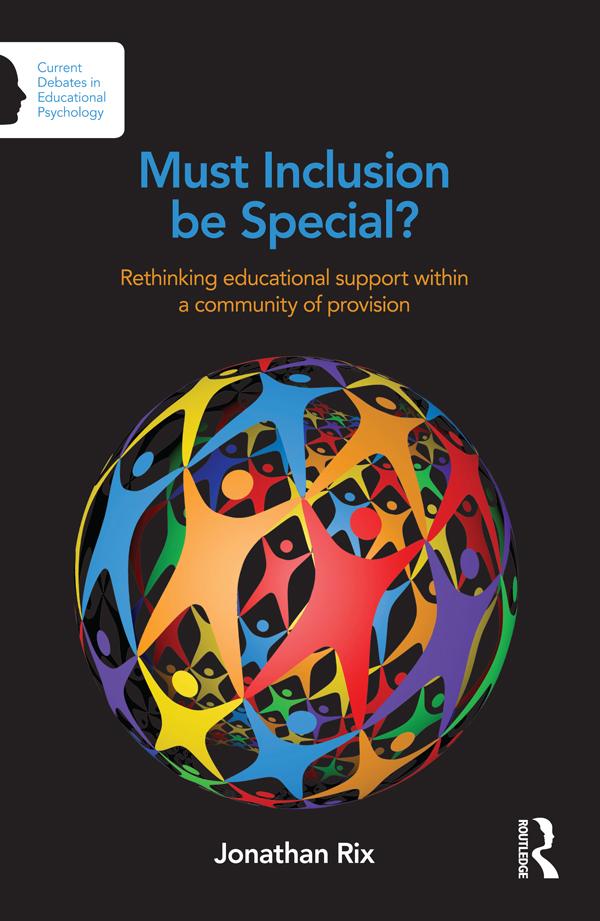
Must Inclusion be Special? examines the discord between special and inclusive education and why this discord can only be resolved when wider inequalities within mainstream education are confronted. It calls for a shift in our approach to provision, from seeing it as a conglomeration of individualised needs to identifying it as a conglomeration of collective needs.
The author examines the political, medical and cultural tendency of current times to focus upon the individual and contrasts this with the necessity to focus on context. This book distinguishes the theoretical perspectives that are often associated with special or inclusive education and the broad range of interests which depend upon their ongoing development. This examination leads to a problematisation of mainstream education provision, our understanding of why social inequities emerge and how additional support can overcome these inequities.
Further chapters explore the underlying challenges which emerge from our use and understanding of the notions of special and inclusive, outlining an alternative approach based upon a community of provision. This approach recognises the interconnectedness of services and the significance of context, and it encapsulates the aspiration of much international legislation for participation and inclusion for all. But it also assumes that we tend towards diffuse practices, services, policies, settings and roles, spread across provision which is variously inclusive and exclusionary. In seeking to create equitable participation for all, support needs to shift its focus from the individual to this diffuse network of contexts.
Must Inclusion be Special? emerges from the research base which problematises inclusion and special education, drawing upon examples from many countries. It also refers to the author’s research into pedagogy, language and policy, and his experiences as a teacher and the parent of a child identified with special educational needs.
Before Memmo my notes were scattered across PDFs. Now a workspace pulls everything into one place — I see exactly what's still left to study.
Memmo's summaries are gold before exams. I don't have to re-read 800 pages two weeks before — just the important parts.
The AI chat has saved me the night before an exam more than once. I just keep asking until I get it — no waiting on a study group to reply.
The quizzes hit exactly what I need to know. Memmo tracks what I get stuck on — so I only practice what's worth it.
Flashcards with spaced repetition are magic. Memmo knows when I'm about to forget something and brings it back.
The AI podcasts are my favorite. I listen on my way to school and get a recap without sitting at a computer.

Handbok i kvalitativa metoder
281 kr

Hållbar utveckling: en introduktion för ingenjörer och andra problemlösare
334 kr

Brymans Samhällsvetenskapliga metoder
390 kr

Projektledning
491 kr

Den orättvisa hälsan: om socioekonomiska skillnader i hälsa och livslängd
326 kr

Organizational Leadership
429 kr

Vetenskapsteori för nybörjare
196 kr

På väg mot läraryrket
172 kr

Det sociala livet i skolan: Socialpsykologiska perspektiv
253 kr

Betygsättningens didaktik
151 kr

Personality
402 kr

Studying Leadership
404 kr

Managing Innovation
477 kr

Introduktion till samhällsvetenskaplig metod
347 kr

The Psychology of Sex and Gender
698 kr

Evidens och kunskap för socialt arbete
207 kr

Introduction to Leadership
605 kr