
Before Memmo my notes were scattered across PDFs. Now a workspace pulls everything into one place — I see exactly what's still left to study.
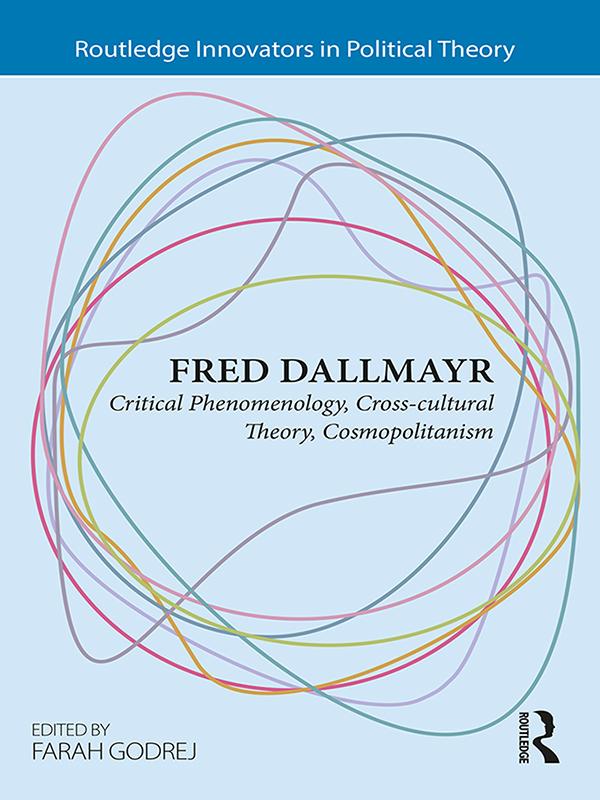
Fred Dallmayr’s work is innovative in its rethinking of some of the central concepts of modern political philosophy, challenging the hegemony of a modern “subjectivity” at the heart of Western liberalism, individualism and rationalism, and articulating alternative voices, claims and ideas. His writings productively confound the logocentrism of Western modernity, while providing alternative conceptions of political community that are post-individualist, post-anthropocentric and relational.
The editor has focused on work in three key areas:
Critical phenomenology and the study of politicsThe first selections focus on the philosophical roots of Dallmayr’s work in two of the most innovative intellectual trends of the twentieth century: phenomenology and critical theory. These chapters outline some of the main arguments advanced by practitioners of phenomenology, particularly “existential phenomenology,” as well the guiding ideas of critical theory and critical Marxism, while tracing Dallmayr’s debt to thinkers such as Heidegger, Gadamer, Habermas, Adorno and Merleau-Ponty.
Cross-cultural theoryThese readings illustrate Dallmayr’s explorations beyond the confines of Western culture, as this phase of his thinking turns toward what is now called cross-cultural or “comparative” political theory. In an approach that maintains its linkage with critical phenomenology, Dallmayr asserts that Western (or European-American) political theory can no longer claim undisputed hegemony; rather it must allow itself to be contested, amplified and corrected through a comparison with non-Western theoretical traditions and initiatives.
CosmopolitanismThese selections explore the final phase of Dallmayr’s work, in which he applies his insights on cross-cultural studies to the context of global politics, rebutting Samuel Huntington’s “clash of civilizations” thesis, and instead arguing for a cosmopolitanism that takes a middle path between both global universalism and restrictive particularism, advocating sustained dialogue and respectful mutual learning between countries and civilizations.
Before Memmo my notes were scattered across PDFs. Now a workspace pulls everything into one place — I see exactly what's still left to study.
Memmo's summaries are gold before exams. I don't have to re-read 800 pages two weeks before — just the important parts.
The AI chat has saved me the night before an exam more than once. I just keep asking until I get it — no waiting on a study group to reply.
The quizzes hit exactly what I need to know. Memmo tracks what I get stuck on — so I only practice what's worth it.
Flashcards with spaced repetition are magic. Memmo knows when I'm about to forget something and brings it back.
The AI podcasts are my favorite. I listen on my way to school and get a recap without sitting at a computer.

Handbok i kvalitativa metoder
281 kr

Hållbar utveckling: en introduktion för ingenjörer och andra problemlösare
334 kr

Brymans Samhällsvetenskapliga metoder
390 kr

Projektledning
491 kr

Den orättvisa hälsan: om socioekonomiska skillnader i hälsa och livslängd
326 kr

Organizational Leadership
429 kr

Vetenskapsteori för nybörjare
196 kr

På väg mot läraryrket
172 kr

Det sociala livet i skolan: Socialpsykologiska perspektiv
253 kr

Betygsättningens didaktik
151 kr

Personality
402 kr

Studying Leadership
404 kr

Managing Innovation
477 kr

Introduktion till samhällsvetenskaplig metod
347 kr

The Psychology of Sex and Gender
698 kr

Evidens och kunskap för socialt arbete
207 kr

Introduction to Leadership
605 kr