
Before Memmo my notes were scattered across PDFs. Now a workspace pulls everything into one place — I see exactly what's still left to study.
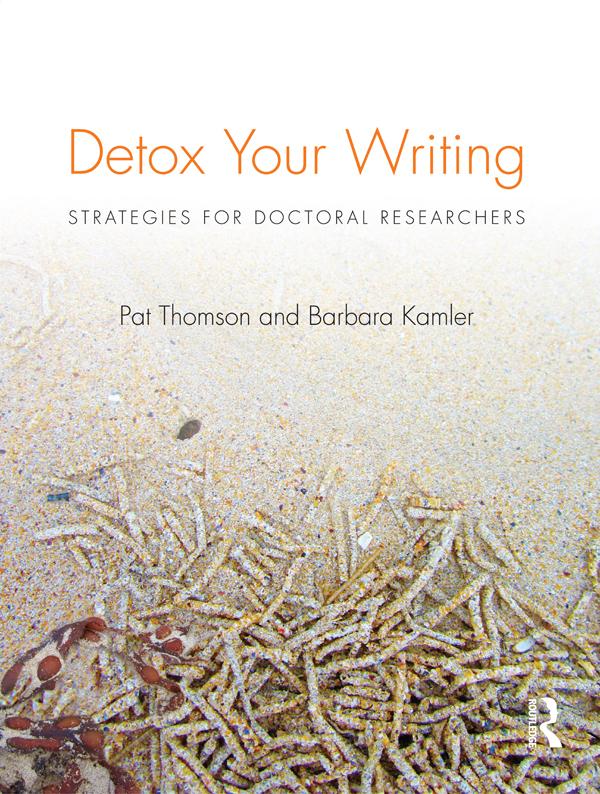
There are a number of books which aim to help doctoral researchers write the PhD. This book offers something different - the scholarly detox. This is not a faddish alternative, it’s not extreme. It’s a moderate approach intended to gently interrupt old ways of doing things and establish new habits and orientations to writing the PhD.
The book addresses the problems that most doctoral researchers experience at some time during their candidature – being unclear about their contribution, feeling lost in the literature, feeling like an imposter, not knowing how to write with authority, wanting to edit rather than revise. Each chapter addresses a problem, suggests an alternative framing, and then offers strategies designed to address the real issue.
Detox Your Writing is intended to be a companionable work book – something doctoral researchers can use throughout their doctorate to ask questions about taken-for-granted ways of writing and reading, and to develop new and effective approaches.
The authors’ distinctive approach to doctoral writing mobilises the rich traditions of linguistic scholarship, as well as the literatures on scholarly identity formation. Building on years of expertise they place their emphasis both on tools and techniques as well as the discursive practices of becoming a scholar.
The authors provide a wide repertoire of strategies that doctoral researchers can select from, rather than a linear lock step progression through a set of exercises. The book is a toolkit but a far from prescriptive one. It shows that there are many routes to developing a personal academic voice and identity and a well-crafted text. With points for reflection alongside examples from a broad range of disciplines, the book offers thinking tools, writing tools, linguistic tools, and reading tools which are relevant to all stages of doctoral research.
This practical text can be used in all university doctoral training and composition and writing courses. However, it is not a dry how-to-do–it manual that ignores debates or focuses solely on the mechanical at the expense of the lived experience of doctoral research. It provides a practical, theorised, real-world, guide to postgraduate writing.
Before Memmo my notes were scattered across PDFs. Now a workspace pulls everything into one place — I see exactly what's still left to study.
Memmo's summaries are gold before exams. I don't have to re-read 800 pages two weeks before — just the important parts.
The AI chat has saved me the night before an exam more than once. I just keep asking until I get it — no waiting on a study group to reply.
The quizzes hit exactly what I need to know. Memmo tracks what I get stuck on — so I only practice what's worth it.
Flashcards with spaced repetition are magic. Memmo knows when I'm about to forget something and brings it back.
The AI podcasts are my favorite. I listen on my way to school and get a recap without sitting at a computer.

Handbok i kvalitativa metoder
281 kr

Hållbar utveckling: en introduktion för ingenjörer och andra problemlösare
334 kr

Brymans Samhällsvetenskapliga metoder
390 kr

Projektledning
491 kr

Den orättvisa hälsan: om socioekonomiska skillnader i hälsa och livslängd
326 kr

Organizational Leadership
429 kr

Vetenskapsteori för nybörjare
196 kr

På väg mot läraryrket
172 kr

Det sociala livet i skolan: Socialpsykologiska perspektiv
253 kr

Betygsättningens didaktik
151 kr

Personality
402 kr

Studying Leadership
404 kr

Managing Innovation
477 kr

Introduktion till samhällsvetenskaplig metod
347 kr

The Psychology of Sex and Gender
698 kr

Evidens och kunskap för socialt arbete
207 kr

Introduction to Leadership
605 kr