
Before Memmo my notes were scattered across PDFs. Now a workspace pulls everything into one place — I see exactly what's still left to study.
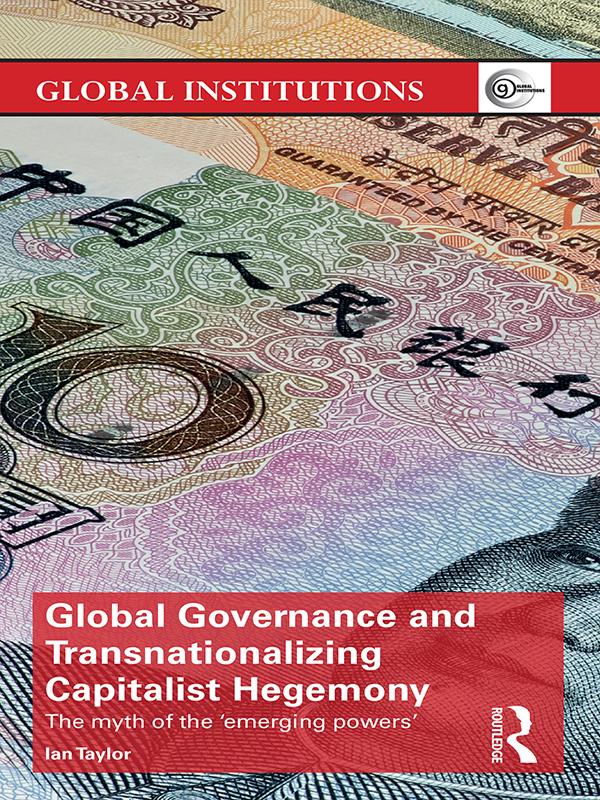
This book is a critique of claims regarding how emerging economies are supposedly rewriting the rules of global governance and ushering in alternative models to neoliberal orthodoxy. It argues that such assumptions are abstractions that ignore both the transnationalizing nature of the global political economy and the actual policy goals of the ruling classes within most emerging economies.
Considering the larger issues behind the emerging economies (or powers) debate, the book deploys an adapted global capitalism perspective with insights from Gramsci, Poulantzas and Cox, to argue that the transnational nature of the global political economy and the actual policy goals of the dominant elites within most emerging economies merge to undermine any transformative element. Far from challenging the global order, these ostensible new rivals in fact seek to integrate their economies more and more within the existing liberal global economy. Inter-state dynamics and even inter-elite tensions exist and it is clear that the nation state has not simply become a transmission belt for global capital, but equally we must move beyond the surface phenomena that are most visible in global tensions to get at the underlying essence of social and class forces in the global political economy. Looking at the largest emerging powers, such as Brazil, Russia, India and China, Taylor explains why the emerging powers’ elites, although essentially subscribing to neoliberalism (in all its variegated forms) may confront the core in a myriad of ways, but that these are not challenges to the ongoing world order and, in fact, the so-called emerging powers serve a legitimizing function for the extant global system.
The book will be of great use to graduates and scholars of International Relations, Global/International Political Economy and International Development.
Before Memmo my notes were scattered across PDFs. Now a workspace pulls everything into one place — I see exactly what's still left to study.
Memmo's summaries are gold before exams. I don't have to re-read 800 pages two weeks before — just the important parts.
The AI chat has saved me the night before an exam more than once. I just keep asking until I get it — no waiting on a study group to reply.
The quizzes hit exactly what I need to know. Memmo tracks what I get stuck on — so I only practice what's worth it.
Flashcards with spaced repetition are magic. Memmo knows when I'm about to forget something and brings it back.
The AI podcasts are my favorite. I listen on my way to school and get a recap without sitting at a computer.

Handbok i kvalitativa metoder
281 kr

Hållbar utveckling: en introduktion för ingenjörer och andra problemlösare
334 kr

Brymans Samhällsvetenskapliga metoder
390 kr

Projektledning
491 kr

Den orättvisa hälsan: om socioekonomiska skillnader i hälsa och livslängd
326 kr

Organizational Leadership
429 kr

Vetenskapsteori för nybörjare
196 kr

På väg mot läraryrket
172 kr

Det sociala livet i skolan: Socialpsykologiska perspektiv
253 kr

Betygsättningens didaktik
151 kr

Personality
402 kr

Studying Leadership
404 kr

Managing Innovation
477 kr

Introduktion till samhällsvetenskaplig metod
347 kr

The Psychology of Sex and Gender
698 kr

Evidens och kunskap för socialt arbete
207 kr

Introduction to Leadership
605 kr