
Before Memmo my notes were scattered across PDFs. Now a workspace pulls everything into one place — I see exactly what's still left to study.
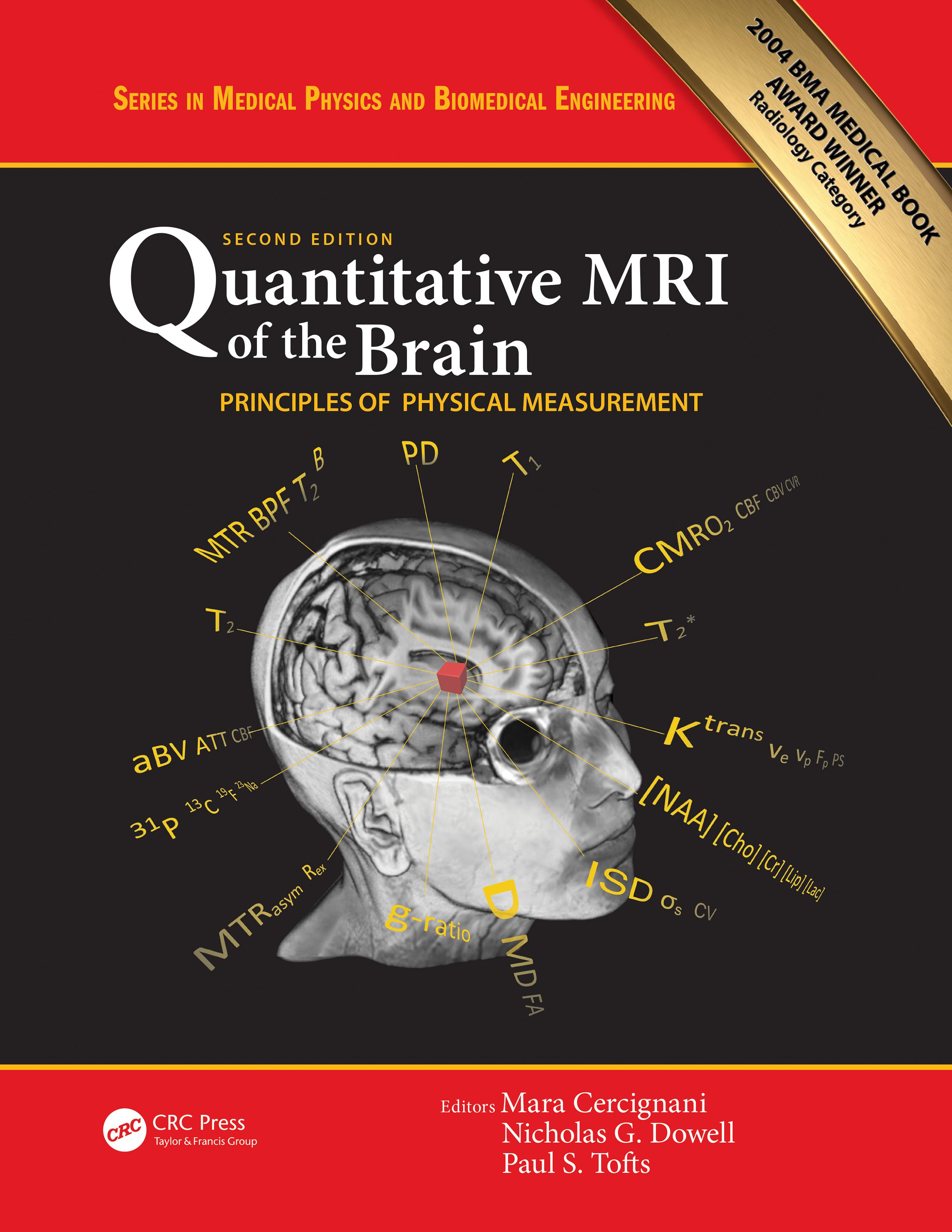
Building on the success of the first edition of this book, the winner of the 2004 British Medical Association Radiology Medical Book Competition, Quantitative MRI of the Brain: Principles of Physical Measurement gives a unique view on how to use an MRI machine in a new way. Used as a scientific instrument it can make measurements of a myriad of physical and biological quantities in the human brain and body. For each small tissue voxel, non-invasive information monitors how tissue changes with disease and responds to treatment.
The book opens with a detailed exposition of the principles of good practice in quantification, including fundamental concepts, quality assurance, MR data collection and analysis and improved study statistical power through minimised instrumental variation. There follow chapters on 14 specific groups of quantities: proton density, T1, T2, T2*, diffusion, advanced diffusion, magnetisation transfer, CEST, 1H and multi-nuclear spectroscopy, DCE-MRI, quantitative fMRI, arterial spin-labelling and image analysis, and finally a chapter on the future of quantification. The physical principles behind each quantity are stated, followed by its biological significance. Practical techniques for measurement are given, along with pitfalls and examples of clinical applications.
This second edition of this indispensable 'how to' manual of quantitative MR shows the MRI physicist and research clinician how to implement these techniques on an MRI scanner to understand more about the biological processes in the patient and physiological changes in healthy controls. Although focussed on the brain, most techniques are applicable to characterising tissue in the whole body.
This book is essential reading for anyone who wants to use the gamut of modern quantitative MRI methods to measure the effects of disease, its progression, and its response to treatment.
Features:
Gives specific ‘how to’ information for implementation of MRI measurement sequence techniques
Before Memmo my notes were scattered across PDFs. Now a workspace pulls everything into one place — I see exactly what's still left to study.
Memmo's summaries are gold before exams. I don't have to re-read 800 pages two weeks before — just the important parts.
The AI chat has saved me the night before an exam more than once. I just keep asking until I get it — no waiting on a study group to reply.
The quizzes hit exactly what I need to know. Memmo tracks what I get stuck on — so I only practice what's worth it.
Flashcards with spaced repetition are magic. Memmo knows when I'm about to forget something and brings it back.
The AI podcasts are my favorite. I listen on my way to school and get a recap without sitting at a computer.

Handbok i kvalitativa metoder
281 kr

Hållbar utveckling: en introduktion för ingenjörer och andra problemlösare
334 kr

Brymans Samhällsvetenskapliga metoder
390 kr

Projektledning
491 kr

Den orättvisa hälsan: om socioekonomiska skillnader i hälsa och livslängd
326 kr

Vetenskapsteori för nybörjare
196 kr

Organizational Leadership
429 kr

På väg mot läraryrket
172 kr

Det sociala livet i skolan: Socialpsykologiska perspektiv
253 kr

Betygsättningens didaktik
151 kr

Personality
402 kr

Studying Leadership
404 kr

Managing Innovation
477 kr

Introduktion till samhällsvetenskaplig metod
347 kr

The Psychology of Sex and Gender
698 kr

Evidens och kunskap för socialt arbete
207 kr

Introduction to Leadership
605 kr