
Before Memmo my notes were scattered across PDFs. Now a workspace pulls everything into one place — I see exactly what's still left to study.
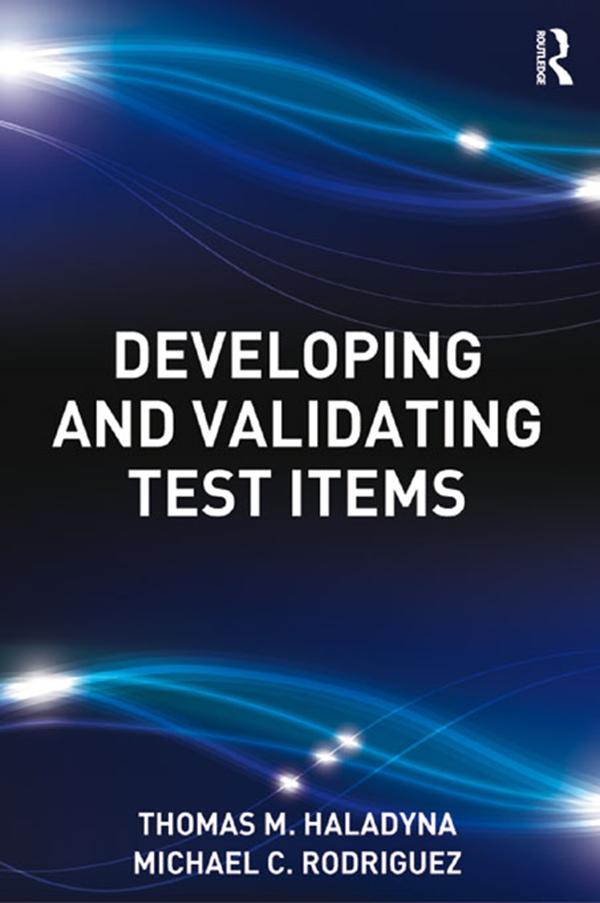
Since test items are the building blocks of any test, learning how to develop and validate test items has always been critical to the teaching-learning process. As they grow in importance and use, testing programs increasingly supplement the use of selected-response (multiple-choice) items with constructed-response formats. This trend is expected to continue. As a result, a new item writing book is needed, one that provides comprehensive coverage of both types of items and of the validity theory underlying them.
This book is an outgrowth of the author’s previous book, Developing and Validating Multiple-Choice Test Items, 3e (Haladyna, 2004). That book achieved distinction as the leading source of guidance on creating and validating selected-response test items. Like its predecessor, the content of this new book is based on both an extensive review of the literature and on its author’s long experience in the testing field. It is very timely in this era of burgeoning testing programs, especially when these items are delivered in a computer-based environment. Key features include …
Comprehensive and Flexible – No other book so thoroughly covers the field of test item development and its various applications.
Focus on Validity – Validity, the most important consideration in testing, is stressed throughout and is based on the Standards for Educational and Psychological Testing, currently under revision by AERA, APA, and NCME
Illustrative Examples – The book presents various selected and constructed response formats and uses many examples to illustrate correct and incorrect ways of writing items. Strategies for training item writers and developing large numbers of items using algorithms and other item-generating methods are also presented.
Based on Theory and Research – A comprehensive review and synthesis of existing research runs throughout the book and complements the expertise of its authors.
Before Memmo my notes were scattered across PDFs. Now a workspace pulls everything into one place — I see exactly what's still left to study.
Memmo's summaries are gold before exams. I don't have to re-read 800 pages two weeks before — just the important parts.
The AI chat has saved me the night before an exam more than once. I just keep asking until I get it — no waiting on a study group to reply.
The quizzes hit exactly what I need to know. Memmo tracks what I get stuck on — so I only practice what's worth it.
Flashcards with spaced repetition are magic. Memmo knows when I'm about to forget something and brings it back.
The AI podcasts are my favorite. I listen on my way to school and get a recap without sitting at a computer.

Handbok i kvalitativa metoder
281 kr

Hållbar utveckling: en introduktion för ingenjörer och andra problemlösare
334 kr

Brymans Samhällsvetenskapliga metoder
390 kr

Projektledning
491 kr

Den orättvisa hälsan: om socioekonomiska skillnader i hälsa och livslängd
326 kr

Organizational Leadership
429 kr

Vetenskapsteori för nybörjare
196 kr

På väg mot läraryrket
172 kr

Det sociala livet i skolan: Socialpsykologiska perspektiv
253 kr

Betygsättningens didaktik
151 kr

Personality
402 kr

Studying Leadership
404 kr

Managing Innovation
477 kr

Introduktion till samhällsvetenskaplig metod
347 kr

The Psychology of Sex and Gender
698 kr

Evidens och kunskap för socialt arbete
207 kr

Introduction to Leadership
605 kr