
Before Memmo my notes were scattered across PDFs. Now a workspace pulls everything into one place — I see exactly what's still left to study.
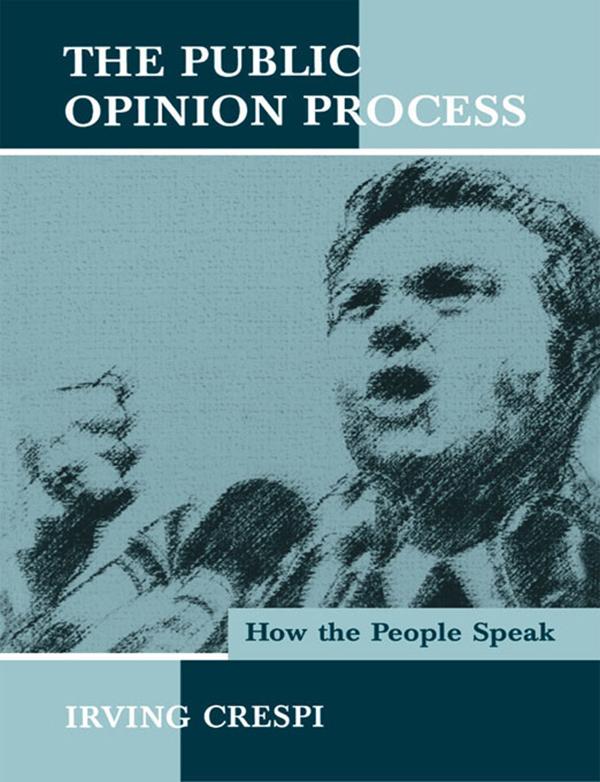
What is public opinion? How can we best study it?
This work presents a "process model" that answers these questions by defining public opinion in a way that also identifies an approach to studying it. The model serves as a framework into which the findings of empirical research are integrated, producing a comprehensive understanding of public opinion that encompasses the congeries of middle-range theories that have emerged from empirical research. The three-dimensional process model--and the way it is explicated--satisfies the diverse and sometimes divergent needs and interests of political scientists, sociologists, social psychologists, and communication specialists who study public opinion. This is achieved by clearly differentiating and interrelating the following:
* individual opinions--the judgmental outcomes of a process in which attitudinal systems--comprised of beliefs, values/interests, and feelings--function as intervening variables that direct and structure perceptions of public issues;
* collective opinions--the outcomes of communication from which mutual awareness emerges and that integrate separate individual opinions into a significant social force; and
* political roles of collective and individual opinions--the outcomes of the extent to which collective and individual opinions have achieved legitimacy as the basis for governing a people.
DON'T USE THIS PARAGRAPH FOR GENERAL CATALOGS... Each dimension of the model has its corresponding subprocess: transactions between individuals and their environments, communications among individuals and collectives, and political legitimation of public opinion. Since the process model is -- by definition -- interactional, none of the three dimensions has theoretical or sequential priority over the others. Instead of treating the psychological, political, and sociological aspects of public opinion as separate stages of an unidirectional process, the three aspects are modeled as dimensions of a complex, ongoing system in continuous interaction with each other. This conceptualization satisfies the need for a truly interdisciplinary theory in that it demands that each dimension be studied in terms of its defining sub-process. It also avoids the twin errors of reductionism and reification in the study of public opinion.
Before Memmo my notes were scattered across PDFs. Now a workspace pulls everything into one place — I see exactly what's still left to study.
Memmo's summaries are gold before exams. I don't have to re-read 800 pages two weeks before — just the important parts.
The AI chat has saved me the night before an exam more than once. I just keep asking until I get it — no waiting on a study group to reply.
The quizzes hit exactly what I need to know. Memmo tracks what I get stuck on — so I only practice what's worth it.
Flashcards with spaced repetition are magic. Memmo knows when I'm about to forget something and brings it back.
The AI podcasts are my favorite. I listen on my way to school and get a recap without sitting at a computer.

Handbok i kvalitativa metoder
281 kr

Hållbar utveckling: en introduktion för ingenjörer och andra problemlösare
334 kr

Brymans Samhällsvetenskapliga metoder
390 kr

Projektledning
491 kr

Den orättvisa hälsan: om socioekonomiska skillnader i hälsa och livslängd
326 kr

Organizational Leadership
429 kr

Vetenskapsteori för nybörjare
196 kr

På väg mot läraryrket
172 kr

Det sociala livet i skolan: Socialpsykologiska perspektiv
253 kr

Betygsättningens didaktik
151 kr

Personality
402 kr

Studying Leadership
404 kr

Managing Innovation
477 kr

Introduktion till samhällsvetenskaplig metod
347 kr

The Psychology of Sex and Gender
698 kr

Evidens och kunskap för socialt arbete
207 kr

Introduction to Leadership
605 kr