
Before Memmo my notes were scattered across PDFs. Now a workspace pulls everything into one place — I see exactly what's still left to study.
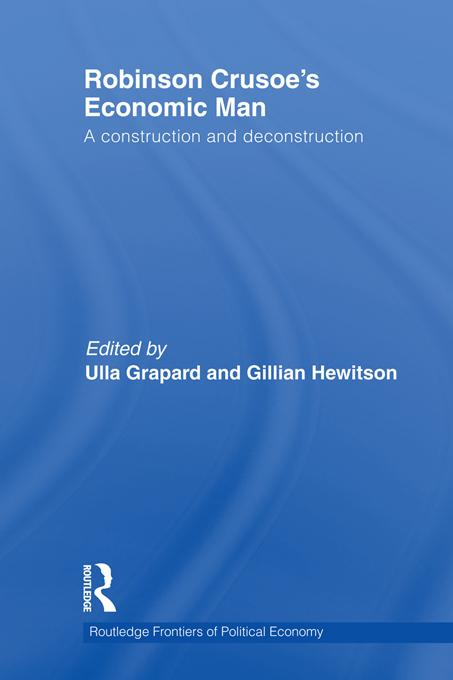
In this book, economists and literary scholars examine the uses to which the Robinson Crusoe figure has been put by the economics discipline since the publication of Defoe’s novel in 1719. The authors’ critical readings of two centuries of texts that have made use of Robinson Crusoe undermine the pervasive belief of mainstream economics that Robinson Crusoe is a benign representative of economic agency, and that he, like other economic agents, can be understood independently of historical and cultural specificity.
The book provides a detailed account of the appearance of Robinson Crusoe in the economics literature and in a plethora of modern economics texts, in which, for example, we find Crusoe is portrayed as a schizophrenic consumer/producer trying to maximize his personal well-being. Using poststructuralist, feminist, postcolonial, Marxist and literary criticism approaches, the authors of the fourteen chapters in this volume examine and critique some of the deepest, fundamental assumptions neoclassical economics hold about human nature; the political economy of colonization; international trade; and the pervasive gendered organization of social relations.
The contributors to this volume can be seen as engaging in the emerging conversation between economists and literary scholars known as the New Economic Criticism. They offer unique perspectives on how the economy and economic thought can be read through different disciplinary lenses. Economists pay attention to rhetoric and metaphor deployed in economics, and literary scholars have found new areas to explore and understand by focusing on economic concepts and vocabulary encountered in literary texts.
Before Memmo my notes were scattered across PDFs. Now a workspace pulls everything into one place — I see exactly what's still left to study.
Memmo's summaries are gold before exams. I don't have to re-read 800 pages two weeks before — just the important parts.
The AI chat has saved me the night before an exam more than once. I just keep asking until I get it — no waiting on a study group to reply.
The quizzes hit exactly what I need to know. Memmo tracks what I get stuck on — so I only practice what's worth it.
Flashcards with spaced repetition are magic. Memmo knows when I'm about to forget something and brings it back.
The AI podcasts are my favorite. I listen on my way to school and get a recap without sitting at a computer.

Handbok i kvalitativa metoder
281 kr

Hållbar utveckling: en introduktion för ingenjörer och andra problemlösare
334 kr

Brymans Samhällsvetenskapliga metoder
390 kr

Projektledning
491 kr

Den orättvisa hälsan: om socioekonomiska skillnader i hälsa och livslängd
326 kr

Organizational Leadership
429 kr

Vetenskapsteori för nybörjare
196 kr

På väg mot läraryrket
172 kr

Det sociala livet i skolan: Socialpsykologiska perspektiv
253 kr

Betygsättningens didaktik
151 kr

Personality
402 kr

Studying Leadership
404 kr

Managing Innovation
477 kr

Introduktion till samhällsvetenskaplig metod
347 kr

The Psychology of Sex and Gender
698 kr

Evidens och kunskap för socialt arbete
207 kr

Introduction to Leadership
605 kr