
Before Memmo my notes were scattered across PDFs. Now a workspace pulls everything into one place — I see exactly what's still left to study.
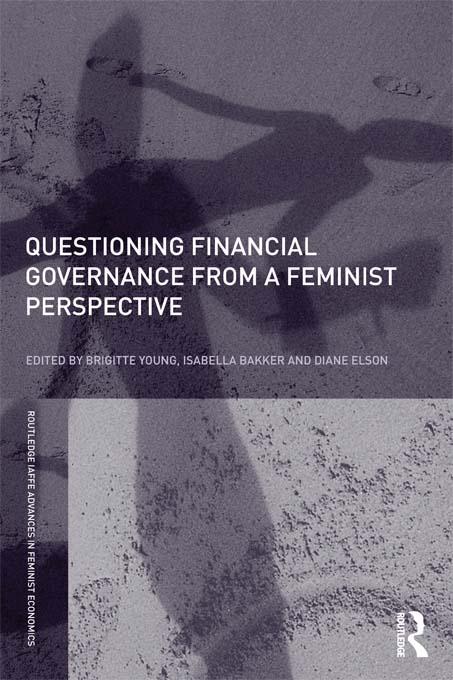
Questioning Financial Governance from a Feminist Perspective brings together feminist economists and feminist political economists from different countries located in North America and Europe to analyze the ‘strategic silence’ about gender in fiscal and monetary policy, and financial regulation. This silence reflects a set of assumptions that the key instruments of financial governance are gender-neutral. This often masks the ways in which financial governance operates to the disadvantage of women and reinforces gender inequality.
This book examines both the transformations in the governance of finance that predate the financial crisis, as well as some dimension of the crisis itself. The transformations increasingly involved private as well as public forms of power, along with institutions of state and civil society, operating at the local, national, regional and global levels. An important aspect of these transformations has been the creation of policy rules (often enacted in laws) that limit the discretion of national policy makers with respect to fiscal, monetary, and financial sector policies. These policy rules tend to have inscribed in them a series of biases that have gender (as well as class and race-based) outcomes. The biases identified by the authors in the various chapters are the deflationary bias, male breadwinner bias, and commodification bias, adding two new biases: risk bias and creditor bias.
The originality of the book is that its primary focus is on macroeconomic policies (fiscal and monetary) and financial governance from a feminist perspective with a focus on the gross domestic product and its fluctuations and growth, paid employment and inflation, the budget surplus/deficit, levels of government expenditure and tax revenue, and supply of money. The central findings are that the key instruments of financial governance are not gender neutral. Each chapter considers examples of financial governance, and how it relates to the gender order, including divisions of labour, and relations of power and privilege.
This book is key reading for anyone studying feminist economics, and should also be of interest to those researching macroeconomics, political economics and women’s studies.
Before Memmo my notes were scattered across PDFs. Now a workspace pulls everything into one place — I see exactly what's still left to study.
Memmo's summaries are gold before exams. I don't have to re-read 800 pages two weeks before — just the important parts.
The AI chat has saved me the night before an exam more than once. I just keep asking until I get it — no waiting on a study group to reply.
The quizzes hit exactly what I need to know. Memmo tracks what I get stuck on — so I only practice what's worth it.
Flashcards with spaced repetition are magic. Memmo knows when I'm about to forget something and brings it back.
The AI podcasts are my favorite. I listen on my way to school and get a recap without sitting at a computer.

Handbok i kvalitativa metoder
281 kr

Hållbar utveckling: en introduktion för ingenjörer och andra problemlösare
334 kr

Brymans Samhällsvetenskapliga metoder
390 kr

Projektledning
491 kr

Den orättvisa hälsan: om socioekonomiska skillnader i hälsa och livslängd
326 kr

Vetenskapsteori för nybörjare
196 kr

Organizational Leadership
429 kr

På väg mot läraryrket
172 kr

Det sociala livet i skolan: Socialpsykologiska perspektiv
253 kr

Betygsättningens didaktik
151 kr

Personality
402 kr

Studying Leadership
404 kr

Managing Innovation
477 kr

Introduktion till samhällsvetenskaplig metod
347 kr

The Psychology of Sex and Gender
698 kr

Evidens och kunskap för socialt arbete
207 kr

Introduction to Leadership
605 kr