
Before Memmo my notes were scattered across PDFs. Now a workspace pulls everything into one place — I see exactly what's still left to study.
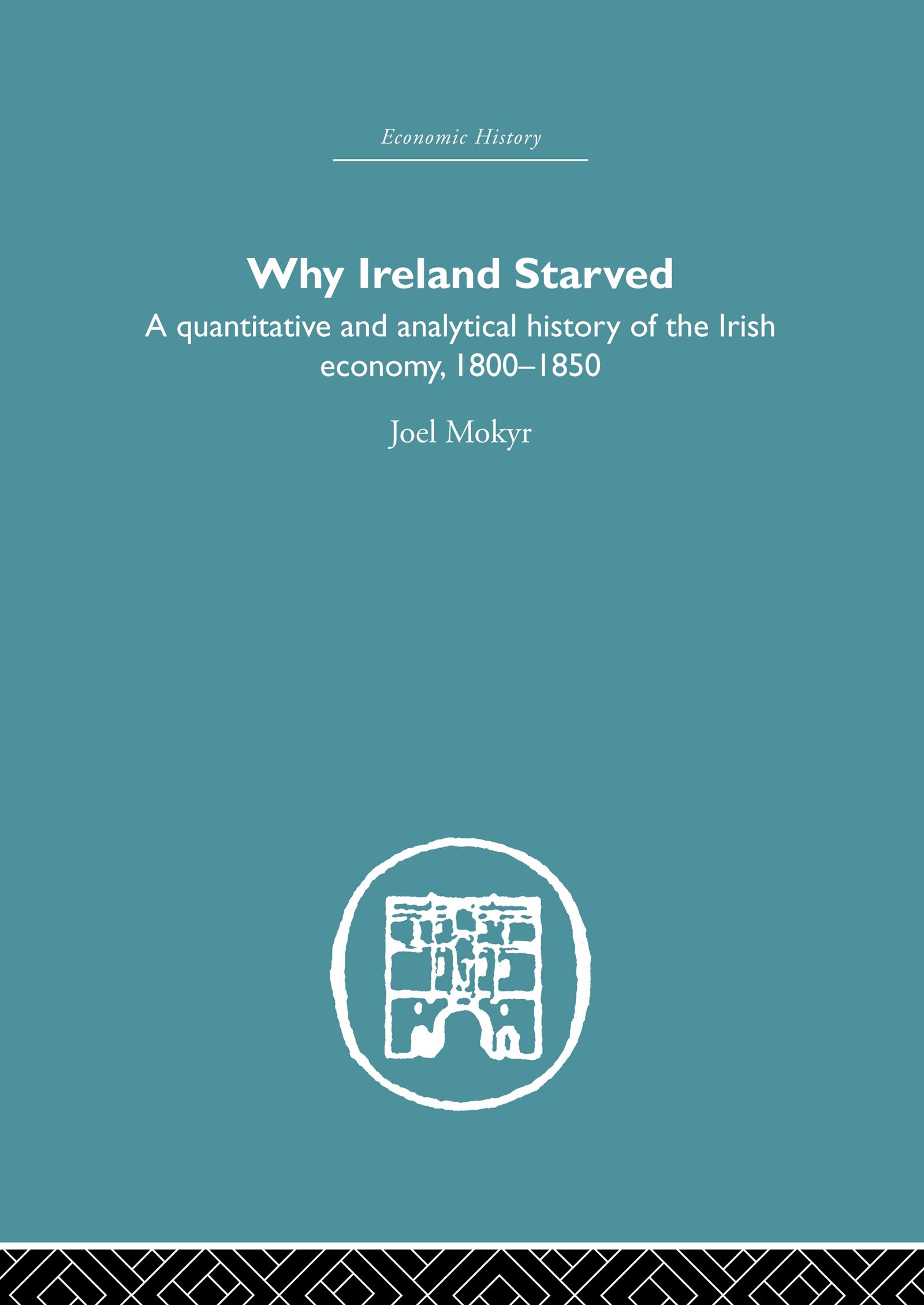
Technical changes in the first half of the nineteenth century led to unprecedented economic growth and capital formation throughout Western Europe; and yet Ireland hardly participated in this process at all. While the Northern Atlantic Economy prospered, the Great Irish Famine of 1845–50 killed a million and a half people and caused hundreds of thousands to flee the country. Why the Irish economy failed to grow, and ‘why Ireland starved’ remains an unresolved riddle of economic history.
Professor Mokyr maintains that the ‘Hungry Forties’ were caused by the overall underdevelopment of the economy during the decades which preceded the famine. In Why Ireland Starved he tests various hypotheses that have been put forward to account for this backwardness. He dismisses widespread arguments that Irish poverty can be explained in terms of over-population, an evil land system or malicious exploitation by the British. Instead, he argues that the causes have to be sought in the low productivity of labor and the insufficient formation of physical capital – results of the peculiar political and social structure of Ireland, continuous conflicts between landlords and tenants, and the rigidity of Irish economic institutions.
Mokyr’s methodology is rigorous and quantitative, in the tradition of the New Economic History. It sets out to test hypotheses about the causal connections between economic and non-economic phenomena. Irish history is often heavily coloured by political convictions: of Dutch-Jewish origin, trained in Israel and working in the United States. Mokyr brings to this controversial field not only wide research experience but also impartiality and scientific objectivity.
The book is primarily aimed at numerate economic historians, historical demographers, economists specializing in agricultural economics and economic development and specialists in Irish and British nineteenth-century history. The text is, nonetheless, free of technical jargon, with the more complex material relegated to appendixes. Mokyr’s line of reasoning is transparent and has been easily accessible and useful to readers without graduate training in economic theory and econometrics since ists first publication in 1983.
Before Memmo my notes were scattered across PDFs. Now a workspace pulls everything into one place — I see exactly what's still left to study.
Memmo's summaries are gold before exams. I don't have to re-read 800 pages two weeks before — just the important parts.
The AI chat has saved me the night before an exam more than once. I just keep asking until I get it — no waiting on a study group to reply.
The quizzes hit exactly what I need to know. Memmo tracks what I get stuck on — so I only practice what's worth it.
Flashcards with spaced repetition are magic. Memmo knows when I'm about to forget something and brings it back.
The AI podcasts are my favorite. I listen on my way to school and get a recap without sitting at a computer.

Handbok i kvalitativa metoder
281 kr

Hållbar utveckling: en introduktion för ingenjörer och andra problemlösare
334 kr

Brymans Samhällsvetenskapliga metoder
390 kr

Projektledning
491 kr

Den orättvisa hälsan: om socioekonomiska skillnader i hälsa och livslängd
326 kr

Organizational Leadership
429 kr

Vetenskapsteori för nybörjare
196 kr

På väg mot läraryrket
172 kr

Det sociala livet i skolan: Socialpsykologiska perspektiv
253 kr

Betygsättningens didaktik
151 kr

Personality
402 kr

Studying Leadership
404 kr

Managing Innovation
477 kr

Introduktion till samhällsvetenskaplig metod
347 kr

The Psychology of Sex and Gender
698 kr

Evidens och kunskap för socialt arbete
207 kr

Introduction to Leadership
605 kr