
Before Memmo my notes were scattered across PDFs. Now a workspace pulls everything into one place — I see exactly what's still left to study.
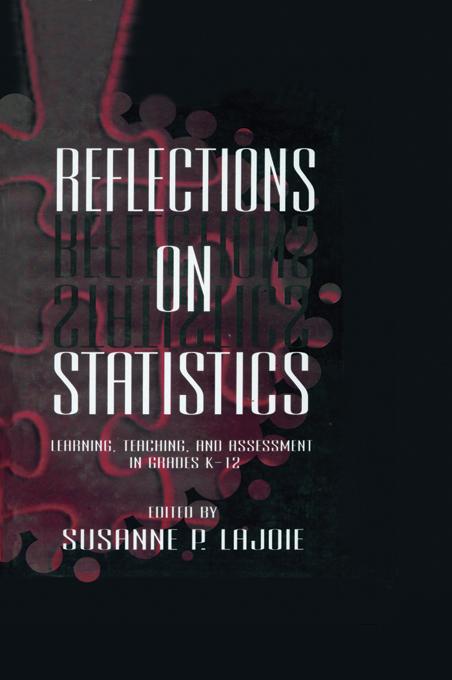
An issue in the current push for reform in mathematics education is the call to address statistics at the precollege level. This volume represents the emerging findings of an interdisciplinary collaboration among a group of mathematics educators, cognitive scientists, teachers, and statisticians to construct an understanding of how to introduce statistics education and assessment for students in elementary and secondary schools. A premise shared by the contributors to this volume is that when students are introduced to statistics at the K-12 level and provided with opportunities to do statistics that are related to actual life situations, they will be better prepared for decision making in the real world.
The interdisciplinary nature of the group of researchers stimulated a lively interchange of ideas for enhancing the learning, teaching, and assessment of statistical understanding, which is reflected in this volume. Mathematics educators contribute their insights into how teachers teach mathematical ideas and heighten our awareness of the ecological needs of the current mathematics classroom. Cognitive scientists share their understanding of developmental differences in learning and present theoretical perspectives that contribute to the design of effective learning environments. Classroom teachers share their ideas about classroom activities and assessment of student learning, as well as their concerns for in-service training and workshops to help teachers acquire skills in this new content area. Statisticians offer their understanding of what is feasible to teach in the early grades, and what their view is of statistical literacy.
The book is organized around four interdependent themes: content, teaching, learning, and assessment. By focusing their respective chapters on particular themes, the authors intend to cultivate a better understanding of how each relates to improvements in statistics education. This is the first book to:
* address statistics learning in grades K-12,
* address issues of statistical curriculum content in grades K-12,
* address issues of assessment of statistics learning in grades K-12,
* bring issues of technology instruction and assessment in statistics education in grades K-12, and
* look at teacher education for statistics instruction in grades K-12.
This is a must-read book for both practitioners and researchers involved in K-12 mathematics education.
Before Memmo my notes were scattered across PDFs. Now a workspace pulls everything into one place — I see exactly what's still left to study.
Memmo's summaries are gold before exams. I don't have to re-read 800 pages two weeks before — just the important parts.
The AI chat has saved me the night before an exam more than once. I just keep asking until I get it — no waiting on a study group to reply.
The quizzes hit exactly what I need to know. Memmo tracks what I get stuck on — so I only practice what's worth it.
Flashcards with spaced repetition are magic. Memmo knows when I'm about to forget something and brings it back.
The AI podcasts are my favorite. I listen on my way to school and get a recap without sitting at a computer.

Handbok i kvalitativa metoder
281 kr

Hållbar utveckling: en introduktion för ingenjörer och andra problemlösare
334 kr

Brymans Samhällsvetenskapliga metoder
390 kr

Projektledning
491 kr

Den orättvisa hälsan: om socioekonomiska skillnader i hälsa och livslängd
326 kr

Organizational Leadership
429 kr

Vetenskapsteori för nybörjare
196 kr

På väg mot läraryrket
172 kr

Det sociala livet i skolan: Socialpsykologiska perspektiv
253 kr

Betygsättningens didaktik
151 kr

Personality
402 kr

Studying Leadership
404 kr

Managing Innovation
477 kr

Introduktion till samhällsvetenskaplig metod
347 kr

The Psychology of Sex and Gender
698 kr

Evidens och kunskap för socialt arbete
207 kr

Introduction to Leadership
605 kr