
Before Memmo my notes were scattered across PDFs. Now a workspace pulls everything into one place — I see exactly what's still left to study.
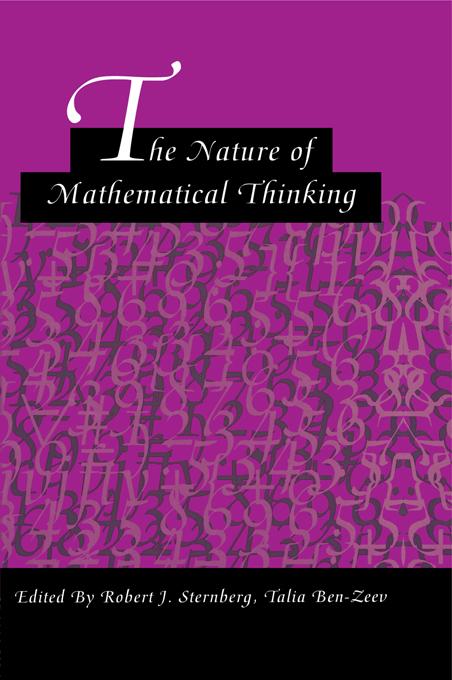
Why do some children seem to learn mathematics easily and others slave away at it, learning it only with great effort and apparent pain? Why are some people good at algebra but terrible at geometry? How can people who successfully run a business as adults have been failures at math in school? How come some professional mathematicians suffer terribly when trying to balance a checkbook? And why do school children in the United States perform so dismally in international comparisons? These are the kinds of real questions the editors set out to answer, or at least address, in editing this book on mathematical thinking. Their goal was to seek a diversity of contributors representing multiple viewpoints whose expertise might converge on the answers to these and other pressing and interesting questions regarding this subject.
The chapter authors were asked to focus on their own approach to mathematical thinking, but also to address a common core of issues such as the nature of mathematical thinking, how it is similar to and different from other kinds of thinking, what makes some people or some groups better than others in this subject area, and how mathematical thinking can be assessed and taught. Their work is directed to a diverse audience -- psychologists interested in the nature of mathematical thinking and abilities, computer scientists who want to simulate mathematical thinking, educators involved in teaching and testing mathematical thinking, philosophers who need to understand the qualitative aspects of logical thinking, anthropologists and others interested in how and why mathematical thinking seems to differ in quality across cultures, and laypeople and others who have to think mathematically and want to understand how they are going to accomplish that feat.
Before Memmo my notes were scattered across PDFs. Now a workspace pulls everything into one place — I see exactly what's still left to study.
Memmo's summaries are gold before exams. I don't have to re-read 800 pages two weeks before — just the important parts.
The AI chat has saved me the night before an exam more than once. I just keep asking until I get it — no waiting on a study group to reply.
The quizzes hit exactly what I need to know. Memmo tracks what I get stuck on — so I only practice what's worth it.
Flashcards with spaced repetition are magic. Memmo knows when I'm about to forget something and brings it back.
The AI podcasts are my favorite. I listen on my way to school and get a recap without sitting at a computer.

Handbok i kvalitativa metoder
281 kr

Hållbar utveckling: en introduktion för ingenjörer och andra problemlösare
334 kr

Brymans Samhällsvetenskapliga metoder
390 kr

Projektledning
491 kr

Den orättvisa hälsan: om socioekonomiska skillnader i hälsa och livslängd
326 kr

Vetenskapsteori för nybörjare
196 kr

Organizational Leadership
429 kr

På väg mot läraryrket
172 kr

Det sociala livet i skolan: Socialpsykologiska perspektiv
253 kr

Betygsättningens didaktik
151 kr

Personality
402 kr

Studying Leadership
404 kr

Managing Innovation
477 kr

Introduktion till samhällsvetenskaplig metod
347 kr

The Psychology of Sex and Gender
698 kr

Evidens och kunskap för socialt arbete
207 kr

Introduction to Leadership
605 kr