
Before Memmo my notes were scattered across PDFs. Now a workspace pulls everything into one place — I see exactly what's still left to study.
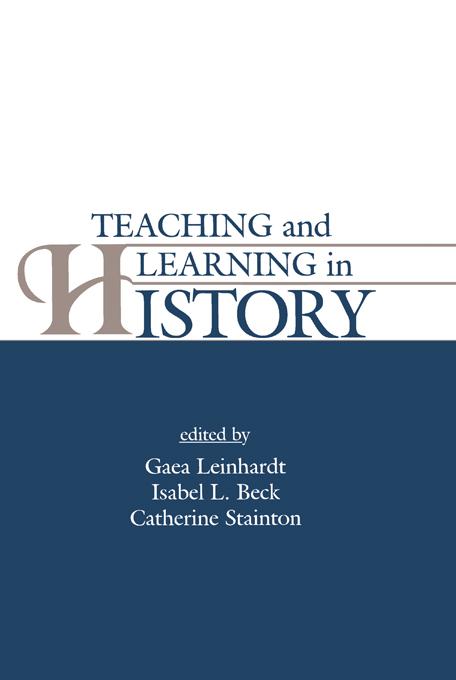
Research on history instruction and learning is emerging as an exciting new field of inquiry. The editors prepared this volume because the field is at an important moment in its development -- a stage where there is research of sufficient depth and breadth to warrant a collection of representative pieces.
The field of research on history teaching and learning connects with both traditional research on social studies and with recent cognitive analyses of domains such as mathematics and physics. However, the newer research goes beyond these activities as well. Where traditional research approaches to social studies instruction and learning have focused on curriculum, they have avoided the study of purely disciplinary features, the textual components of history and the concomitant demands, as well as the nature of various learners. Where recent cognitive analyses of mathematics and physics have dealt with misconceptions and knowledge construction, they have avoided topics such as perspective-taking, interpretation, and rhetorical layerings. The new work, by contrast, has been concerned with these issues as well as the careful analyses of the nature of historical tasks and the nature of disciplinary and instructional explanations.
The lines of research presented in these chapters are both compelling and diverse and include a range of topical questions such as:
* What affects the quality of teaching?
* How are historical documents interpreted in the writing of history?
* How is history explained?
* What are the classroom demands on an elementary school social studies teacher?
* What does text accomplish or fail to accomplish in educational settings?
* How do teachers think about particular topics for history teaching?
Although much of the research reflects a grounding in, or the influence of, cognitive psychology, not all of it derives from that tradition. Traditions of rhetoric, curriculum analysis, and developmental psychology are also woven throughout the chapters. The editors envision this volume as a contribution to educational research in a subject matter, and as a tool for practitioners concerned with the improvement of instruction in history. They also anticipate that it will contribute to cognitive science.
Before Memmo my notes were scattered across PDFs. Now a workspace pulls everything into one place — I see exactly what's still left to study.
Memmo's summaries are gold before exams. I don't have to re-read 800 pages two weeks before — just the important parts.
The AI chat has saved me the night before an exam more than once. I just keep asking until I get it — no waiting on a study group to reply.
The quizzes hit exactly what I need to know. Memmo tracks what I get stuck on — so I only practice what's worth it.
Flashcards with spaced repetition are magic. Memmo knows when I'm about to forget something and brings it back.
The AI podcasts are my favorite. I listen on my way to school and get a recap without sitting at a computer.

Handbok i kvalitativa metoder
281 kr

Hållbar utveckling: en introduktion för ingenjörer och andra problemlösare
334 kr

Brymans Samhällsvetenskapliga metoder
390 kr

Projektledning
491 kr

Den orättvisa hälsan: om socioekonomiska skillnader i hälsa och livslängd
326 kr

Vetenskapsteori för nybörjare
196 kr

Organizational Leadership
429 kr

På väg mot läraryrket
172 kr

Det sociala livet i skolan: Socialpsykologiska perspektiv
253 kr

Betygsättningens didaktik
151 kr

Personality
402 kr

Studying Leadership
404 kr

Managing Innovation
477 kr

Introduktion till samhällsvetenskaplig metod
347 kr

The Psychology of Sex and Gender
698 kr

Evidens och kunskap för socialt arbete
207 kr

Introduction to Leadership
605 kr