
Before Memmo my notes were scattered across PDFs. Now a workspace pulls everything into one place — I see exactly what's still left to study.
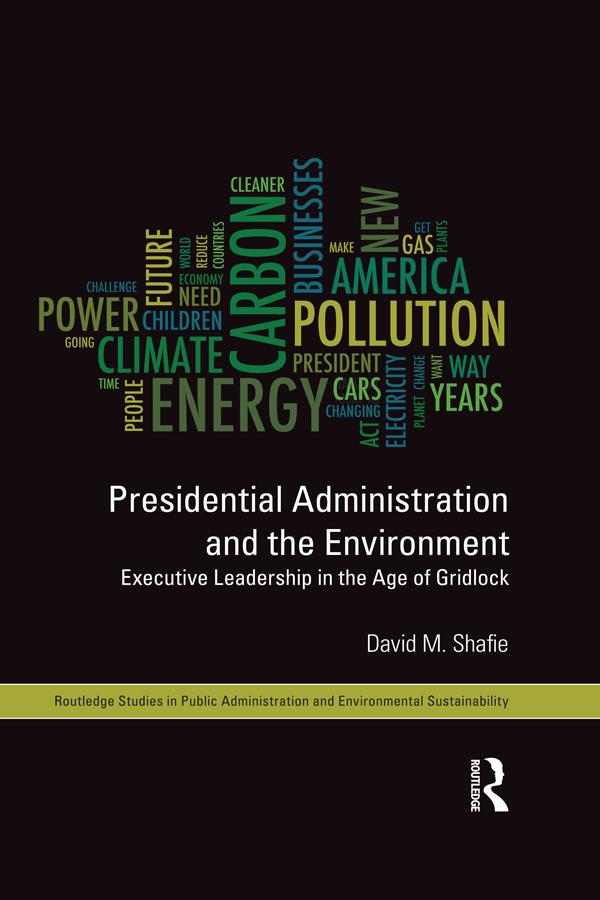
After sweeping environmental legislation passed in the 1970s and 1980s, the 1990s ushered in an era when new legislation and reforms to existing laws were consistently caught up in a gridlock. In response, environmental groups became more specialized and professional, learning how to effect policy change through the courts, states, and federal agencies rather than through grassroots movements. Without a significantly mobilized public and with a generally uncooperative Congress, presidents since the 1990s have been forced to step into a new role of increasing presidential dominance over environmental policies. Rather than working with Congress, presidents instead have employed unilateral actions and administrative strategies to further their environmental goals.
Presidential Administration and the Environment offers a detailed examination of the strategies and tools used by U.S. presidents. Using primary sources from presidential libraries such as speeches and staff communications, David M. Shafie analyzes how presidents such as Bill Clinton and George W. Bush have used alternative executive approaches to pass environmental policies. From there, Shafie presents case studies in land management, water policy, toxics, and climate change. He analyzes the role that executive leadership has played in passing policies within these four areas, explains how this role has changed over time, and concludes by investigating how Obama’s policies compare thus far with those of his predecessors.
Shafie’s combination of qualitative content analysis and topical case studies offers scholars and researchers alike important insights for understanding the interactions between environmental groups and the executive branch and the implications for future policymaking in the United States.
Before Memmo my notes were scattered across PDFs. Now a workspace pulls everything into one place — I see exactly what's still left to study.
Memmo's summaries are gold before exams. I don't have to re-read 800 pages two weeks before — just the important parts.
The AI chat has saved me the night before an exam more than once. I just keep asking until I get it — no waiting on a study group to reply.
The quizzes hit exactly what I need to know. Memmo tracks what I get stuck on — so I only practice what's worth it.
Flashcards with spaced repetition are magic. Memmo knows when I'm about to forget something and brings it back.
The AI podcasts are my favorite. I listen on my way to school and get a recap without sitting at a computer.

Handbok i kvalitativa metoder
281 kr

Hållbar utveckling: en introduktion för ingenjörer och andra problemlösare
334 kr

Brymans Samhällsvetenskapliga metoder
390 kr

Projektledning
491 kr

Den orättvisa hälsan: om socioekonomiska skillnader i hälsa och livslängd
326 kr

Organizational Leadership
429 kr

Vetenskapsteori för nybörjare
196 kr

På väg mot läraryrket
172 kr

Det sociala livet i skolan: Socialpsykologiska perspektiv
253 kr

Betygsättningens didaktik
151 kr

Personality
402 kr

Studying Leadership
404 kr

Managing Innovation
477 kr

Introduktion till samhällsvetenskaplig metod
347 kr

The Psychology of Sex and Gender
698 kr

Evidens och kunskap för socialt arbete
207 kr

Introduction to Leadership
605 kr