
Before Memmo my notes were scattered across PDFs. Now a workspace pulls everything into one place — I see exactly what's still left to study.
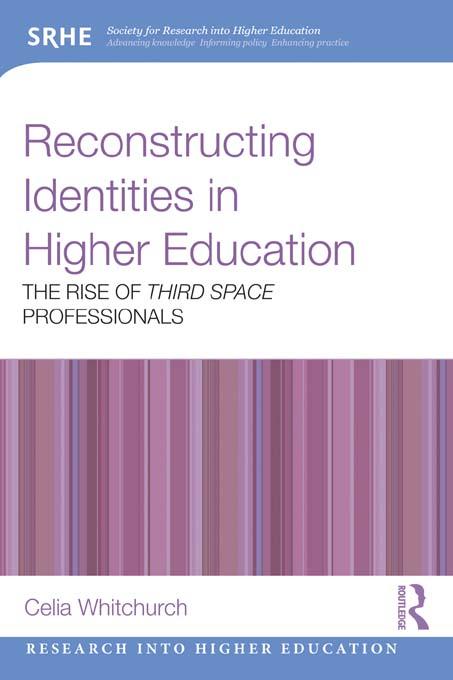
Reconstructing Identities in Higher Education: The Rise of Third Space Professionals draws on studies conducted in Australia, the United Kingdom and the United States to explore the roles and identities of a growing number of staff associated with broadly based institutional projects such as student life and welfare, widening participation, learning support, community partnership, research and business partnership, and institutional research. Thus, at the same time as professional staff are acquiring academic credentials, some academic staff are moving in a more project-oriented direction. This has effectively created a Third Space between professional and academic spheres in which lateral interactions, involving teams and networks, occur in parallel with formal institutional structures and processes, and give rise to new forms of management and leadership. Yet such developments have tended to occur ‘under the radar’, and have not been fully articulated.
The concept of Third Space is offered as a way of exploring the knowledges, relationships, legitimacies and languages that characterise those who work in less boundaried roles, and the implications of these developments for both individuals and institutions. The ability to problematise and accommodate a series of paradoxes and tensions, for instance between formal and more open-ended structures and relationships, would appear to be at the heart of working in Third Space. Individuals also grapple with the fact that Third Space can, at one and the same time, be a safe haven for experimentation and creativity, and also a risky space in which there is likely to be contestation and uncertainty.
The text is addressed to professional and academic staff who, by design or default, for long or short periods, find themselves working in Third Space environments; to those to whom such staff may be responsible, including senior management teams; and also to researchers interested in changing identities in higher education.
Before Memmo my notes were scattered across PDFs. Now a workspace pulls everything into one place — I see exactly what's still left to study.
Memmo's summaries are gold before exams. I don't have to re-read 800 pages two weeks before — just the important parts.
The AI chat has saved me the night before an exam more than once. I just keep asking until I get it — no waiting on a study group to reply.
The quizzes hit exactly what I need to know. Memmo tracks what I get stuck on — so I only practice what's worth it.
Flashcards with spaced repetition are magic. Memmo knows when I'm about to forget something and brings it back.
The AI podcasts are my favorite. I listen on my way to school and get a recap without sitting at a computer.

Handbok i kvalitativa metoder
281 kr

Hållbar utveckling: en introduktion för ingenjörer och andra problemlösare
334 kr

Brymans Samhällsvetenskapliga metoder
390 kr

Projektledning
491 kr

Den orättvisa hälsan: om socioekonomiska skillnader i hälsa och livslängd
326 kr

Vetenskapsteori för nybörjare
196 kr

Organizational Leadership
429 kr

På väg mot läraryrket
172 kr

Det sociala livet i skolan: Socialpsykologiska perspektiv
253 kr

Betygsättningens didaktik
151 kr

Personality
402 kr

Studying Leadership
404 kr

Managing Innovation
477 kr

Introduktion till samhällsvetenskaplig metod
347 kr

The Psychology of Sex and Gender
698 kr

Evidens och kunskap för socialt arbete
207 kr

Introduction to Leadership
605 kr