
Before Memmo my notes were scattered across PDFs. Now a workspace pulls everything into one place — I see exactly what's still left to study.
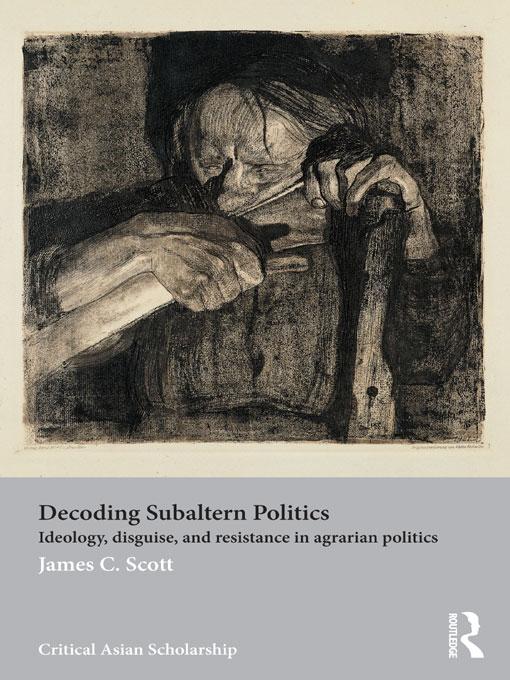
James C. Scott has researched and written on subaltern groups, and, in particular, peasants, rebellion, resistance, and agriculture, for over 35 years. Yet much of Scott’s most interesting work on the peasantry and the state, both conceptually and empirically, has never been published in book form. For the first time Decoding Subaltern Politics: Ideology, Disguise, and Resistance in Agrarian Politics, brings together some of his most important work in one volume.
The book covers three distinct yet interlinked bodies of work. The first lays out a framework for understanding peasant politics and rebellion, much of which is applicable to rural areas of the contemporary global south. Scott then goes on to develop his arguments regarding everyday forms of peasant resistance using the comparative example of the religious tithe in France and Malaysia, and tracing the forms of resistance that cover their own tracks and avoid direct clashes with authorities. For much of the world’s population, and for most of its history, this sort of politics was far more common than the violent clashes that dominate the history books, and in this book one can examine the anatomy of such resistance in rich comparative detail. Finally, Scott explores how the state’s increasing grip on its population: its identity, land-holding, income, and movements, is a precondition for political hegemony. Crucially, in examining the invention of state-mandated legal identities, especially, the permanent patronym and the vagaries of its imposition on vernacular life, Scott lays bare the micro-processes of state-formation and resistance.
Written by one of the leading social theorists of our age, Decoding Subaltern Politics: Ideology, Disguise, and Resistance in Agrarian Politics is an indispensible guide to the study of subaltern culture and politics and is essential reading for political scientists, anthropologists, sociologists and historians alike.
Before Memmo my notes were scattered across PDFs. Now a workspace pulls everything into one place — I see exactly what's still left to study.
Memmo's summaries are gold before exams. I don't have to re-read 800 pages two weeks before — just the important parts.
The AI chat has saved me the night before an exam more than once. I just keep asking until I get it — no waiting on a study group to reply.
The quizzes hit exactly what I need to know. Memmo tracks what I get stuck on — so I only practice what's worth it.
Flashcards with spaced repetition are magic. Memmo knows when I'm about to forget something and brings it back.
The AI podcasts are my favorite. I listen on my way to school and get a recap without sitting at a computer.

Handbok i kvalitativa metoder
281 kr

Hållbar utveckling: en introduktion för ingenjörer och andra problemlösare
334 kr

Brymans Samhällsvetenskapliga metoder
390 kr

Projektledning
491 kr

Den orättvisa hälsan: om socioekonomiska skillnader i hälsa och livslängd
326 kr

Organizational Leadership
429 kr

Vetenskapsteori för nybörjare
196 kr

På väg mot läraryrket
172 kr

Det sociala livet i skolan: Socialpsykologiska perspektiv
253 kr

Betygsättningens didaktik
151 kr

Personality
402 kr

Studying Leadership
404 kr

Managing Innovation
477 kr

Introduktion till samhällsvetenskaplig metod
347 kr

The Psychology of Sex and Gender
698 kr

Evidens och kunskap för socialt arbete
207 kr

Introduction to Leadership
605 kr