
Before Memmo my notes were scattered across PDFs. Now a workspace pulls everything into one place — I see exactly what's still left to study.
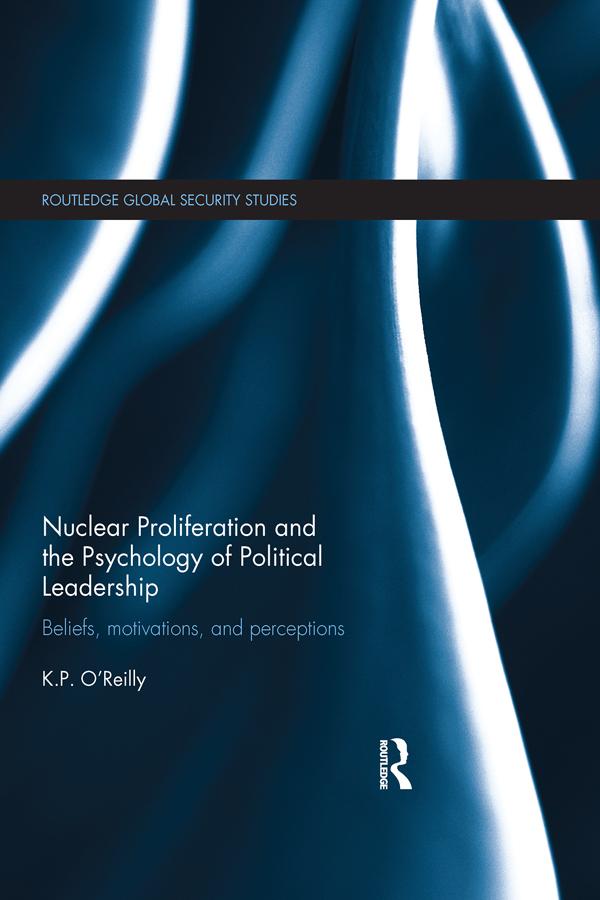
This book offers a novel approach to understanding the puzzle of nuclear proliferation by examining how leaders’ beliefs and perceptions about the international system influence states' decisions to acquire nuclear weapons.
Today, there is a persisting dilemma over the spread of nuclear weapons for both practitioners and scholars of international affairs. Uncertainty remains whether determined proliferators can be stopped, as shown by the cases of North Korea and Iran. These instances of proliferation raise questions about regional stability, the use of pre-emptive military action, and the potential for reactive-proliferation by neighbouring countries. Despite the serious implications surrounding the spread of these weapons, proliferation scholarship has thus far failed to solve what has been described as the "proliferation puzzle"- why do some countries choose nuclear weapons while others do not?
The author argues that understanding basic psychological motivations, such as the role of power and perceptions of self and others, forms a strategic context which provides answers about a leader’s willingness to proliferate. Proliferation willingness is a critical, yet frequently overlooked, part of the proliferation equation. Ultimately, it is the combination of willingness and proliferation opportunity (i.e. technical and scientific capabilities) that determines whether a country 'goes nuclear'. By examining several historical instances of proliferation decision-making—in South Africa, India, Libya and Australia—the book's findings highlight the fundamental role of leaders’ beliefs in shaping proliferation outcomes.
This book will be of much interest to students of nuclear proliferation, political psychology, security studies and IR in general.
Before Memmo my notes were scattered across PDFs. Now a workspace pulls everything into one place — I see exactly what's still left to study.
Memmo's summaries are gold before exams. I don't have to re-read 800 pages two weeks before — just the important parts.
The AI chat has saved me the night before an exam more than once. I just keep asking until I get it — no waiting on a study group to reply.
The quizzes hit exactly what I need to know. Memmo tracks what I get stuck on — so I only practice what's worth it.
Flashcards with spaced repetition are magic. Memmo knows when I'm about to forget something and brings it back.
The AI podcasts are my favorite. I listen on my way to school and get a recap without sitting at a computer.

Handbok i kvalitativa metoder
281 kr

Hållbar utveckling: en introduktion för ingenjörer och andra problemlösare
334 kr

Brymans Samhällsvetenskapliga metoder
390 kr

Projektledning
491 kr

Den orättvisa hälsan: om socioekonomiska skillnader i hälsa och livslängd
326 kr

Vetenskapsteori för nybörjare
196 kr

Organizational Leadership
429 kr

På väg mot läraryrket
172 kr

Det sociala livet i skolan: Socialpsykologiska perspektiv
253 kr

Betygsättningens didaktik
151 kr

Personality
402 kr

Studying Leadership
404 kr

Managing Innovation
477 kr

Introduktion till samhällsvetenskaplig metod
347 kr

The Psychology of Sex and Gender
698 kr

Evidens och kunskap för socialt arbete
207 kr

Introduction to Leadership
605 kr