
Before Memmo my notes were scattered across PDFs. Now a workspace pulls everything into one place — I see exactly what's still left to study.
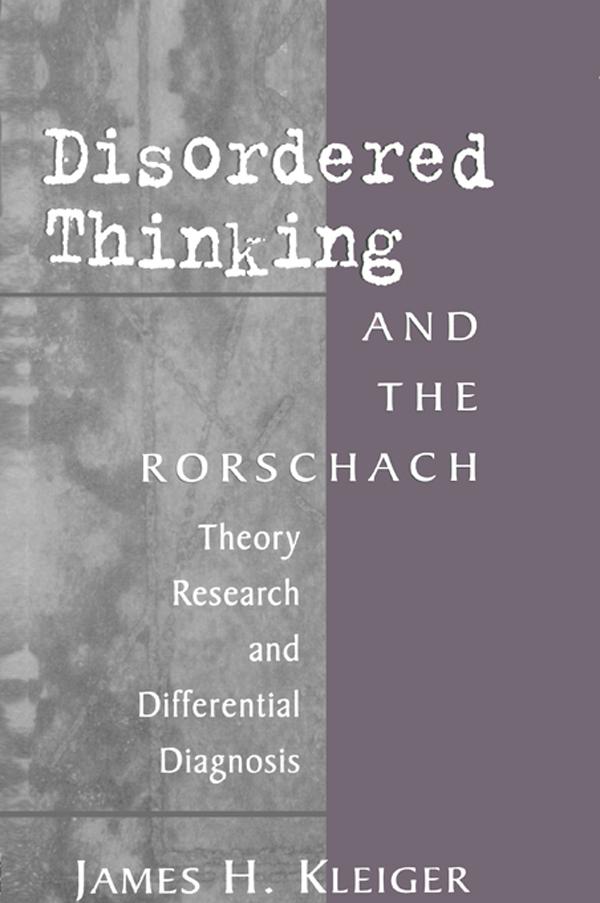
In Disordered Thinking and the Rorschach, James Kleiger provides a thoroughly up-to-date text that covers the entire range of clinical and diagnostic issues associated with the phenomenon of disordered thinking as revealed on the Rorschach. Kleiger guides the reader through the history of psychiatric and psychoanalytic conceptualizations of the nature and significance of different kinds of disordered thinking and their relevance to understanding personality structure and differential diagnosis. He then moves on to thorough reviews of the respective contributions of David Rapaport, Robert Holt, Philip Holzman, and John Exner in conceptualizing and scoring disordered thinking on the Rorschach. These synopses are followed by an equally fascinating examination of less well known research conceptualizations, which, taken together, help clarify the basic interpretive conundrums besetting the major systems.
Finally, having brought the reader to a full understanding of systematic exploration to date, Kleiger enters into a detailed analysis of the phenomenological and psychodynamic aspects of disordered thinking per se. Even experienced clinicians will find themselves challenged to reconceptualize such familiar categories as confabulatory or combinative thinking in a manner that leads not only to new diagnostic precision, but also to a richer understanding of the varieties of thought disturbances with their equally variable therapeutic and prognostic implications.
With Disordered Thinking and the Rorschach, Kleiger has succeeded in summarizing a wealth of experience pertaining to the rigorous empirical detection and classification of disordered thinking. Equally impressive, he has taken full advantage of the Rorschach as an assessment instrument able to capture the richness of personality and thus capable of providing a unique clinical window into those crucially important differences in the quality of thought that patients may evince.
Before Memmo my notes were scattered across PDFs. Now a workspace pulls everything into one place — I see exactly what's still left to study.
Memmo's summaries are gold before exams. I don't have to re-read 800 pages two weeks before — just the important parts.
The AI chat has saved me the night before an exam more than once. I just keep asking until I get it — no waiting on a study group to reply.
The quizzes hit exactly what I need to know. Memmo tracks what I get stuck on — so I only practice what's worth it.
Flashcards with spaced repetition are magic. Memmo knows when I'm about to forget something and brings it back.
The AI podcasts are my favorite. I listen on my way to school and get a recap without sitting at a computer.

Handbok i kvalitativa metoder
281 kr

Hållbar utveckling: en introduktion för ingenjörer och andra problemlösare
334 kr

Brymans Samhällsvetenskapliga metoder
390 kr

Projektledning
491 kr

Den orättvisa hälsan: om socioekonomiska skillnader i hälsa och livslängd
326 kr

Vetenskapsteori för nybörjare
196 kr

Organizational Leadership
429 kr

På väg mot läraryrket
172 kr

Det sociala livet i skolan: Socialpsykologiska perspektiv
253 kr

Betygsättningens didaktik
151 kr

Personality
402 kr

Studying Leadership
404 kr

Managing Innovation
477 kr

Introduktion till samhällsvetenskaplig metod
347 kr

The Psychology of Sex and Gender
698 kr

Evidens och kunskap för socialt arbete
207 kr

Introduction to Leadership
605 kr