
Before Memmo my notes were scattered across PDFs. Now a workspace pulls everything into one place — I see exactly what's still left to study.
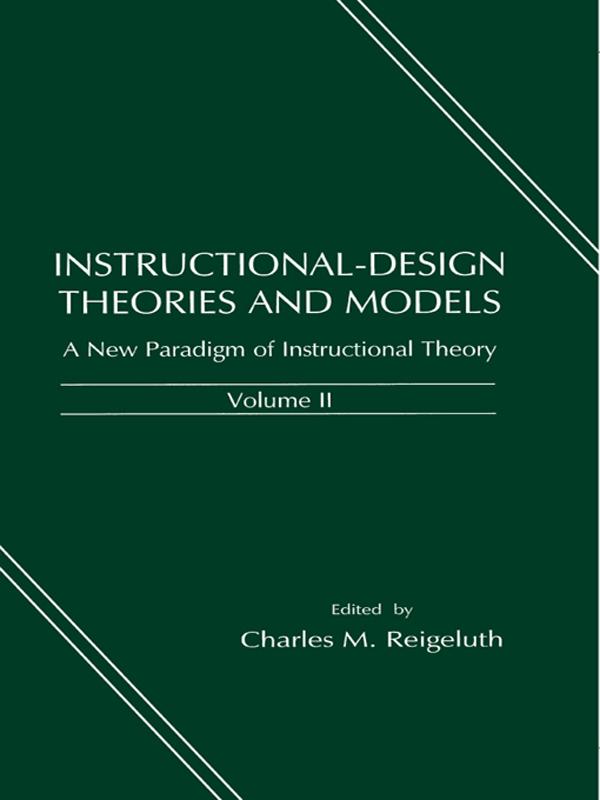
Instructional theory describes a variety of methods of instruction (different ways of facilitating human learning and development) and when to use--and not use--each of those methods. It is about how to help people learn better.
This volume provides a concise summary of a broad sampling of new methods of instruction currently under development, helps show the interrelationships among these diverse theories, and highlights current issues and trends in instructional design. It is a sequel to Instructional-Design Theories and Models: An Overview of Their Current Status, which provided a "snapshot in time" of the status of instructional theory in the early 1980s. Dramatic changes in the nature of instructional theory have occurred since then, partly in response to advances in knowledge about the human brain and learning theory, partly due to shifts in educational philosophies and beliefs, and partly in response to advances in information technologies. These changes have made new methods of instruction not only possible, but also necessary in order to take advantage of new instructional capabilities offered by the new technologies. These changes are so dramatic that many argue they constitute a new paradigm of instruction, which requires a new paradigm of instructional theory.
In short, there is a clear need for this Volume II of Instructional Design Theories and Models. To attain the broad sampling of methods and theories it presents, and to make this book more useful for practitioners as well as graduate students interested in education and training, this volume contains twice as many chapters, but each half as long as the ones in Volume I, and the descriptions are generally less technical. Several unique features are provided by the editor to help readers understand and compare the theories in this book:
*Chapter 1, which discusses the characteristics of instructional theory and the nature of the new paradigm of instruction, helps the reader identify commonalities across the theories.
*Chapter forewords, which summarize the major elements of the instructional-design theories, are useful for reviewing and comparing theories, as well as for previewing a theory to decide if it is of interest, and for developing a general schema that will make it easier to understand.
*Editor's notes provide additional help in understanding and comparing the theories and the new paradigm of instruction to which they belong.
*Units 2 and 4 have introductory chapters to help readers analyze and understand the theories in those units.
This is an essential book for anyone interested in exploring new approaches to fostering human learning and development and thinking creatively about ways to best meet the needs of learners in all kinds of learning contexts.
Readers are invited to use Dr. Charles Reigeluth's Web site to comment and to view others' comments about the instructional design theories in this book, as well as other theories. Point your browser to: www.indiana.edu/~idtheory
Before Memmo my notes were scattered across PDFs. Now a workspace pulls everything into one place — I see exactly what's still left to study.
Memmo's summaries are gold before exams. I don't have to re-read 800 pages two weeks before — just the important parts.
The AI chat has saved me the night before an exam more than once. I just keep asking until I get it — no waiting on a study group to reply.
The quizzes hit exactly what I need to know. Memmo tracks what I get stuck on — so I only practice what's worth it.
Flashcards with spaced repetition are magic. Memmo knows when I'm about to forget something and brings it back.
The AI podcasts are my favorite. I listen on my way to school and get a recap without sitting at a computer.

Handbok i kvalitativa metoder
281 kr

Hållbar utveckling: en introduktion för ingenjörer och andra problemlösare
334 kr

Brymans Samhällsvetenskapliga metoder
390 kr

Projektledning
491 kr

Den orättvisa hälsan: om socioekonomiska skillnader i hälsa och livslängd
326 kr

Organizational Leadership
429 kr

Vetenskapsteori för nybörjare
196 kr

På väg mot läraryrket
172 kr

Det sociala livet i skolan: Socialpsykologiska perspektiv
253 kr

Betygsättningens didaktik
151 kr

Personality
402 kr

Studying Leadership
404 kr

Managing Innovation
477 kr

Introduktion till samhällsvetenskaplig metod
347 kr

The Psychology of Sex and Gender
698 kr

Evidens och kunskap för socialt arbete
207 kr

Introduction to Leadership
605 kr