
Before Memmo my notes were scattered across PDFs. Now a workspace pulls everything into one place — I see exactly what's still left to study.
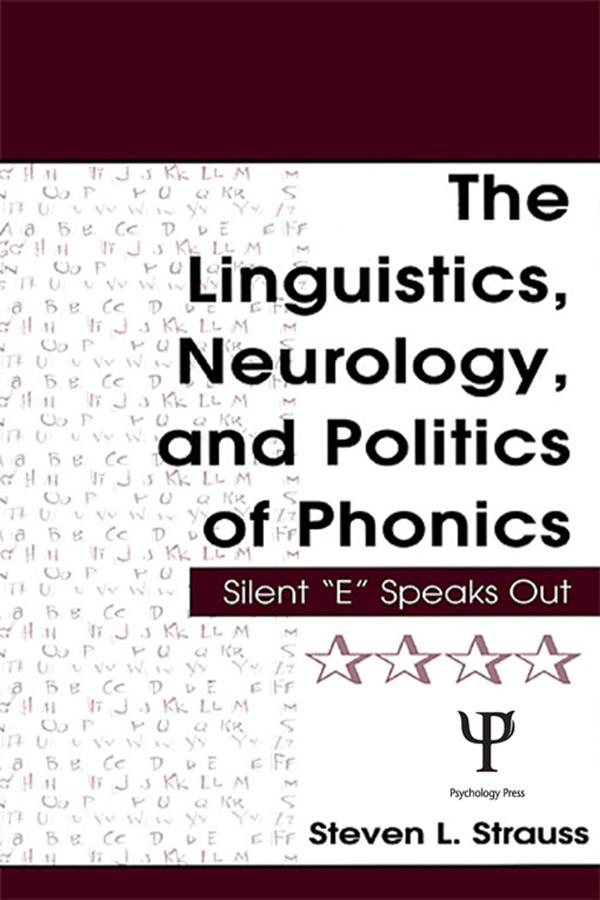
This book explores the driving forces behind the current government-sponsored resurrection of phonics, and the arguments used to justify it. It examines the roles played by three key actors--corporate America, politicians, and state-supported reading researchers--in the formulation of what Strauss terms the neophonics political program. Essential for researchers, students, and teachers of literacy and reading, and for anyone seeking to understand what is happening in U.S. public schools today, The Linguistics, Neurology, and Politics of Phonics: Silent "E" Speaks Out:
*analyzes the political nature of the alleged literacy crisis in the United States, through an investigation of the political and corporate motives behind the renewed focus on phonics, and media complicity in promoting the neophonics political program as the solution to the so-called crisis;
*examines the scientific claims of neophonics, including methodology, linguistics, and neuroscience, and exposes the flaws in its reasoning and the weakness of its arguments;
*addresses the scientific, empirical investigation of letter-sound relationships in English (of phonics itself), and demonstrates the complexity of the system and its associated benefits and limitations in the theory and practice of reading;
*proposes actions to help make a return to politically undistorted science and to democratic classrooms a reality; and
*introduces, in a postscript, a formal analysis of the letter-sound system, using empirically based rules to convert one finite set of elements, the alphabet, into another, the phonemes of the spoken language.
Offering up-to-date information and an original critique, this book makes two important contributions. One is the policy analysis linking government agencies, policymakers, and corporate interests. The second is the neurological and linguistic treatment of why traditional phonics programs are not the solution and why the rhetoric developed to support their resurgence is so far off the mark.
Before Memmo my notes were scattered across PDFs. Now a workspace pulls everything into one place — I see exactly what's still left to study.
Memmo's summaries are gold before exams. I don't have to re-read 800 pages two weeks before — just the important parts.
The AI chat has saved me the night before an exam more than once. I just keep asking until I get it — no waiting on a study group to reply.
The quizzes hit exactly what I need to know. Memmo tracks what I get stuck on — so I only practice what's worth it.
Flashcards with spaced repetition are magic. Memmo knows when I'm about to forget something and brings it back.
The AI podcasts are my favorite. I listen on my way to school and get a recap without sitting at a computer.

Handbok i kvalitativa metoder
281 kr

Hållbar utveckling: en introduktion för ingenjörer och andra problemlösare
334 kr

Brymans Samhällsvetenskapliga metoder
390 kr

Projektledning
491 kr

Den orättvisa hälsan: om socioekonomiska skillnader i hälsa och livslängd
326 kr

Vetenskapsteori för nybörjare
196 kr

Organizational Leadership
429 kr

På väg mot läraryrket
172 kr

Det sociala livet i skolan: Socialpsykologiska perspektiv
253 kr

Betygsättningens didaktik
151 kr

Personality
402 kr

Studying Leadership
404 kr

Managing Innovation
477 kr

Introduktion till samhällsvetenskaplig metod
347 kr

The Psychology of Sex and Gender
698 kr

Evidens och kunskap för socialt arbete
207 kr

Introduction to Leadership
605 kr