
Before Memmo my notes were scattered across PDFs. Now a workspace pulls everything into one place — I see exactly what's still left to study.
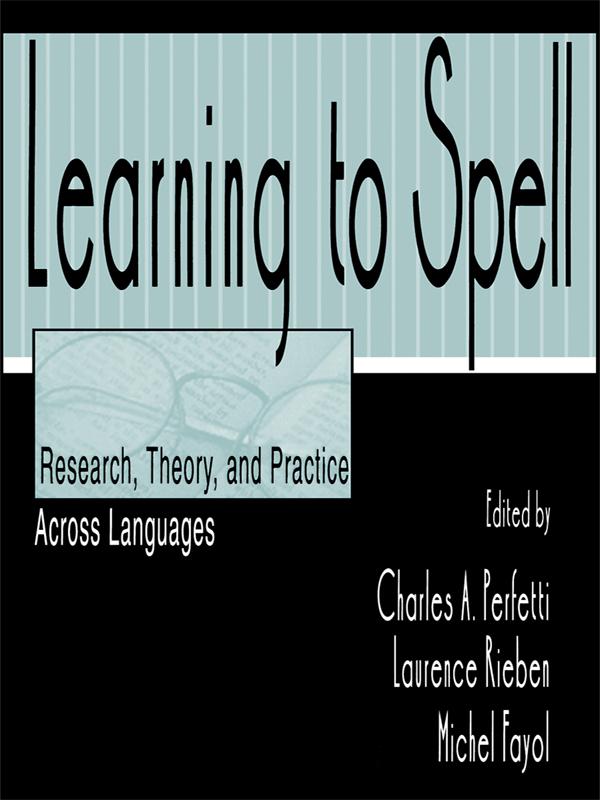
This distinctive cross-linguistic examination of spelling examines the cognitive processes that underlie spelling and the process of learning how to spell. The chapters report and summarize recent research in English, German, Hebrew, and French.
Framing the specific research on spelling are chapters that place spelling in braod theoretical perspectives provided by cognitive neuroscience, psycholinguistic, and writing system-linguistic frameworks. Of special interest is the focus on two major interrelated issues: how spelling is acquired and the relationship between reading and spelling. An important dimension of the book is the interweaving of these basic questions about the nature of spelling with practical questions about how children learn to spell in classrooms. A motivating factor in this work was to demonstrate that spelling research has become a central challenging topic in the study of cognitive processes, rather than an isolated skill learned in school. It thus brings together schooling and learning issues with modern cognitive research in a unique way. testing, children writing strings of letters as a teacher pronounces words ever so clearly. In parts of the United States it can also bring an image of specialized wizardry and school room competition, the "spelling bee." And for countless adults who confess with self-deprecation to being "terrible spellers," it is a reminder of a mysterious but minor affliction that the fates have visited on them. Beneath these popular images, spelling is a human literacy ability that reflects language and nonlanguage cognitive processes. This collection of papers presents a sample of contemporary research across different languages that addresses this ability.
To understand spelling as an interesting scientific problem, there are several important perspectives. First, spelling is the use of conventionalized writing systems that encode languages. A second asks how children learn to spell. Finally, from a literacy point of view, another asks the extent to which spelling and reading are related. In collecting some of the interesting research on spelling, the editors have adopted each of these perspectives. Many of the papers themselves reflect more than one perspective, and the reader will find important observations about orthographies, the relationship between spelling and reading, and issues of learning and teaching throughout the collection.
Before Memmo my notes were scattered across PDFs. Now a workspace pulls everything into one place — I see exactly what's still left to study.
Memmo's summaries are gold before exams. I don't have to re-read 800 pages two weeks before — just the important parts.
The AI chat has saved me the night before an exam more than once. I just keep asking until I get it — no waiting on a study group to reply.
The quizzes hit exactly what I need to know. Memmo tracks what I get stuck on — so I only practice what's worth it.
Flashcards with spaced repetition are magic. Memmo knows when I'm about to forget something and brings it back.
The AI podcasts are my favorite. I listen on my way to school and get a recap without sitting at a computer.

Handbok i kvalitativa metoder
281 kr

Hållbar utveckling: en introduktion för ingenjörer och andra problemlösare
334 kr

Brymans Samhällsvetenskapliga metoder
390 kr

Projektledning
491 kr

Den orättvisa hälsan: om socioekonomiska skillnader i hälsa och livslängd
326 kr

Organizational Leadership
429 kr

Vetenskapsteori för nybörjare
196 kr

På väg mot läraryrket
172 kr

Det sociala livet i skolan: Socialpsykologiska perspektiv
253 kr

Betygsättningens didaktik
151 kr

Personality
402 kr

Studying Leadership
404 kr

Managing Innovation
477 kr

Introduktion till samhällsvetenskaplig metod
347 kr

The Psychology of Sex and Gender
698 kr

Evidens och kunskap för socialt arbete
207 kr

Introduction to Leadership
605 kr