
Before Memmo my notes were scattered across PDFs. Now a workspace pulls everything into one place — I see exactly what's still left to study.
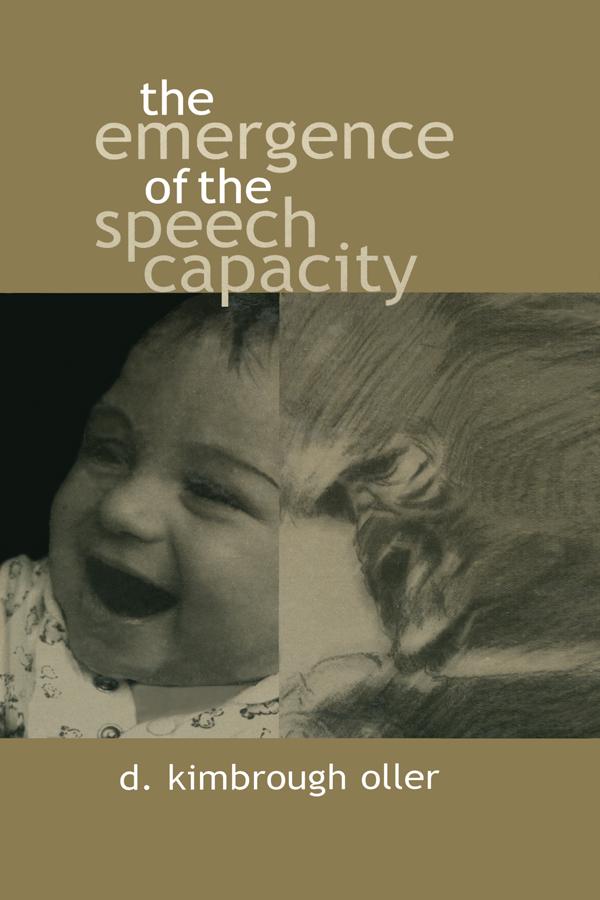
Recent studies of vocal development in infants have shed new light on old questions of how the speech capacity is founded and how it may have evolved in the human species. Vocalizations in the very first months of life appear to provide previously unrecognized clues to the earliest steps in the process by which language came to exist and the processes by which communicative disorders arise.
Perhaps the most interesting sounds made by infants are the uniquely human 'protophones' (loosely, 'babbling'), the precursors to speech. Kimbrough Oller argues that these are most profitably interpreted in the context of a new infrastructural model of speech. The model details the manner in which well-formed speech units are constructed, and it reveals how infant vocalizations mature through the first months of life by increasingly adhering to the rules of well-formed speech.
He lays out many advantages of an infrastructural approach. Infrastructural interpretation illuminates the significance of vocal stages, and highlights clinically significant deviations, such as the previously unnoticed delays in vocal development that occur in deaf infants. An infrastructural approach also specifies potential paths of evolution for vocal communicative systems. Infrastructural properties and principles of potential communicative systems prove to be organized according to a natural logic--some properties and principles naturally presuppose others. Consequently some paths of evolution are likely while others can be ruled out. An infrastructural analysis also provides a stable basis for comparisons across species, comparisons that show how human vocal capabilities outstrip those of their primate relatives even during the first months of human infancy.
The Emergence of the Speech Capacity will challenge psychologists, linguists, speech pathologists, and primatologists alike to rethink the ways they categorize and describe communication. Oller's infraphonological model permits provocative reconceptualizations of the ways infant vocalizations progress systematically toward speech, insightful comparisons between speech and the vocal systems of other species, and fruitful speculations about the origins of language.
Before Memmo my notes were scattered across PDFs. Now a workspace pulls everything into one place — I see exactly what's still left to study.
Memmo's summaries are gold before exams. I don't have to re-read 800 pages two weeks before — just the important parts.
The AI chat has saved me the night before an exam more than once. I just keep asking until I get it — no waiting on a study group to reply.
The quizzes hit exactly what I need to know. Memmo tracks what I get stuck on — so I only practice what's worth it.
Flashcards with spaced repetition are magic. Memmo knows when I'm about to forget something and brings it back.
The AI podcasts are my favorite. I listen on my way to school and get a recap without sitting at a computer.

Handbok i kvalitativa metoder
281 kr

Hållbar utveckling: en introduktion för ingenjörer och andra problemlösare
334 kr

Brymans Samhällsvetenskapliga metoder
390 kr

Projektledning
491 kr

Den orättvisa hälsan: om socioekonomiska skillnader i hälsa och livslängd
326 kr

Vetenskapsteori för nybörjare
196 kr

Organizational Leadership
429 kr

På väg mot läraryrket
172 kr

Det sociala livet i skolan: Socialpsykologiska perspektiv
253 kr

Betygsättningens didaktik
151 kr

Personality
402 kr

Studying Leadership
404 kr

Managing Innovation
477 kr

Introduktion till samhällsvetenskaplig metod
347 kr

The Psychology of Sex and Gender
698 kr

Evidens och kunskap för socialt arbete
207 kr

Introduction to Leadership
605 kr