
Before Memmo my notes were scattered across PDFs. Now a workspace pulls everything into one place — I see exactly what's still left to study.
Decision making plays a major role in virtually every theory of organizational behavior. However, decision theory has not provided organizational theorists with useful descriptions of how decisions are made, either by individuals or by individuals in organizations. The earliest offering came from economics in the form of the "normative" rational view of decision making. The underlying presumption was that decision makers are all striving to maximize return or minimize loss, that decisions are based upon unlimited information, and that they have the capacity to use the information efficiently. They know the options open to them and the consequences of pursuing one or another of those options. The optimal course of action is revealed by applying the appropriate analysis and choosing the most profitable option. The key concepts are rationality, analysis, orderliness, and maximization, and even a moment's thought demonstrates the gap between these concepts and real-life experience. From the viewpoint of organizational theory, the primary problem with the normative view of decision making, and by analogy with much behavioral decision research, is its reliance on the "gamble metaphor." That is, decisions are characterized as gambles in an effort to capture the inherent risk. This metaphor has the advantage of simplicity, but it is a flawed simplicity.
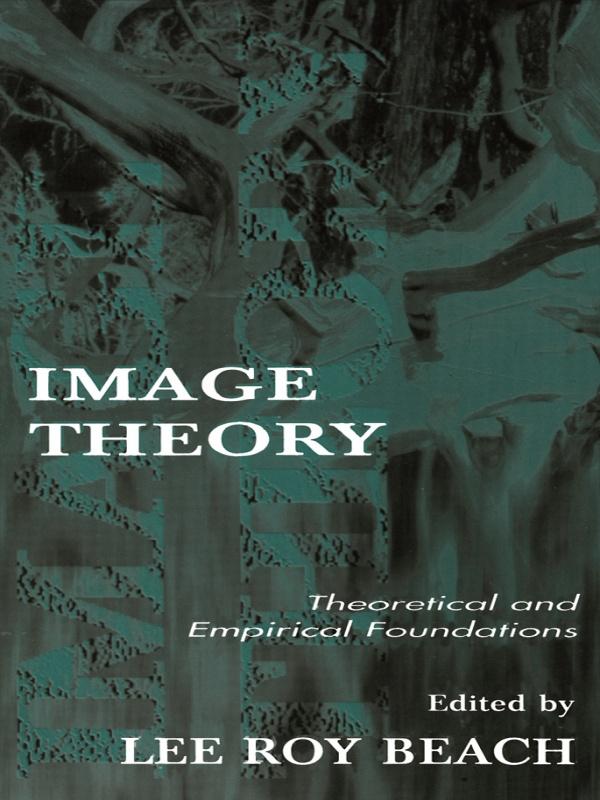
This book is about a different kind of behavioral theory -- image theory. It is a psychological theory of decision making that abandons the gamble metaphor and the normative logic that the metaphor supports. Instead it sees decision making as guided by the beliefs and values that the decision maker, or a community of decision makers, holds to be relevant to the decision at hand. These beliefs and values dictate the goals of the decision. The point is to craft a course of action that will achieve these goals without interfering with the pursuit of other goals. The book begins with an overview of image theory that outlines the basic concepts of the theory and a little of its history. The next two parts correspond to the theory's two decision mechanisms, the compatibility test and the profitability test. The final section contains extensions and developments of the theory as well as cognate ideas that have their basis in the theory. This book's purpose is to provide -- in one place -- the theoretical and empirical work that has been done up to now and to suggest directions for future work.
Before Memmo my notes were scattered across PDFs. Now a workspace pulls everything into one place — I see exactly what's still left to study.
Memmo's summaries are gold before exams. I don't have to re-read 800 pages two weeks before — just the important parts.
The AI chat has saved me the night before an exam more than once. I just keep asking until I get it — no waiting on a study group to reply.
The quizzes hit exactly what I need to know. Memmo tracks what I get stuck on — so I only practice what's worth it.
Flashcards with spaced repetition are magic. Memmo knows when I'm about to forget something and brings it back.
The AI podcasts are my favorite. I listen on my way to school and get a recap without sitting at a computer.

Handbok i kvalitativa metoder
281 kr

Hållbar utveckling: en introduktion för ingenjörer och andra problemlösare
334 kr

Brymans Samhällsvetenskapliga metoder
390 kr

Projektledning
491 kr

Den orättvisa hälsan: om socioekonomiska skillnader i hälsa och livslängd
326 kr

Vetenskapsteori för nybörjare
196 kr

Organizational Leadership
429 kr

På väg mot läraryrket
172 kr

Det sociala livet i skolan: Socialpsykologiska perspektiv
253 kr

Betygsättningens didaktik
151 kr

Personality
402 kr

Studying Leadership
404 kr

Managing Innovation
477 kr

Introduktion till samhällsvetenskaplig metod
347 kr

The Psychology of Sex and Gender
698 kr

Evidens och kunskap för socialt arbete
207 kr

Introduction to Leadership
605 kr