
Before Memmo my notes were scattered across PDFs. Now a workspace pulls everything into one place — I see exactly what's still left to study.
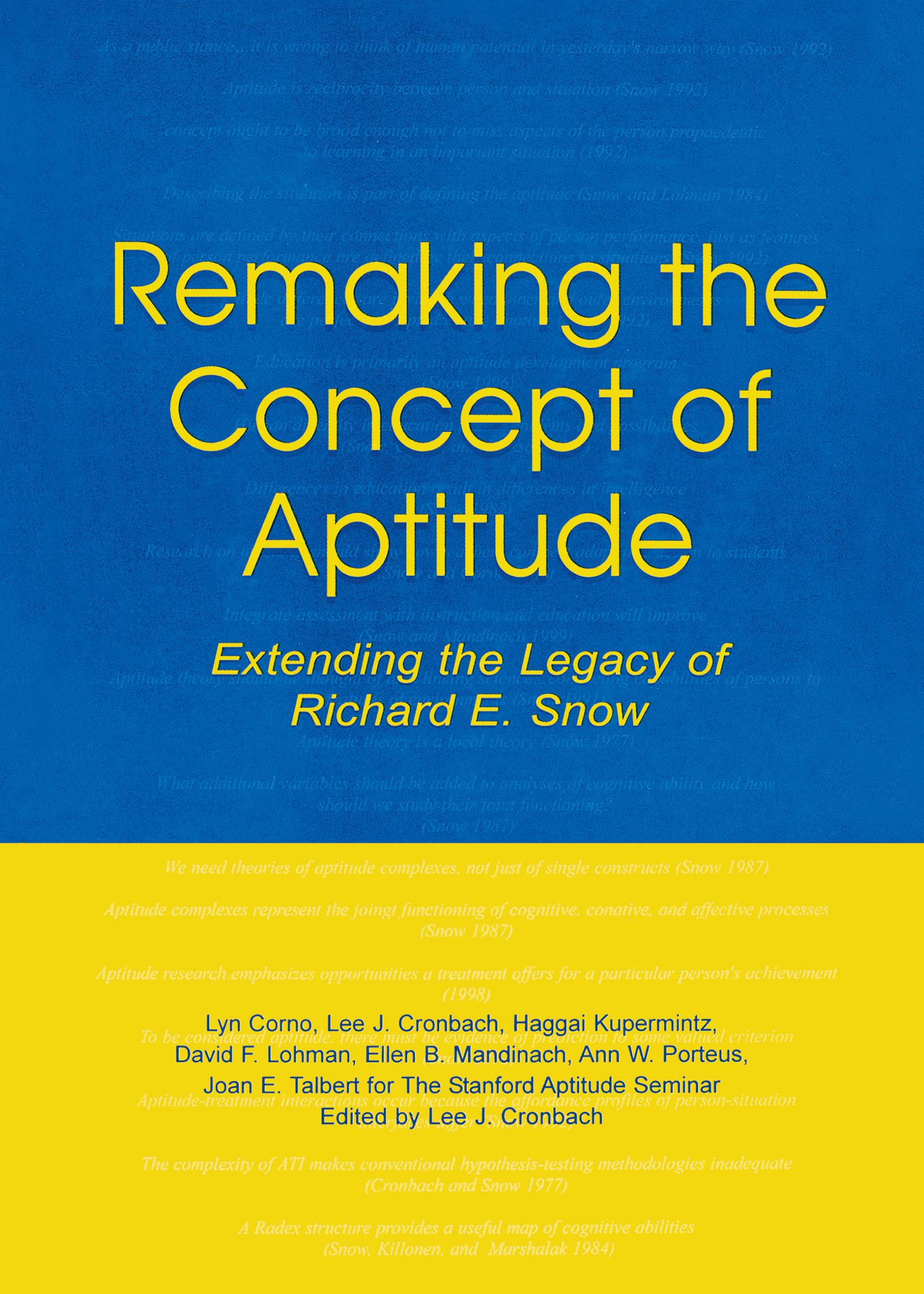
The unique perspective of Richard E. Snow, in recent years one of the most distinguished educational psychologists, integrates psychology of individual differences, cognitive psychology, and motivational psychology. This capstone book pulls together the findings of his own 35 years of research on aptitudes and those from (especially) European scholars, of which he had exceptional knowledge. A panel of experts and former associates completed this book after his death in 1997, expanding his notes on implications of the theory for instructional design and teaching practice. The panel developed Snow's ideas on where the field should go next, emphasizing promising research strategies.
Viewing intelligence as education's most important product, as well as its most important raw material, Snow stressed the need to consider both cognitive skills and affective-motivational characteristics. In this book, previously unconnected research and scattered theoretical ideas are integrated into a dynamic model of aptitude. Understanding the transaction between person and situation was Snow's primary concern. This volume draws from diverse resources to construct a theoretical model of aptitude as a complex process of unfolding person-situation dynamics. Remaking the Concept of Aptitude: Extending the Legacy of Richard E. Snow:
*presents historical and contemporary discussion of aptitude theory, illuminating recent ideas by pointing to their historic antecedents;
*provides evidence of how sound research can have practical ramifications in classroom settings;
*discusses the strengths and weaknesses of prominent research programs, including Gardner's "multiple intelligence," meta-analysis, ATI experiments, and information processing;
*describes in detail specific research that has developed important concepts--for example, Czikszentmihalyi on "flow"; Lambrechts on success in stressful training; Sternberg on componential analysis; and Gibson on tailoring affordances to match motivations; and
*keeps statistical complexities to a minimum, and includes a simply written Appendix that explains the interpretation of key technical concepts.
By characterizing sound research in the field, this volume is useful for psychologists and educational researchers. It will also be instructive for teachers seeking to deepen their knowledge of the whole child and for parents of children facing standardized testing.
Before Memmo my notes were scattered across PDFs. Now a workspace pulls everything into one place — I see exactly what's still left to study.
Memmo's summaries are gold before exams. I don't have to re-read 800 pages two weeks before — just the important parts.
The AI chat has saved me the night before an exam more than once. I just keep asking until I get it — no waiting on a study group to reply.
The quizzes hit exactly what I need to know. Memmo tracks what I get stuck on — so I only practice what's worth it.
Flashcards with spaced repetition are magic. Memmo knows when I'm about to forget something and brings it back.
The AI podcasts are my favorite. I listen on my way to school and get a recap without sitting at a computer.

Handbok i kvalitativa metoder
281 kr

Hållbar utveckling: en introduktion för ingenjörer och andra problemlösare
334 kr

Brymans Samhällsvetenskapliga metoder
390 kr

Projektledning
491 kr

Den orättvisa hälsan: om socioekonomiska skillnader i hälsa och livslängd
326 kr

Organizational Leadership
429 kr

Vetenskapsteori för nybörjare
196 kr

På väg mot läraryrket
172 kr

Det sociala livet i skolan: Socialpsykologiska perspektiv
253 kr

Betygsättningens didaktik
151 kr

Personality
402 kr

Studying Leadership
404 kr

Managing Innovation
477 kr

Introduktion till samhällsvetenskaplig metod
347 kr

The Psychology of Sex and Gender
698 kr

Evidens och kunskap för socialt arbete
207 kr

Introduction to Leadership
605 kr