
Before Memmo my notes were scattered across PDFs. Now a workspace pulls everything into one place — I see exactly what's still left to study.
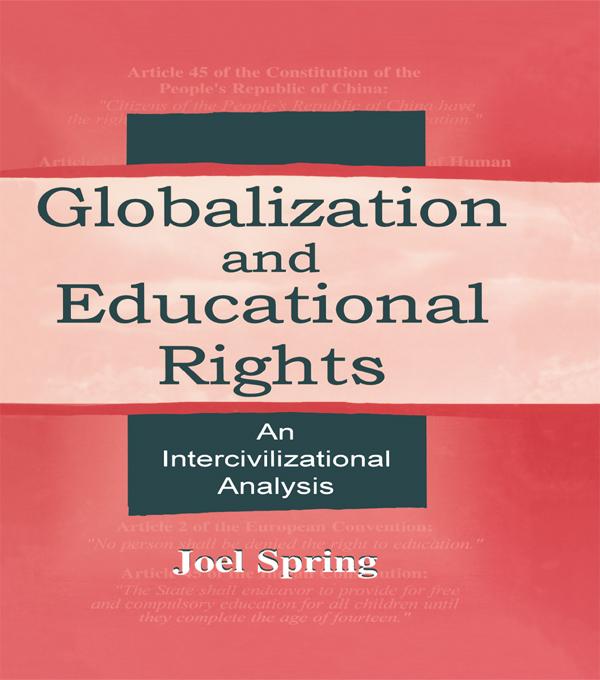
This is the first book to explore the meaning of equality and freedom of education in a global context and their relationship to the universal right to education. It also proposes evaluating school systems according to their achievement of equality and freedom.
Education in the 21st century is widely viewed as a necessary condition for the promotion of human welfare, and thus identified as a basic human right. Educational rights are included in many national constitutions written since the global spread of human rights ideas after World War II. But as a global idea, the meaning of educational rights varies between civilizations. In this book, which builds on the concept of the universal right to education set forth in Spring's The Universal Right to Education: Justification, Definition, and Guidelines, his intercivilizational analysis of educational rights focuses on four of the world's major civilizations: Confucian, Islamic, Western, and Hindu.
Spring begins by considering educational rights as part of the global flow of ideas and the global culture of schooling. He also considers the tension this generates within different civilizational traditions. Next, he proceeds to:
*examine the meaning of educational rights in the Confucian tradition, in the recent history of China, and in the Chinese Constitution;
*look at educational rights in the context of Islamic civilization and as presented in the constitutions of Islamic countries, including an analysis of the sharp contrast between the religious orientation of Islamic educational rights and those of China and the West;
*explore the problems created by the Western natural rights tradition and the eventual acceptance of educational rights as represented in European constitutions, with a focus on the development and prominence given in the West to the relationship between schooling and equality of opportunity; and,
*investigate the effect of global culture on India and the blend of Western and Hindu ideas in the Indian constitution, highlighting the obstacles to fulfillment of educational rights created by centuries of discrimination against women and lower castes.
In his conclusion, Spring presents an educational rights statement based on his intercivilizational analysis and his examination of national constitutions. This statement is intended to serve as a model for the inclusion of educational rights in national constitutions.
Before Memmo my notes were scattered across PDFs. Now a workspace pulls everything into one place — I see exactly what's still left to study.
Memmo's summaries are gold before exams. I don't have to re-read 800 pages two weeks before — just the important parts.
The AI chat has saved me the night before an exam more than once. I just keep asking until I get it — no waiting on a study group to reply.
The quizzes hit exactly what I need to know. Memmo tracks what I get stuck on — so I only practice what's worth it.
Flashcards with spaced repetition are magic. Memmo knows when I'm about to forget something and brings it back.
The AI podcasts are my favorite. I listen on my way to school and get a recap without sitting at a computer.

Handbok i kvalitativa metoder
281 kr

Hållbar utveckling: en introduktion för ingenjörer och andra problemlösare
334 kr

Brymans Samhällsvetenskapliga metoder
390 kr

Projektledning
491 kr

Den orättvisa hälsan: om socioekonomiska skillnader i hälsa och livslängd
326 kr

Vetenskapsteori för nybörjare
196 kr

Organizational Leadership
429 kr

På väg mot läraryrket
172 kr

Det sociala livet i skolan: Socialpsykologiska perspektiv
253 kr

Betygsättningens didaktik
151 kr

Personality
402 kr

Studying Leadership
404 kr

Managing Innovation
477 kr

Introduktion till samhällsvetenskaplig metod
347 kr

The Psychology of Sex and Gender
698 kr

Evidens och kunskap för socialt arbete
207 kr

Introduction to Leadership
605 kr