
Before Memmo my notes were scattered across PDFs. Now a workspace pulls everything into one place — I see exactly what's still left to study.
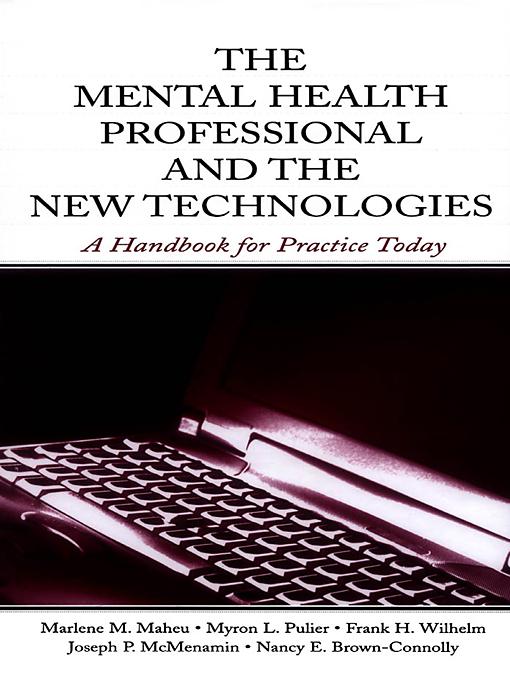
In the last two decades, new communication technologies have dramatically changed the world in which mental health professionals and their patients live. Developments such as e-mail, online chat groups, Web pages, search engines, and electronic databases are directly or indirectly affecting most people's routines and expectations. Other developments are poised to do so in the near future. Already, for example, patients are acquiring both good and bad advice and information on the Web; many expect to be able to reach their therapists by e-mail. And already there is pressure from third party payers for providers to submit claims electronically.
These technological breakthroughs have the potential to make mental health care more widely available and accessible, affordable, acceptable to patients, and adaptable to special needs. But many mental health professionals, as well as those who train them, are skeptical about integrating the new capabilities into their services and question the ethical and legal appropriateness of doing so. Those unfamiliar with the technologies tend to be particularly doubtful. How much e-mail contact with patients should I encourage or permit, and for what purposes? Why should I set up a Web site and how do I do so and what should I put on it? Should I refer patients to chat groups or Web-based discussion forums? Could video-conferencing be a helpful tool in some cases and what is involved? How do I avoid trouble if I dare to experiment with innovations? And last but not least, will the results of my experimentation be cost-effective?
The book includes:
For better or worse, no mental health professional today can avoid confronting the issues presented by the new technologies. The Mental Health Professional and the New Technologies: A Handbook for Practice Today will enormously simplify the job of thinking through the issues and making clinically, ethically, and legally prudent decisions.
Before Memmo my notes were scattered across PDFs. Now a workspace pulls everything into one place — I see exactly what's still left to study.
Memmo's summaries are gold before exams. I don't have to re-read 800 pages two weeks before — just the important parts.
The AI chat has saved me the night before an exam more than once. I just keep asking until I get it — no waiting on a study group to reply.
The quizzes hit exactly what I need to know. Memmo tracks what I get stuck on — so I only practice what's worth it.
Flashcards with spaced repetition are magic. Memmo knows when I'm about to forget something and brings it back.
The AI podcasts are my favorite. I listen on my way to school and get a recap without sitting at a computer.

Handbok i kvalitativa metoder
281 kr

Hållbar utveckling: en introduktion för ingenjörer och andra problemlösare
334 kr

Brymans Samhällsvetenskapliga metoder
390 kr

Projektledning
491 kr

Den orättvisa hälsan: om socioekonomiska skillnader i hälsa och livslängd
326 kr

Vetenskapsteori för nybörjare
196 kr

Organizational Leadership
429 kr

På väg mot läraryrket
172 kr

Det sociala livet i skolan: Socialpsykologiska perspektiv
253 kr

Betygsättningens didaktik
151 kr

Personality
402 kr

Studying Leadership
404 kr

Managing Innovation
477 kr

Introduktion till samhällsvetenskaplig metod
347 kr

The Psychology of Sex and Gender
698 kr

Evidens och kunskap för socialt arbete
207 kr

Introduction to Leadership
605 kr