
Before Memmo my notes were scattered across PDFs. Now a workspace pulls everything into one place — I see exactly what's still left to study.
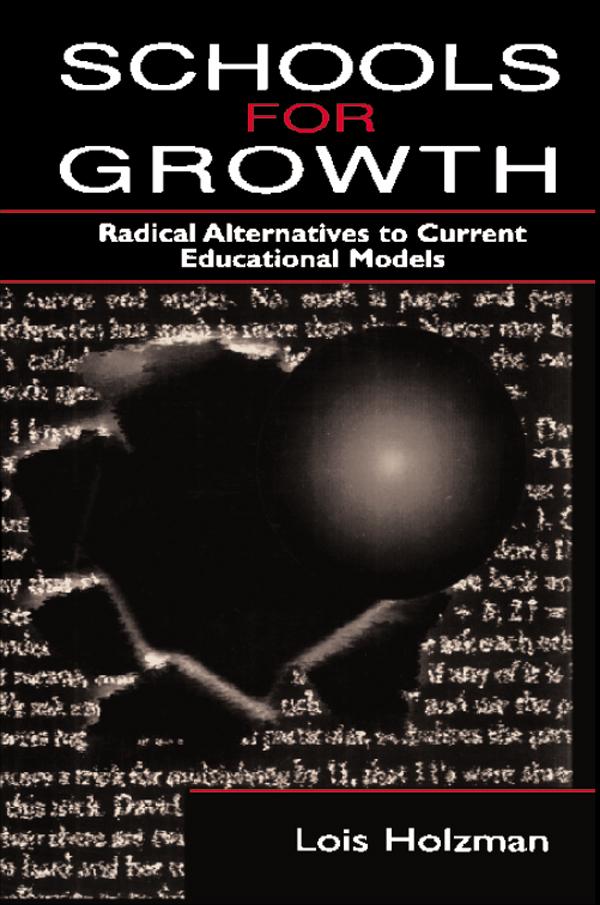
A passionate deconstruction and reconstruction of learning, development, and schooling that urges teachers to explore and create new educational opportunities for themselves and their students, Schools for Growth: Radical Alternatives to Current Educational Models asks the following questions:
This book challenges educators to look at the deeply-rooted assumptions about schooling, learning, and development and urges that the way psychology and education have constructed our conceptions of what it means to teach, to learn, and to grow may be the most serious impediment to the learning and developing of children. Beyond the criticism, the author presents an original methodological reformation of what learning and development are as relational activities and then takes readers on a visit to three radical independent school settings.
Arguing that current educational models have been misguided by scientific psychology, the author states that the dominant model of human development actually hinders development. Moreover, as learning theory has become infused with developmental theory over the past 30 years, the overly cognitive manner in which psychologists have come to think about thinking, learning, and development has become further insinuated into education. Both theories--learning and developmental--fail o recognize the human capacity for relational-revolutionary activity and for performance. The prevalent mode of education--acquisitional learning--is grounded in a world view that gives primacy to knowledge and knowing which Holzman believes is inconsistent with ongoing developmental activity.
The author focuses on "developmental learning"--a social constructionist, activity-theoretic conception of development which includes a transformation and synthesis of Vygotsky and philosopher Ludwig Wittgenstein. She also discusses educational projects that are self-conscious attempts to break with key elements of modern epistemology and the dominant psychological paradigm as they are perpetrated in contemporary educational theory and practice. Their specific philosophies and practices highlight important methodological issues raised in the attempt to create "postmodern schools"--schools more concerned with growing than knowing.
Before Memmo my notes were scattered across PDFs. Now a workspace pulls everything into one place — I see exactly what's still left to study.
Memmo's summaries are gold before exams. I don't have to re-read 800 pages two weeks before — just the important parts.
The AI chat has saved me the night before an exam more than once. I just keep asking until I get it — no waiting on a study group to reply.
The quizzes hit exactly what I need to know. Memmo tracks what I get stuck on — so I only practice what's worth it.
Flashcards with spaced repetition are magic. Memmo knows when I'm about to forget something and brings it back.
The AI podcasts are my favorite. I listen on my way to school and get a recap without sitting at a computer.

Handbok i kvalitativa metoder
281 kr

Hållbar utveckling: en introduktion för ingenjörer och andra problemlösare
334 kr

Brymans Samhällsvetenskapliga metoder
390 kr

Projektledning
491 kr

Den orättvisa hälsan: om socioekonomiska skillnader i hälsa och livslängd
326 kr

Organizational Leadership
429 kr

Vetenskapsteori för nybörjare
196 kr

På väg mot läraryrket
172 kr

Det sociala livet i skolan: Socialpsykologiska perspektiv
253 kr

Betygsättningens didaktik
151 kr

Personality
402 kr

Studying Leadership
404 kr

Managing Innovation
477 kr

Introduktion till samhällsvetenskaplig metod
347 kr

The Psychology of Sex and Gender
698 kr

Evidens och kunskap för socialt arbete
207 kr

Introduction to Leadership
605 kr