
Before Memmo my notes were scattered across PDFs. Now a workspace pulls everything into one place — I see exactly what's still left to study.
Received the ‘highly commended’ award by the Society for Educational Studies for books published in 2010.
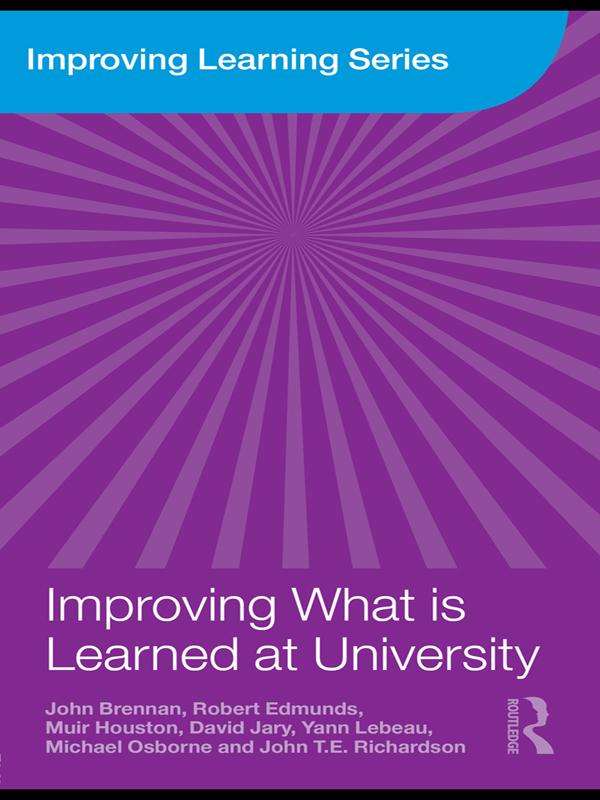
What is learned in universities today? Is it what students expect to learn? Is it what universities say they learn? How far do the answers to questions such as these differ according to what, where and how one studies?
As higher education has expanded, it has diversified both in terms of its institutional forms and the characteristics of its students. However, what we do not know is the extent to which it has also diversified in terms of ‘what is learned’. In this book, the authors explore this question through the voices of higher education students, using empirical data from students taking 15 different courses at different universities across three subject areas – bioscience, business studies and sociology. The study concentrates on the students’ experiences, lives, hopes and aspirations while at university through data from interviews and questionnaires, and this is collated and assessed alongside the perspectives of their teachers and official data from the universities they attend.
Through this study the authors provide insights into ‘what is really learned at university’ and how much it differs between individual students and the universities they attend. Notions of ‘best’ or ‘top’ universities are challenged throughout, and both diversities and commonalities of being a student are demonstrated. Posing important questions for higher education institutions about the experiences of their students and the consequences for graduates and society, this book is compelling reading for all those involved in higher education, providing conclusions which do not always follow conventional lines of thought about diversity and difference in UK higher education.
Before Memmo my notes were scattered across PDFs. Now a workspace pulls everything into one place — I see exactly what's still left to study.
Memmo's summaries are gold before exams. I don't have to re-read 800 pages two weeks before — just the important parts.
The AI chat has saved me the night before an exam more than once. I just keep asking until I get it — no waiting on a study group to reply.
The quizzes hit exactly what I need to know. Memmo tracks what I get stuck on — so I only practice what's worth it.
Flashcards with spaced repetition are magic. Memmo knows when I'm about to forget something and brings it back.
The AI podcasts are my favorite. I listen on my way to school and get a recap without sitting at a computer.

Handbok i kvalitativa metoder
281 kr

Hållbar utveckling: en introduktion för ingenjörer och andra problemlösare
334 kr

Brymans Samhällsvetenskapliga metoder
390 kr

Projektledning
491 kr

Den orättvisa hälsan: om socioekonomiska skillnader i hälsa och livslängd
326 kr

Vetenskapsteori för nybörjare
196 kr

Organizational Leadership
429 kr

På väg mot läraryrket
172 kr

Det sociala livet i skolan: Socialpsykologiska perspektiv
253 kr

Betygsättningens didaktik
151 kr

Personality
402 kr

Studying Leadership
404 kr

Managing Innovation
477 kr

Introduktion till samhällsvetenskaplig metod
347 kr

The Psychology of Sex and Gender
698 kr

Evidens och kunskap för socialt arbete
207 kr

Introduction to Leadership
605 kr