
Before Memmo my notes were scattered across PDFs. Now a workspace pulls everything into one place — I see exactly what's still left to study.
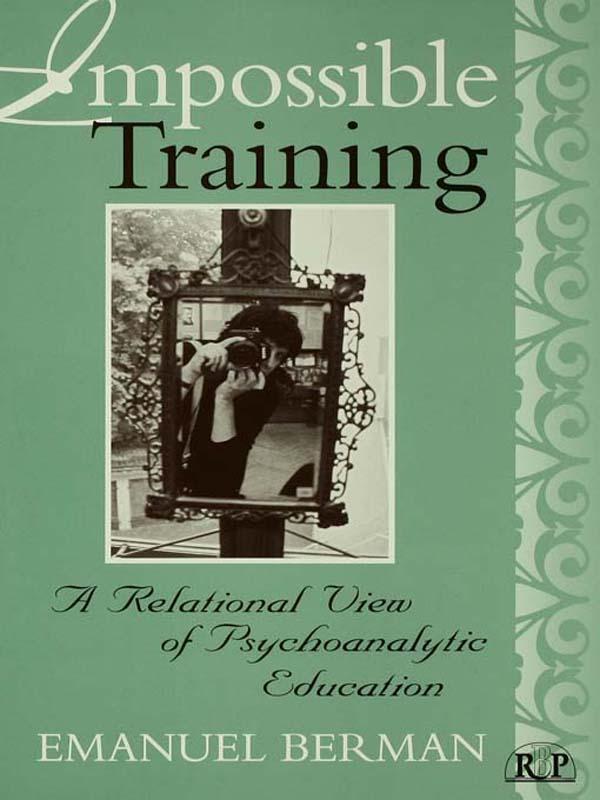
Over the past century psychoanalysis has gone on to establish training institutes, professional societies, accreditation procedures, and models of education, thus bringing into uneasy alliance all three impossible pursuits. In Impossible Training: A Relational View of Psychoanalytic Education, Emanuel Berman turns his attention to the current status and future prospects of this daunting project.
Berman is ideally suited to tackle the impossibility of psychoanalytic education. A graduate of two psychoanalytic institutes, one in Israel and one in America, he has devoted much of his professional life to psychoanalytic education and the organizational issues embedded in it. In Impossible Training, Berman describes the complex emotional and organizational dynamics of psychoanalytic training. Placing these issues within the context of major controversies in psychoanalytic history, he shows how generations of students have either idealized a "proper analytic identity," which evolves into a persecutory ideal, or rebelled against these standards. Are such persecuting and infantilizing trends inherent in analytic training, he asks, or can psychoanalytic education transcend them through changes in its structure and rules?
For Berman, the relational and intersubjective trends in contemporary psychoanalysis call for changes in analytic supervision, not least of which is heightened attentiveness to the many relationships that gain expression in the supervisory process. Envisioned in this relational manner, supervision can become a more personal experience, less guarded, and more conducive to the development of a fertile transitional space between supervisor and supervisee. Anchoring his consideration of the present in the controversies of the past, Berman concludes by considering the mission of psychoanalytic educators today: to provide trainees with the resources to cope creatively with the as yet unknown challenges of tomorrow.
Before Memmo my notes were scattered across PDFs. Now a workspace pulls everything into one place — I see exactly what's still left to study.
Memmo's summaries are gold before exams. I don't have to re-read 800 pages two weeks before — just the important parts.
The AI chat has saved me the night before an exam more than once. I just keep asking until I get it — no waiting on a study group to reply.
The quizzes hit exactly what I need to know. Memmo tracks what I get stuck on — so I only practice what's worth it.
Flashcards with spaced repetition are magic. Memmo knows when I'm about to forget something and brings it back.
The AI podcasts are my favorite. I listen on my way to school and get a recap without sitting at a computer.

Handbok i kvalitativa metoder
281 kr

Hållbar utveckling: en introduktion för ingenjörer och andra problemlösare
334 kr

Brymans Samhällsvetenskapliga metoder
390 kr

Projektledning
491 kr

Den orättvisa hälsan: om socioekonomiska skillnader i hälsa och livslängd
326 kr

Vetenskapsteori för nybörjare
196 kr

Organizational Leadership
429 kr

På väg mot läraryrket
172 kr

Det sociala livet i skolan: Socialpsykologiska perspektiv
253 kr

Betygsättningens didaktik
151 kr

Personality
402 kr

Studying Leadership
404 kr

Managing Innovation
477 kr

Introduktion till samhällsvetenskaplig metod
347 kr

The Psychology of Sex and Gender
698 kr

Evidens och kunskap för socialt arbete
207 kr

Introduction to Leadership
605 kr