
Before Memmo my notes were scattered across PDFs. Now a workspace pulls everything into one place — I see exactly what's still left to study.
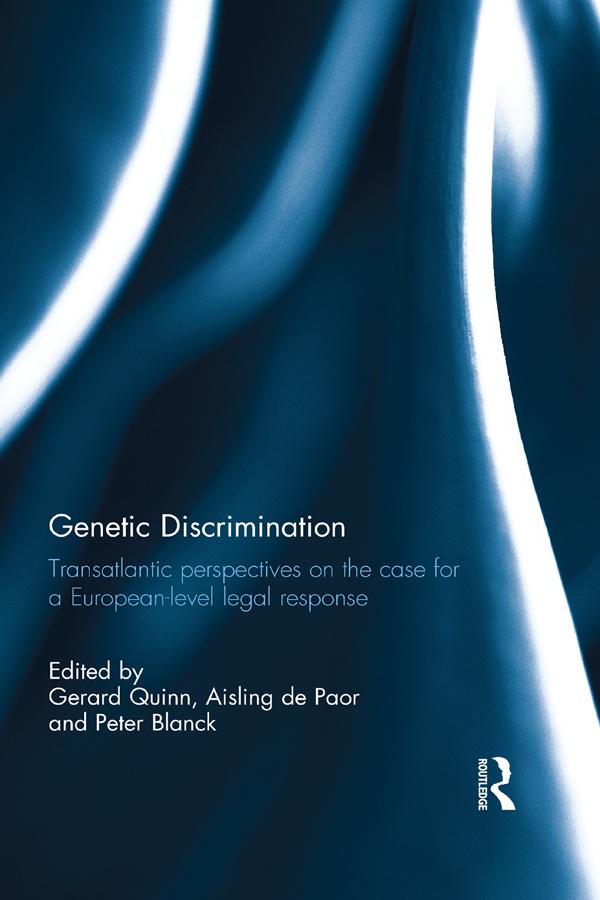
As genetic technologies advance, genetic testing may well offer the prospect of detecting the onset of future disabilities. Some research also forwards that certain behavioural profiles may have a strong genetic basis, such as the determination to succeed, or the propensity for risk-taking. As this technology becomes more prevalent, there is a danger that genetic information may be misused by third parties and that particular genetic profiles may be discriminated against by employers, by providers of social goods and services, such as insurance companies and even by educational facilities.
This book explores the different forms and potential uses of genetic testing. Drawing together leading experts in disability law, bioethics, health law and a range of related fields, it highlights the ethical and legal challenges arising as a result of emerging and rapidly advancing genetic science. On examining transatlantic perspectives on the matter, chapters in the book ask whether the US Genetic Information Nondiscrimination Act (GINA) is proving to be an effective tool in addressing the issue of genetic discrimination and alleviating fears of discrimination. The book also reviews what insights may be gained from GINA within employment and health insurance contexts, and asks how the UN Convention on the Rights of Persons with Disabilities (CRPD) may impact similar debates within the European Union. The book focuses particularly on the legislative and policy framework in the European Union, with an emphasis on the gaps in protection and the scope for specific legislative action in this area.
This book will be of great interest to scholars and students of discrimination law, bioethics and disability law, and will be of considerable use to legal practitioners, medical practitioners and policy-makers in this area.
Before Memmo my notes were scattered across PDFs. Now a workspace pulls everything into one place — I see exactly what's still left to study.
Memmo's summaries are gold before exams. I don't have to re-read 800 pages two weeks before — just the important parts.
The AI chat has saved me the night before an exam more than once. I just keep asking until I get it — no waiting on a study group to reply.
The quizzes hit exactly what I need to know. Memmo tracks what I get stuck on — so I only practice what's worth it.
Flashcards with spaced repetition are magic. Memmo knows when I'm about to forget something and brings it back.
The AI podcasts are my favorite. I listen on my way to school and get a recap without sitting at a computer.

Handbok i kvalitativa metoder
281 kr

Hållbar utveckling: en introduktion för ingenjörer och andra problemlösare
334 kr

Brymans Samhällsvetenskapliga metoder
390 kr

Projektledning
491 kr

Den orättvisa hälsan: om socioekonomiska skillnader i hälsa och livslängd
326 kr

Vetenskapsteori för nybörjare
196 kr

Organizational Leadership
429 kr

På väg mot läraryrket
172 kr

Det sociala livet i skolan: Socialpsykologiska perspektiv
253 kr

Betygsättningens didaktik
151 kr

Personality
402 kr

Studying Leadership
404 kr

Managing Innovation
477 kr

Introduktion till samhällsvetenskaplig metod
347 kr

The Psychology of Sex and Gender
698 kr

Evidens och kunskap för socialt arbete
207 kr

Introduction to Leadership
605 kr