
Before Memmo my notes were scattered across PDFs. Now a workspace pulls everything into one place — I see exactly what's still left to study.
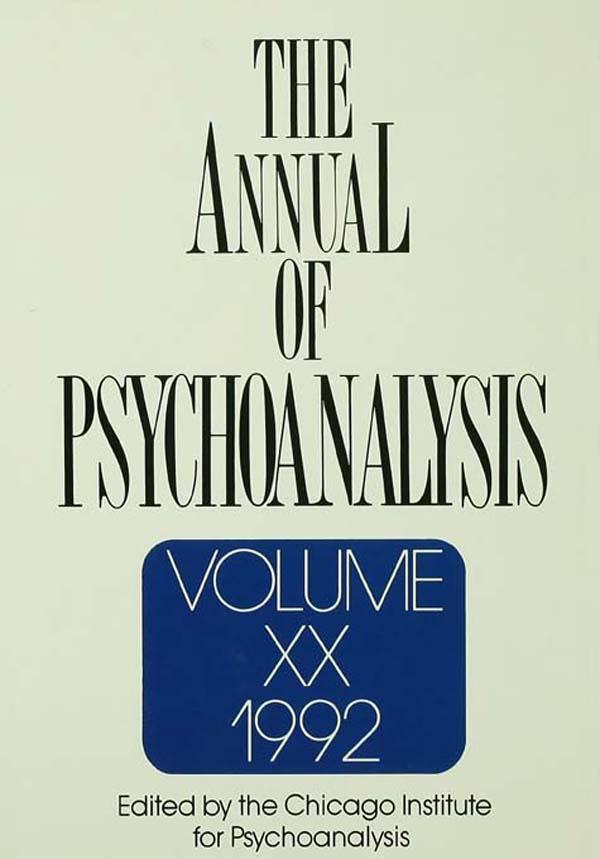
Volume 20 of The Annual of Psychoanalysis ably traverses the analytic canvas with sections on "Theoretical Studies," "Clinical Studies," "Applied Psychoanalysis," and "Psychoanalysis and Philosophy." The first section begins with Arnold Modell's probing consideration of the paradoxical nature of the self, provocatively discussed with John Gedo. Modell focuses on the fact that the self is simultaneously public and private, dependent and autonomous. Alice Rosen Soref next explores innate motivation and self-protective regulatory processes from the standpoint of recent infancy research; her notion of a lifelong two-track model of self and relatedness helps establish a normative baseline that can anchor psychoanalytic theory. George Mahl makes an interesting contribution to Freud studies in the form of a new chronology of Freud's works and the number of pages they contain in the Standard Edition. The section ends with Robert Galatzer-Levy and Mayer Gruber's "quasi-experiment about disgust." They test and disconfirm the hypothesis that disgust is an affective response to an abstract sense of disorder rather than a transformation of a concrete, bodily experience by systematically exploring references to concepts of disgust in the Old Testament.
Section II, on "Clinical Studies," opens with Henry Smith's fascinating elaboration of Freud's notion of "screen memories" into a theory of screening that denotes the general process by which mental content is organized. He illustrates his thesis by invoking the "screen language" employed by a patient throughout her analysis. Ernest Wolf next explores the tension between being a "scientist" and a "healer" in Freud and his followers to illuminate struggles within the psychoanalytic movement and to help account for current attitudes toward abstinence, neutrality, and gratification. Kenneth Newman focuses on this same triptych of technical precepts. He argues, in the spirit of Winnicott and Kohut, that analysts can only alter the hostile internal environments of their patients by becoming "usable" objects and cultivating an optimally responsive analytic environment.
A particularly rich collection of applied analytic studies forms Section III of the volume. Individual chapters focus on the childhood of Vincent van Gogh (W. W. Meissner); the psychological healing process depicted in George Eliot's Silas Marner (Richard Almond); the self-psychological meaning of "blood brotherhood" in D. H. Lawrence's Women in Love (James Cowan); ecstatic mysticism in the 19th-century Indian saint Sri Ramakrishna (Sudhir Kakar); the disintegration of the Tyrone family in Eugene O'Neill's Long Day's Journey into Night (Frank and Annette Lachmann); and the nature and analytic significance of Freud's aesthetic response to Michelangelo's Moses (Gary Goldsmith). Finally, in Section IV, George Brook examines the commonsense psychological knowledge of everyday life, that is, the nonpsychoanalytic knowledge on which much of clinical psychoanalysis ultimately depends.
Taken together, the four sections of Volume 20 of The Annual offer an exciting overview of contemporary psychoanalysis. Section I highlights recent trends in psychoanalytic theorizing and the testing of psychoanalytic propositions; Section II explores the relevance of new theoretical perspectives to clinical work; Section III demonstrates the applicability of these new perspectives to psychobiographical and literary analysis; and Section IV provocatively explores the points of connection between everyday ideas and attitudes and the tenets of psychoanalytic practice.
Before Memmo my notes were scattered across PDFs. Now a workspace pulls everything into one place — I see exactly what's still left to study.
Memmo's summaries are gold before exams. I don't have to re-read 800 pages two weeks before — just the important parts.
The AI chat has saved me the night before an exam more than once. I just keep asking until I get it — no waiting on a study group to reply.
The quizzes hit exactly what I need to know. Memmo tracks what I get stuck on — so I only practice what's worth it.
Flashcards with spaced repetition are magic. Memmo knows when I'm about to forget something and brings it back.
The AI podcasts are my favorite. I listen on my way to school and get a recap without sitting at a computer.

Handbok i kvalitativa metoder
281 kr

Hållbar utveckling: en introduktion för ingenjörer och andra problemlösare
334 kr

Brymans Samhällsvetenskapliga metoder
390 kr

Projektledning
491 kr

Den orättvisa hälsan: om socioekonomiska skillnader i hälsa och livslängd
326 kr

Vetenskapsteori för nybörjare
196 kr

Organizational Leadership
429 kr

På väg mot läraryrket
172 kr

Det sociala livet i skolan: Socialpsykologiska perspektiv
253 kr

Betygsättningens didaktik
151 kr

Personality
402 kr

Studying Leadership
404 kr

Managing Innovation
477 kr

Introduktion till samhällsvetenskaplig metod
347 kr

The Psychology of Sex and Gender
698 kr

Evidens och kunskap för socialt arbete
207 kr

Introduction to Leadership
605 kr