
Before Memmo my notes were scattered across PDFs. Now a workspace pulls everything into one place — I see exactly what's still left to study.
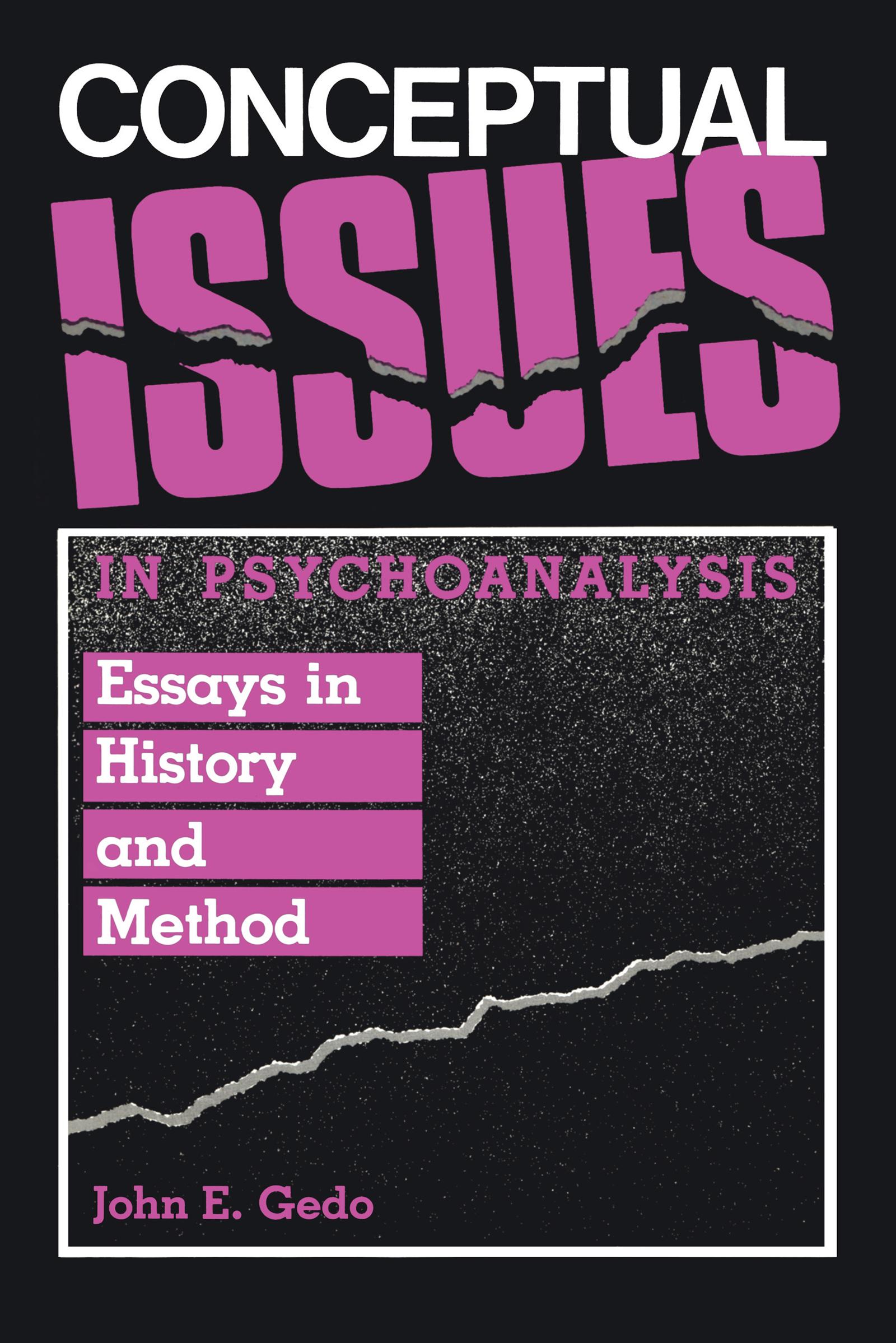
In Conceptual Issues in Psychoanalysis, John Gedo's mastery of Freudian theory and broad historical consciousness subserve a new goal: an understanding of "dissidence" in psychoanalysis. Gedo launches his inquiry by reflecting expansively on recent assessments of Freud's character. His acute remarks on the intellectual and personal agendas that inform the portraits of Freud offered by Frank Sulloway, Jeffrey Masson, and Peter Swales pave the way for his own definition of psychoanalysis in historical context. Then, in topical studies on Sandor Ferenczi, Melanie Klein, and Heinz Kohut, he explicates the commonalities that bind together three generations of dissidents, each of whom undertook to supplant the edifice of hypotheses erected by Freud with alternative theories. Interspersed with these essays are quite insightful studies of Lou Andreas-Salome and David Rapaport, whom Gedo sees as "epistemological referees" attempting to reconcile viewpoints unique to their generations.
In the second part of the book, Gedo argue that analysis now has the opportunity to move beyond this pattern of dissidence followed by mediation by drawing on observational research about infancy and early childhood to validate or refute its clinical hypotheses. In these chapters, Gedo offers critical commentary on recent efforts to extrapolate from infant research to the psychoanalytic theory of development. Only then does he offer his own measured estimation of the "legacy of infancy and the technique of psychoanalysis." This review of "the challenge of scientific method" as it bears on analysis culminates in concluding chapters that probe the status of analysis as a hermeneutic discipline and the contribution of analysis to "vocabularies of moral deliberation."
Before Memmo my notes were scattered across PDFs. Now a workspace pulls everything into one place — I see exactly what's still left to study.
Memmo's summaries are gold before exams. I don't have to re-read 800 pages two weeks before — just the important parts.
The AI chat has saved me the night before an exam more than once. I just keep asking until I get it — no waiting on a study group to reply.
The quizzes hit exactly what I need to know. Memmo tracks what I get stuck on — so I only practice what's worth it.
Flashcards with spaced repetition are magic. Memmo knows when I'm about to forget something and brings it back.
The AI podcasts are my favorite. I listen on my way to school and get a recap without sitting at a computer.

Handbok i kvalitativa metoder
281 kr

Hållbar utveckling: en introduktion för ingenjörer och andra problemlösare
334 kr

Brymans Samhällsvetenskapliga metoder
390 kr

Projektledning
491 kr

Den orättvisa hälsan: om socioekonomiska skillnader i hälsa och livslängd
326 kr

Organizational Leadership
429 kr

Vetenskapsteori för nybörjare
196 kr

På väg mot läraryrket
172 kr

Det sociala livet i skolan: Socialpsykologiska perspektiv
253 kr

Betygsättningens didaktik
151 kr

Personality
402 kr

Studying Leadership
404 kr

Managing Innovation
477 kr

Introduktion till samhällsvetenskaplig metod
347 kr

The Psychology of Sex and Gender
698 kr

Evidens och kunskap för socialt arbete
207 kr

Introduction to Leadership
605 kr