
Before Memmo my notes were scattered across PDFs. Now a workspace pulls everything into one place — I see exactly what's still left to study.
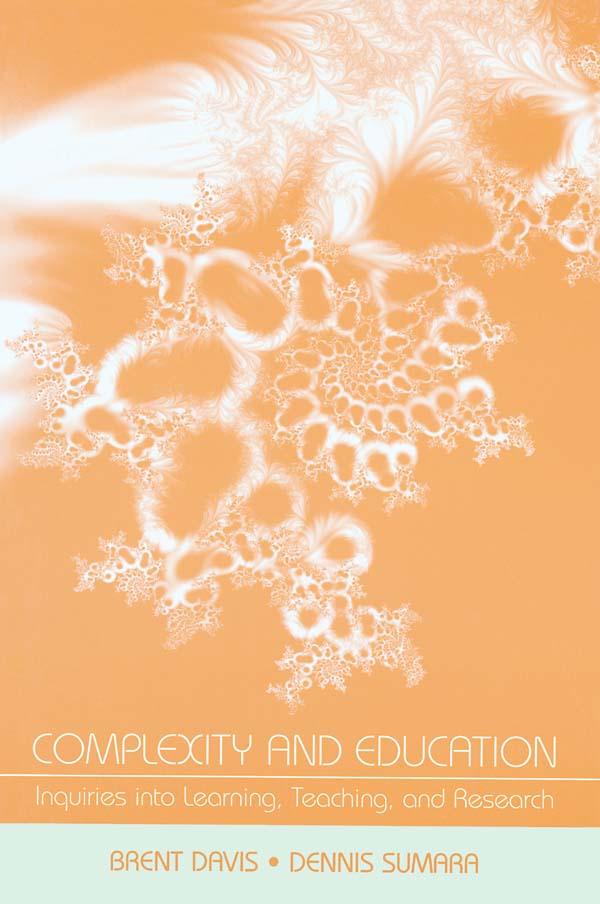
This book explores the contributions, actual and potential, of complexity thinking to educational research and practice. While its focus is on the theoretical premises and the methodology, not specific applications, the aim is pragmatic--to present complexity thinking as an important and appropriate attitude for educators and educational researchers. Part I is concerned with global issues around complexity thinking, as read through an educational lens. Part II cites a diversity of practices and studies that are either explicitly informed by or that might be aligned with complexity research, and offers focused and practiced advice for structuring projects in ways that are consistent with complexity thinking.
Complexity thinking offers a powerful alternative to the linear, reductionist approaches to inquiry that have dominated the sciences for hundreds of years and educational research for more than a century. It has captured the attention of many researchers whose studies reach across traditional disciplinary boundaries to investigate phenomena such as: How does the brain work? What is consciousness? What is intelligence? What is the role of emergent technologies in shaping personalities and possibilities? How do social collectives work? What is knowledge? Complexity research posits that a deep similarity among these phenomena is that each points toward some sort of system that learns. The authors’ intent is not to offer a complete account of the relevance of complexity thinking to education, not to prescribe and delimit, but to challenge readers to examine their own assumptions and theoretical commitments--whether anchored by commonsense, classical thought or any of the posts (such as postmodernism, poststructuralism, postcolonialism, postpositivism, postformalism, postepistemology) that mark the edges of current discursive possibility.
Complexity and Education is THE introduction to the emerging field of complexity thinking for the education community. It is specifically relevant for educational researchers, graduate students, and inquiry-oriented teacher practitioners.
Before Memmo my notes were scattered across PDFs. Now a workspace pulls everything into one place — I see exactly what's still left to study.
Memmo's summaries are gold before exams. I don't have to re-read 800 pages two weeks before — just the important parts.
The AI chat has saved me the night before an exam more than once. I just keep asking until I get it — no waiting on a study group to reply.
The quizzes hit exactly what I need to know. Memmo tracks what I get stuck on — so I only practice what's worth it.
Flashcards with spaced repetition are magic. Memmo knows when I'm about to forget something and brings it back.
The AI podcasts are my favorite. I listen on my way to school and get a recap without sitting at a computer.

Handbok i kvalitativa metoder
281 kr

Hållbar utveckling: en introduktion för ingenjörer och andra problemlösare
334 kr

Brymans Samhällsvetenskapliga metoder
390 kr

Projektledning
491 kr

Den orättvisa hälsan: om socioekonomiska skillnader i hälsa och livslängd
326 kr

Organizational Leadership
429 kr

Vetenskapsteori för nybörjare
196 kr

På väg mot läraryrket
172 kr

Det sociala livet i skolan: Socialpsykologiska perspektiv
253 kr

Betygsättningens didaktik
151 kr

Personality
402 kr

Studying Leadership
404 kr

Managing Innovation
477 kr

Introduktion till samhällsvetenskaplig metod
347 kr

The Psychology of Sex and Gender
698 kr

Evidens och kunskap för socialt arbete
207 kr

Introduction to Leadership
605 kr