
Before Memmo my notes were scattered across PDFs. Now a workspace pulls everything into one place — I see exactly what's still left to study.
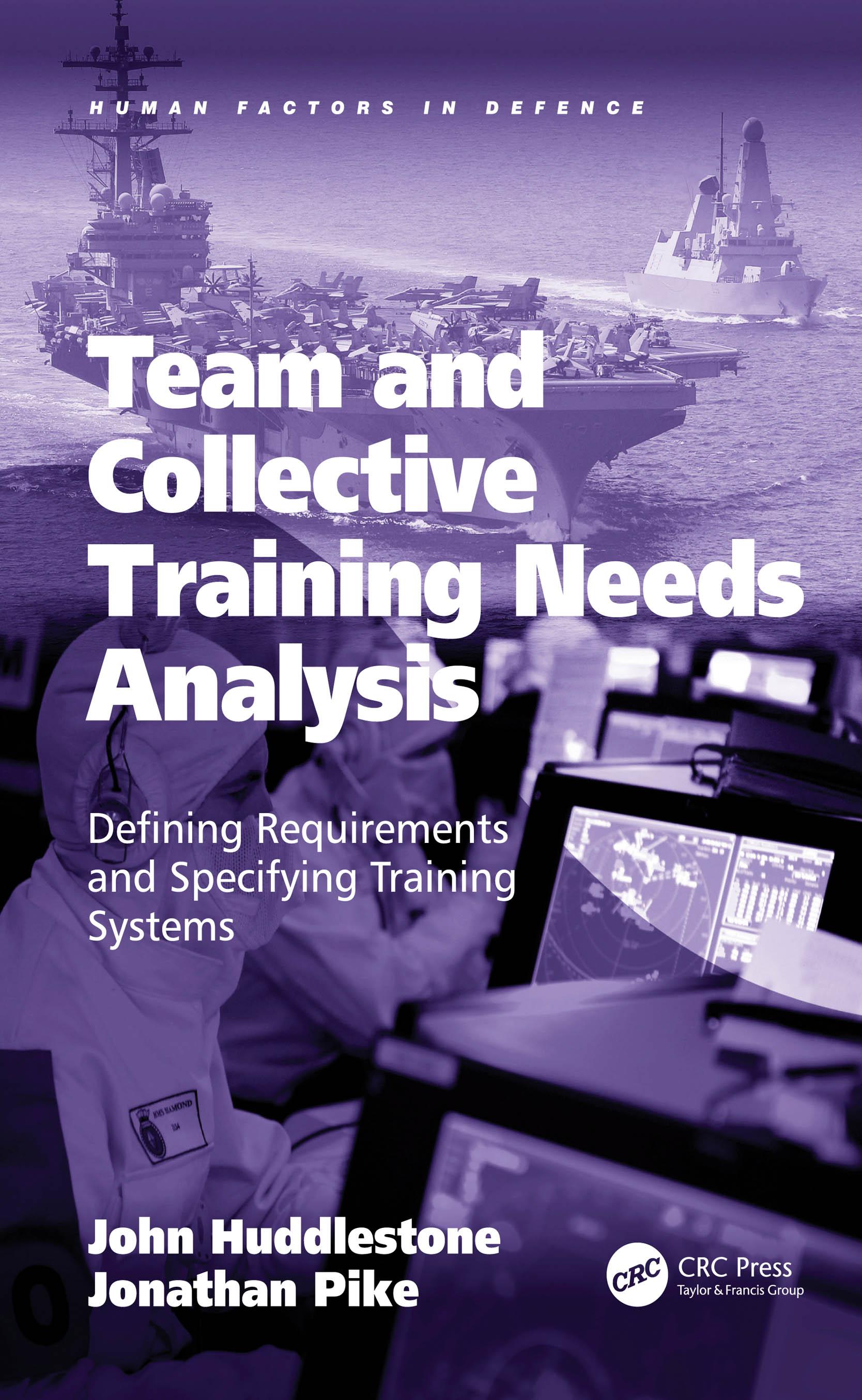
Military capability is delivered operationally at a team and collective level, be it a unit as small as a squad or section, or as large as a maritime task group. Modern military forces are required to deal with a potentially wide range of missions frequently involving multiple alliance partners, within a geopolitical environment which can seem to change rapidly. Individual performance, while being important, is not the primary determinant of mission success - force integration, interoperability, adaptability and teamwork are key factors. Team and collective training which fully addresses these factors is fundamental to the development and delivery of military capability. As a consequence, the requirement to determine training requirements and specify effective systems for the delivery of team and collective training is critical to operational success.
Training Needs Analysis (also known as Front End Analysis), is a well-established methodology for analysing training requirements and specifying training solutions used extensively by the UK and its NATO partners. However, the analytical techniques employed are optimised for individual training, with little guidance being offered on its application in the team and collective context. Team and Collective Training Needs Analysis (TCTNA) has been developed to close this methodological gap. It addresses the issues of the relationship of individual and team tasks, teamwork, command and control, task and training environments, scenario definition, instructional strategy, team training approaches, instructional functions, and wide-ranging organisational and procurement considerations.
Part One of the book develops an integrated set of models which underpin the analytical approach presented in Part Two. Worked examples and case studies illustrate the application of the approach. Between 2005 and 2015 the authors worked on numerous training-related research projects at Cranfield University and Coventry University for the Human Factors Integration Defence Technology Centre and the Defence Human Capability Science and Technology Centre on behalf of the Defence Science and Technology Laboratory, UK Ministry of Defence.
Before Memmo my notes were scattered across PDFs. Now a workspace pulls everything into one place — I see exactly what's still left to study.
Memmo's summaries are gold before exams. I don't have to re-read 800 pages two weeks before — just the important parts.
The AI chat has saved me the night before an exam more than once. I just keep asking until I get it — no waiting on a study group to reply.
The quizzes hit exactly what I need to know. Memmo tracks what I get stuck on — so I only practice what's worth it.
Flashcards with spaced repetition are magic. Memmo knows when I'm about to forget something and brings it back.
The AI podcasts are my favorite. I listen on my way to school and get a recap without sitting at a computer.

Handbok i kvalitativa metoder
281 kr

Hållbar utveckling: en introduktion för ingenjörer och andra problemlösare
334 kr

Brymans Samhällsvetenskapliga metoder
390 kr

Projektledning
491 kr

Den orättvisa hälsan: om socioekonomiska skillnader i hälsa och livslängd
326 kr

Vetenskapsteori för nybörjare
196 kr

Organizational Leadership
429 kr

På väg mot läraryrket
172 kr

Det sociala livet i skolan: Socialpsykologiska perspektiv
253 kr

Betygsättningens didaktik
151 kr

Personality
402 kr

Studying Leadership
404 kr

Managing Innovation
477 kr

Introduktion till samhällsvetenskaplig metod
347 kr

The Psychology of Sex and Gender
698 kr

Evidens och kunskap för socialt arbete
207 kr

Introduction to Leadership
605 kr