
Before Memmo my notes were scattered across PDFs. Now a workspace pulls everything into one place — I see exactly what's still left to study.
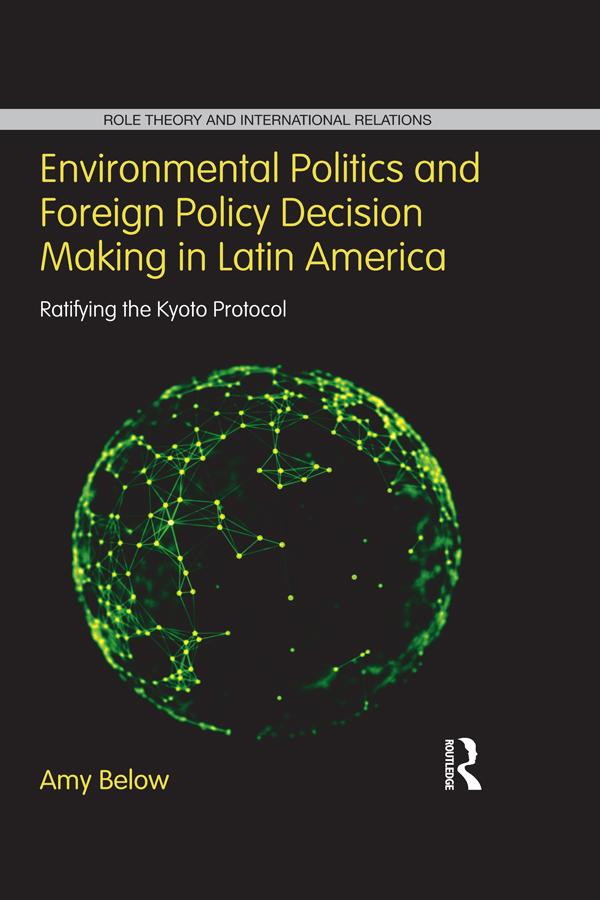
Although the Kyoto Protocol, an international agreement to address global climate change, has been regarded by many as an unsuccessful treaty both politically and environmentally, it stands as one of the world’s few truly global agreements. Why did such a diverse group of countries decide to sign and/or ratify the treaty? Why did they choose to do so at different times and in different ways? What explains their foreign policy behavior? Amy Below’s book builds off the increasing significance of climate change and uses the Kyoto Protocol as a case study to analyze foreign policy decision making in Latin America.
Below’s study takes a regional perspective in order to examine why countries in Latin America made disparate foreign policy choices when they were faced with the same decision. The book looks at the decisions in Argentina, Mexico, and Venezuela via a process-tracing method. Below uses information obtained from primary and secondary documents and elite interviews to help reconstruct the processes, and augments her reconstruction with a content analysis of Conference of the Parties speeches by presidents and country delegates. The book complies with convention in the field by arguing that systemic, national and individual-level factors simultaneously impact foreign policy decisions, but makes the additional claim that role theory most accurately accounts for relationships between variables.
Environmental Politics and Foreign Policy Decision Making in Latin America considers a variety of factors on individual, national, and international levels of analysis, and show that the foreign policy decisions are best viewed through the prism of role theory. The book also draws conclusions about the value of role theory in general and about environmental foreign policy decisions in developing countries, which will be of value to both policy-makers and academics.
Before Memmo my notes were scattered across PDFs. Now a workspace pulls everything into one place — I see exactly what's still left to study.
Memmo's summaries are gold before exams. I don't have to re-read 800 pages two weeks before — just the important parts.
The AI chat has saved me the night before an exam more than once. I just keep asking until I get it — no waiting on a study group to reply.
The quizzes hit exactly what I need to know. Memmo tracks what I get stuck on — so I only practice what's worth it.
Flashcards with spaced repetition are magic. Memmo knows when I'm about to forget something and brings it back.
The AI podcasts are my favorite. I listen on my way to school and get a recap without sitting at a computer.

Handbok i kvalitativa metoder
281 kr

Hållbar utveckling: en introduktion för ingenjörer och andra problemlösare
334 kr

Brymans Samhällsvetenskapliga metoder
390 kr

Projektledning
491 kr

Den orättvisa hälsan: om socioekonomiska skillnader i hälsa och livslängd
326 kr

Vetenskapsteori för nybörjare
196 kr

Organizational Leadership
429 kr

På väg mot läraryrket
172 kr

Det sociala livet i skolan: Socialpsykologiska perspektiv
253 kr

Betygsättningens didaktik
151 kr

Personality
402 kr

Studying Leadership
404 kr

Managing Innovation
477 kr

Introduktion till samhällsvetenskaplig metod
347 kr

The Psychology of Sex and Gender
698 kr

Evidens och kunskap för socialt arbete
207 kr

Introduction to Leadership
605 kr