
Before Memmo my notes were scattered across PDFs. Now a workspace pulls everything into one place — I see exactly what's still left to study.
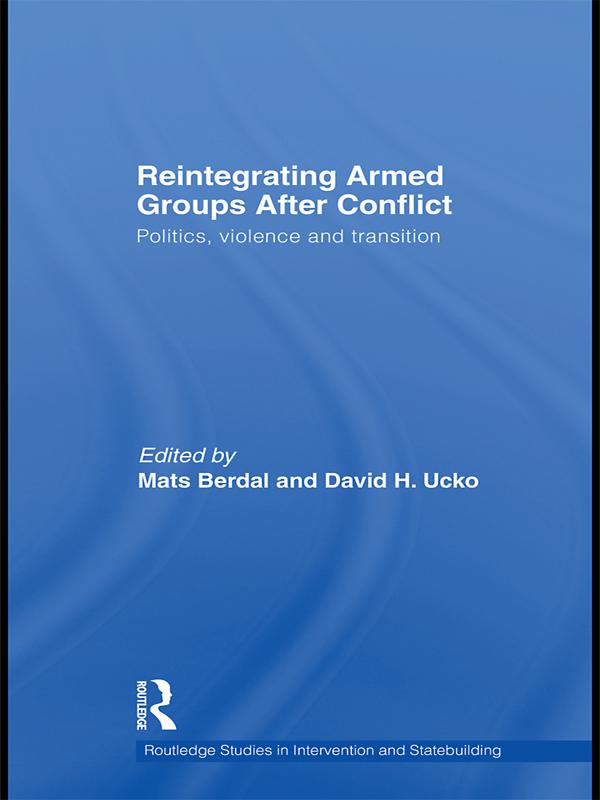
This book looks at the political reintegration of armed groups after civil wars and the challenges of transforming ‘rebel’, ‘insurgent’ or other non-state armed groups into viable political entities.
Drawing on eight case studies, the definition of ‘armed groups’ here ranges from militias, paramilitary forces, police units of various kinds to intelligence outfits. Likewise, the definition of ‘political integration’ or ‘re-integration’ has not been restricted to the formation of political parties, but is understood broadly as active participation in politics, policy-making or public debate through parties, newspapers, social organisations, think-tanks, NGOs or public service.
The book seeks to locate or contextualise individual cases within their distinctive social, cultural and historical settings. As such it differs from much of the donor-driven literature that has tended to abstract the challenge of disarmament, demobilisation and reintegration (DDR) from their political and historical context, focusing instead on technical or bureaucratic issues raised by the DDR process. Among the issues covered by the volume as a whole, three stand out: first, the role of political settlements in creating legitimate opportunities for erstwhile leaders of armed factions; second, the ability of reintegration programmes to create genuine socio-economic opportunities that can absorb former fighters as functional members of their communities; and third, the processes involved in transforming an entire rebel movement into a viable political party, movement or, more generally, allowing it to participate in political life.
This book will be of great interest to students of security and development, peace and conflict studies, and IR in general, as well as practitioners and policymakers.
Mats Berdal is Professor of Security and Development in the Department of War Studies at King’s College London. From 2000 to 2003 he was Director of Studies at the International Institute for Strategic Studies (IISS) in London. Mats Berdal is a Visiting Professor at the National Defence and Command College, Oslo.
David Ucko is the Programme Coordinator & Research Fellow for the Conflict, Security & Development Research Group, King's College London.
Before Memmo my notes were scattered across PDFs. Now a workspace pulls everything into one place — I see exactly what's still left to study.
Memmo's summaries are gold before exams. I don't have to re-read 800 pages two weeks before — just the important parts.
The AI chat has saved me the night before an exam more than once. I just keep asking until I get it — no waiting on a study group to reply.
The quizzes hit exactly what I need to know. Memmo tracks what I get stuck on — so I only practice what's worth it.
Flashcards with spaced repetition are magic. Memmo knows when I'm about to forget something and brings it back.
The AI podcasts are my favorite. I listen on my way to school and get a recap without sitting at a computer.

Handbok i kvalitativa metoder
281 kr

Hållbar utveckling: en introduktion för ingenjörer och andra problemlösare
334 kr

Brymans Samhällsvetenskapliga metoder
390 kr

Projektledning
491 kr

Den orättvisa hälsan: om socioekonomiska skillnader i hälsa och livslängd
326 kr

Vetenskapsteori för nybörjare
196 kr

Organizational Leadership
429 kr

På väg mot läraryrket
172 kr

Det sociala livet i skolan: Socialpsykologiska perspektiv
253 kr

Betygsättningens didaktik
151 kr

Personality
402 kr

Studying Leadership
404 kr

Managing Innovation
477 kr

Introduktion till samhällsvetenskaplig metod
347 kr

The Psychology of Sex and Gender
698 kr

Evidens och kunskap för socialt arbete
207 kr

Introduction to Leadership
605 kr