
Before Memmo my notes were scattered across PDFs. Now a workspace pulls everything into one place — I see exactly what's still left to study.
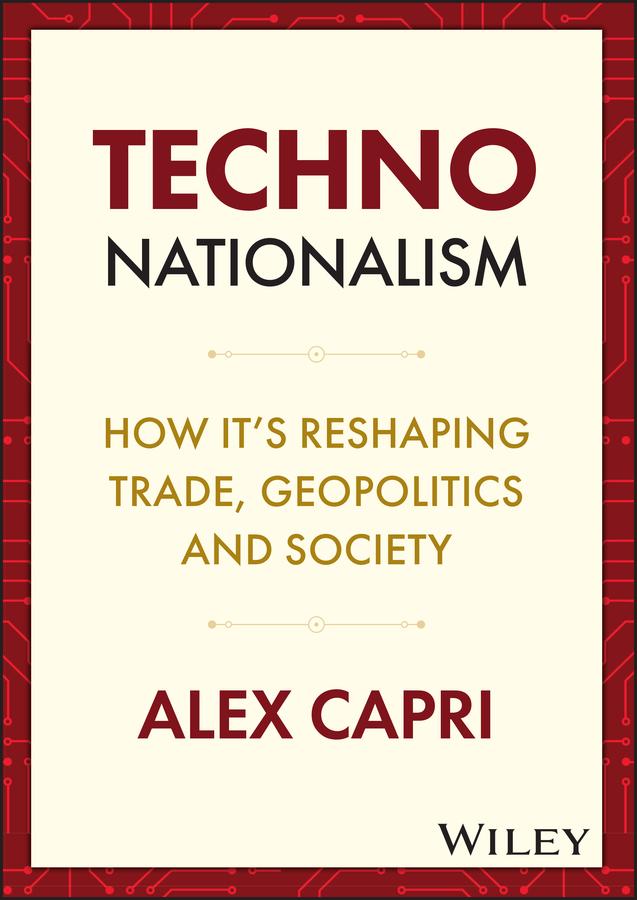
Nations have long sought to use technology as a power-multiplier for their own ambitions. In the twenty-first century, at a time of unprecedented innovation, the United States and China are in a race to achieve technological superiority. But how will this affect long-standing trade ties and the international landscape?
Techno-nationalism holds that a nation’s economic strength and its national security — even its social stability— are linked to the technological prowess of its institutions and enterprises. From artificial intelligence and biotechnology to semiconductors and quantum science, nations that fall behind in the technology race risk becoming permanent losers, with potentially catastrophic consequences. After decades of trade liberalization and free-flowing investment into China, a paradigm shift amongst a bloc of like-minded, mostly Western countries, has set in motion epic change. Techno-nationalism is reorganizing the global economy.
Alex Capri, who spent decades as a trade and supply chain professional in China and throughout the world, lays out the dynamics of this change and its underlying themes, from the paradox facing U.S.-China commercial linkages to the grey zones in which states and firms must now try to coexist. He provides a realist’s perspective of both the challenges and opportunities facing international actors.
Regarding the elements of techno-nationalism, Capri paints a masterful picture of the strategic decoupling of supply chains and the re-shoring of key manufacturing ecosystems such as semiconductors. He provides an illuminating account of the geopolitics of data, and the fragmentation of the digital landscape, as well as the bifurcation of financial markets, academia, and R&D around Chinese and American spheres of influence.
These themes carry through to Capri’s fascinating accounts of the modern-day space-race, and space-based Internet, undersea cables, hypersonic warfare, the AI arms race, drones, and robotics. The book’s clear explanations of semiconductors and their importance is highly useful.
TECHNO-Nationalism is a must-read for business and government leaders, investors and strategists, academics, journalists, NGOs, or anyone who wants to experience a thoroughly entertaining and educational account of one the most important issues of our time.
Before Memmo my notes were scattered across PDFs. Now a workspace pulls everything into one place — I see exactly what's still left to study.
Memmo's summaries are gold before exams. I don't have to re-read 800 pages two weeks before — just the important parts.
The AI chat has saved me the night before an exam more than once. I just keep asking until I get it — no waiting on a study group to reply.
The quizzes hit exactly what I need to know. Memmo tracks what I get stuck on — so I only practice what's worth it.
Flashcards with spaced repetition are magic. Memmo knows when I'm about to forget something and brings it back.
The AI podcasts are my favorite. I listen on my way to school and get a recap without sitting at a computer.

Handbok i kvalitativa metoder
281 kr

Hållbar utveckling: en introduktion för ingenjörer och andra problemlösare
334 kr

Brymans Samhällsvetenskapliga metoder
390 kr

Projektledning
491 kr

Den orättvisa hälsan: om socioekonomiska skillnader i hälsa och livslängd
326 kr

Vetenskapsteori för nybörjare
196 kr

Organizational Leadership
429 kr

På väg mot läraryrket
172 kr

Det sociala livet i skolan: Socialpsykologiska perspektiv
253 kr

Betygsättningens didaktik
151 kr

Personality
402 kr

Studying Leadership
404 kr

Managing Innovation
477 kr

Introduktion till samhällsvetenskaplig metod
347 kr

The Psychology of Sex and Gender
698 kr

Evidens och kunskap för socialt arbete
207 kr

Introduction to Leadership
605 kr