
Before Memmo my notes were scattered across PDFs. Now a workspace pulls everything into one place — I see exactly what's still left to study.
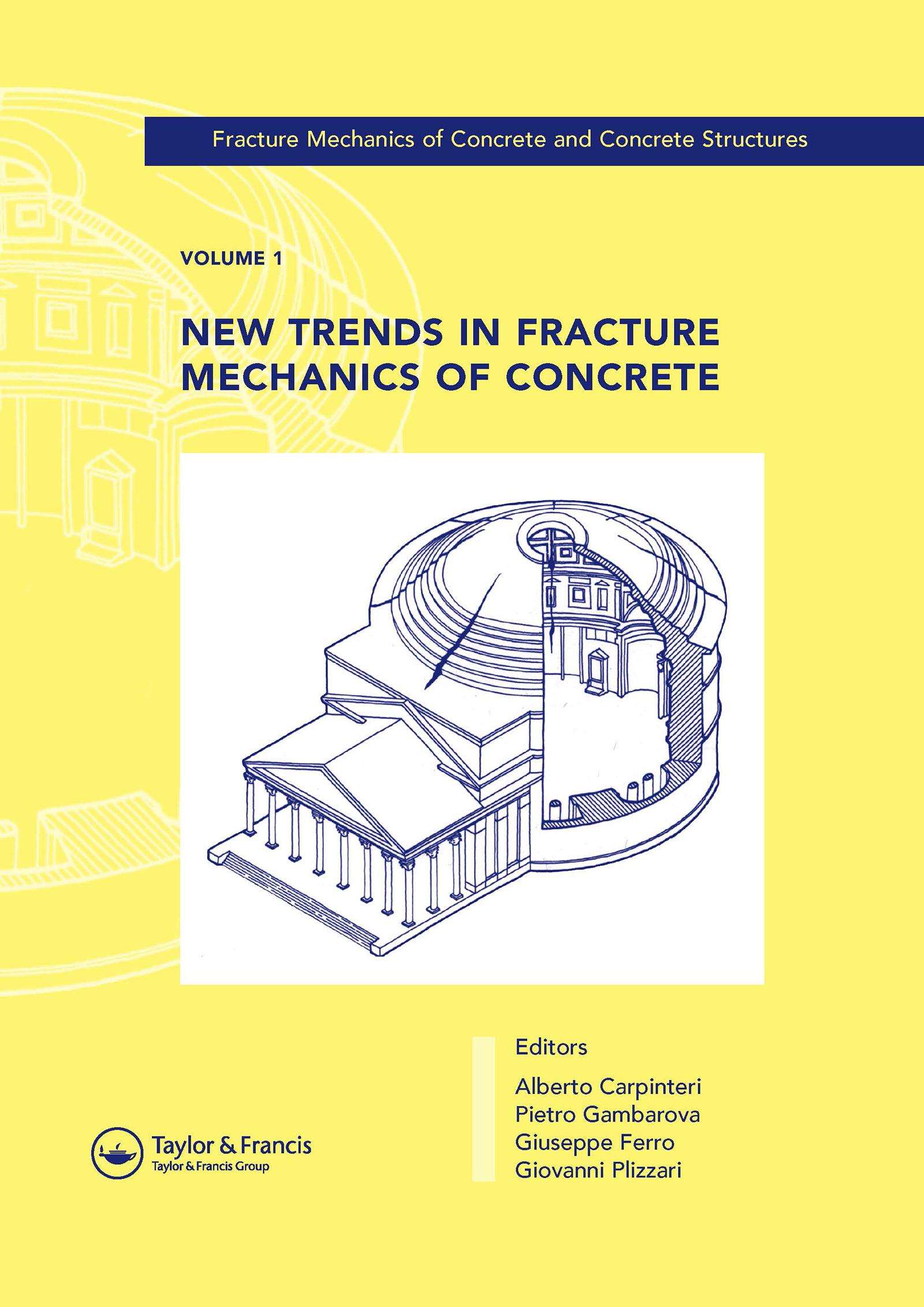
New Trends in Fracture Mechanics of Concrete contains Volume 1 of the Proceedings of the 6th International Conference on Fracture Mechanics of Concrete and Concrete Structures (FraMCoS-6, Catania, Italy, 17-22 June 2007). It is divided into four parts: (1) Theoretical and Numerical Methods in Fracture Mechanics of Concrete; (2) Experimental Methods in Fracture Mechanics of Concrete; (3) Constitutive Damage Modelling of Concrete; (4) Time Effects in the Damage and Fracture of Concrete.
Over the last twenty years, many theoretical, numerical and experimental methods have evolved in the field of Fracture Mechanics of Concrete. These have led to practical applications in reinforced-concrete design, assessment, monitoring and retrofitting, as well as innovative high-performance and durable cementitious materials. Although Fracture Mechanics of Concrete is now mature as a framework for defining and solving a variety of engineering problems, there is still much work to be done in improving previous theoretical and numerical models, and for re-interpreting established phenomena. In particular, there are new developments in the treatment of scale effects; the implementation of 3D-discretisation; and the combination of continuous and discontinuous models. Other areas of rapid progress are the development of innovative testing techniques; the proposal of non-local and anisotropic constitutive laws; the formulation of lattice and multiscale models, and the development of coupled multifield theories.
The other two volumes comprising the Proceedings of the 6th International Conference on Fracture Mechanics of Concrete and Concrete Structures are Design, Assessment and Retrofitting of RC Structures; and High-Performance Concrete, Brick-Masonry and Environmental Aspects. The set presents a wealth of information, and will be useful to professional civil engineers, postgraduate students and researchers.
Before Memmo my notes were scattered across PDFs. Now a workspace pulls everything into one place — I see exactly what's still left to study.
Memmo's summaries are gold before exams. I don't have to re-read 800 pages two weeks before — just the important parts.
The AI chat has saved me the night before an exam more than once. I just keep asking until I get it — no waiting on a study group to reply.
The quizzes hit exactly what I need to know. Memmo tracks what I get stuck on — so I only practice what's worth it.
Flashcards with spaced repetition are magic. Memmo knows when I'm about to forget something and brings it back.
The AI podcasts are my favorite. I listen on my way to school and get a recap without sitting at a computer.

Handbok i kvalitativa metoder
281 kr

Hållbar utveckling: en introduktion för ingenjörer och andra problemlösare
334 kr

Brymans Samhällsvetenskapliga metoder
390 kr

Projektledning
491 kr

Den orättvisa hälsan: om socioekonomiska skillnader i hälsa och livslängd
326 kr

Vetenskapsteori för nybörjare
196 kr

Organizational Leadership
429 kr

På väg mot läraryrket
172 kr

Det sociala livet i skolan: Socialpsykologiska perspektiv
253 kr

Betygsättningens didaktik
151 kr

Personality
402 kr

Studying Leadership
404 kr

Managing Innovation
477 kr

Introduktion till samhällsvetenskaplig metod
347 kr

The Psychology of Sex and Gender
698 kr

Evidens och kunskap för socialt arbete
207 kr

Introduction to Leadership
605 kr