
Before Memmo my notes were scattered across PDFs. Now a workspace pulls everything into one place — I see exactly what's still left to study.
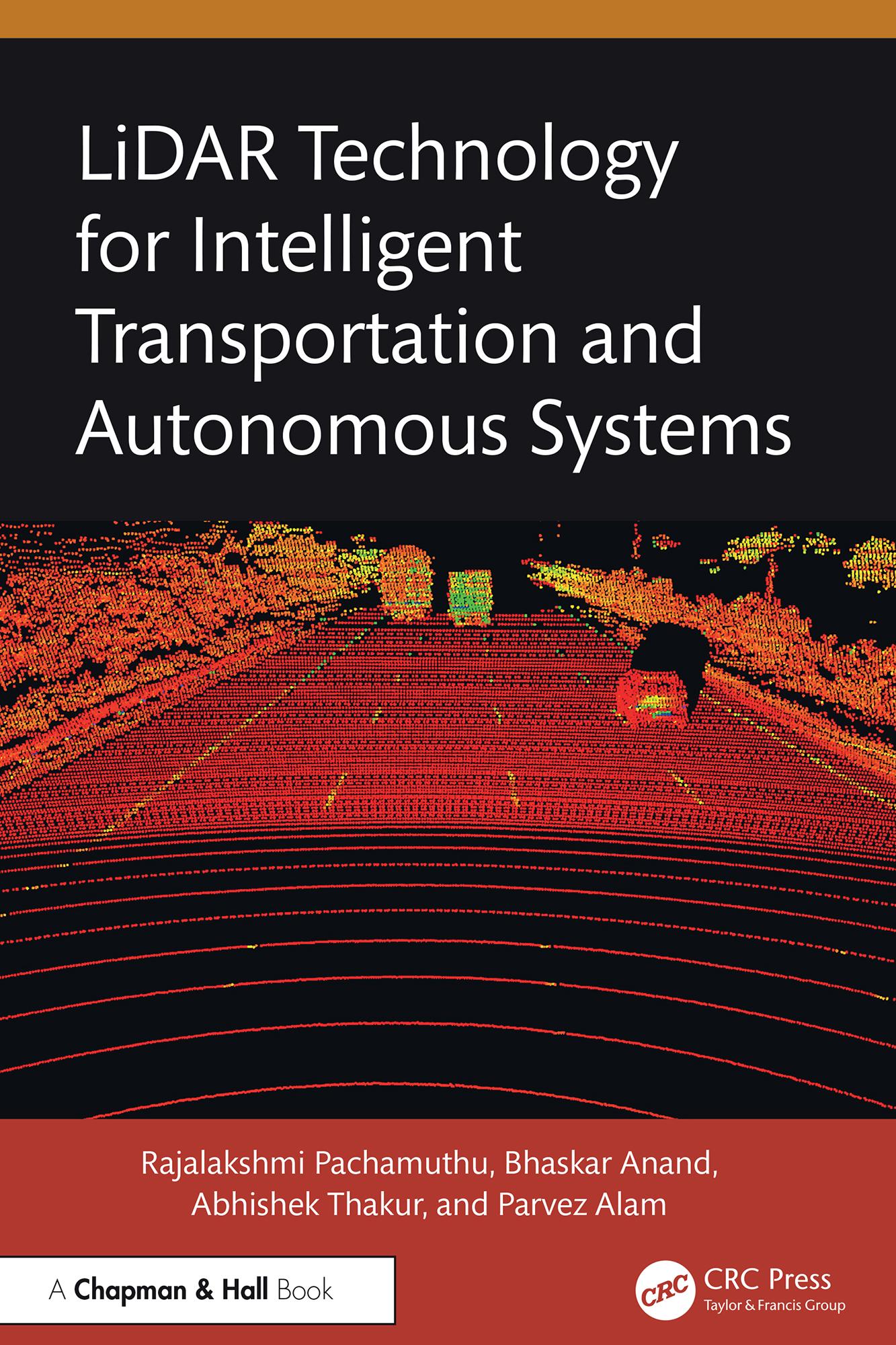
This book explores the critical role of LiDAR technology in autonomous navigation and advanced driver assistance systems (ADAS). It explores the fundamental principles of LiDAR, comparing it with other sensor technologies like radar and cameras while examining the various types of LiDAR systems, including time-of-flight, flash, and frequency-modulated continuous wave systems. It emphasises real-world use cases, including setting up LiDAR data acquisition systems and addressing challenges like sensor calibration, alignment, and integration into autonomous systems.
• Discusses in detail LiDAR’s working principles, laser pulse wavelengths, point cloud data, motion compensation, and datasets commonly used in LiDAR research.
• Examines the effects of ambient light, adverse weather conditions (rain, fog, snow), and practical strategies for mitigating these challenges.
• Describes advanced methods for object detection, segmentation, and multi-object tracking using LiDAR point clouds, including solutions like AnchorPoint and Smart3DMOT.
• Presents techniques for creating high-definition 3D maps and implementing SLAM (Simultaneous Localization and Mapping) that are essential for autonomous navigation.
• Offers practical insights into autonomous navigation, including LiDAR-based localization, path planning, obstacle avoidance, and real-world case studies like autonomous shuttles.
• Explores multi-LiDAR calibration, emphasizing alignment, fusion, and synchronization to enhance coverage and reduce blind spots in autonomous systems.
· Offers a detailed guide on open-source LiDAR processing tools like PCL, Open3D, and ROS for data handling and visualization.
By combining theoretical principles with practical applications and case studies, this book serves as a reference book for academics and researchers in computer science, electronics, communication engineering, and autonomous technologies.
Before Memmo my notes were scattered across PDFs. Now a workspace pulls everything into one place — I see exactly what's still left to study.
Memmo's summaries are gold before exams. I don't have to re-read 800 pages two weeks before — just the important parts.
The AI chat has saved me the night before an exam more than once. I just keep asking until I get it — no waiting on a study group to reply.
The quizzes hit exactly what I need to know. Memmo tracks what I get stuck on — so I only practice what's worth it.
Flashcards with spaced repetition are magic. Memmo knows when I'm about to forget something and brings it back.
The AI podcasts are my favorite. I listen on my way to school and get a recap without sitting at a computer.

Handbok i kvalitativa metoder
281 kr

Hållbar utveckling: en introduktion för ingenjörer och andra problemlösare
334 kr

Brymans Samhällsvetenskapliga metoder
390 kr

Projektledning
491 kr

Den orättvisa hälsan: om socioekonomiska skillnader i hälsa och livslängd
326 kr

Vetenskapsteori för nybörjare
196 kr

Organizational Leadership
429 kr

På väg mot läraryrket
172 kr

Det sociala livet i skolan: Socialpsykologiska perspektiv
253 kr

Betygsättningens didaktik
151 kr

Personality
402 kr

Studying Leadership
404 kr

Managing Innovation
477 kr

Introduktion till samhällsvetenskaplig metod
347 kr

The Psychology of Sex and Gender
698 kr

Evidens och kunskap för socialt arbete
207 kr

Introduction to Leadership
605 kr