
Before Memmo my notes were scattered across PDFs. Now a workspace pulls everything into one place — I see exactly what's still left to study.
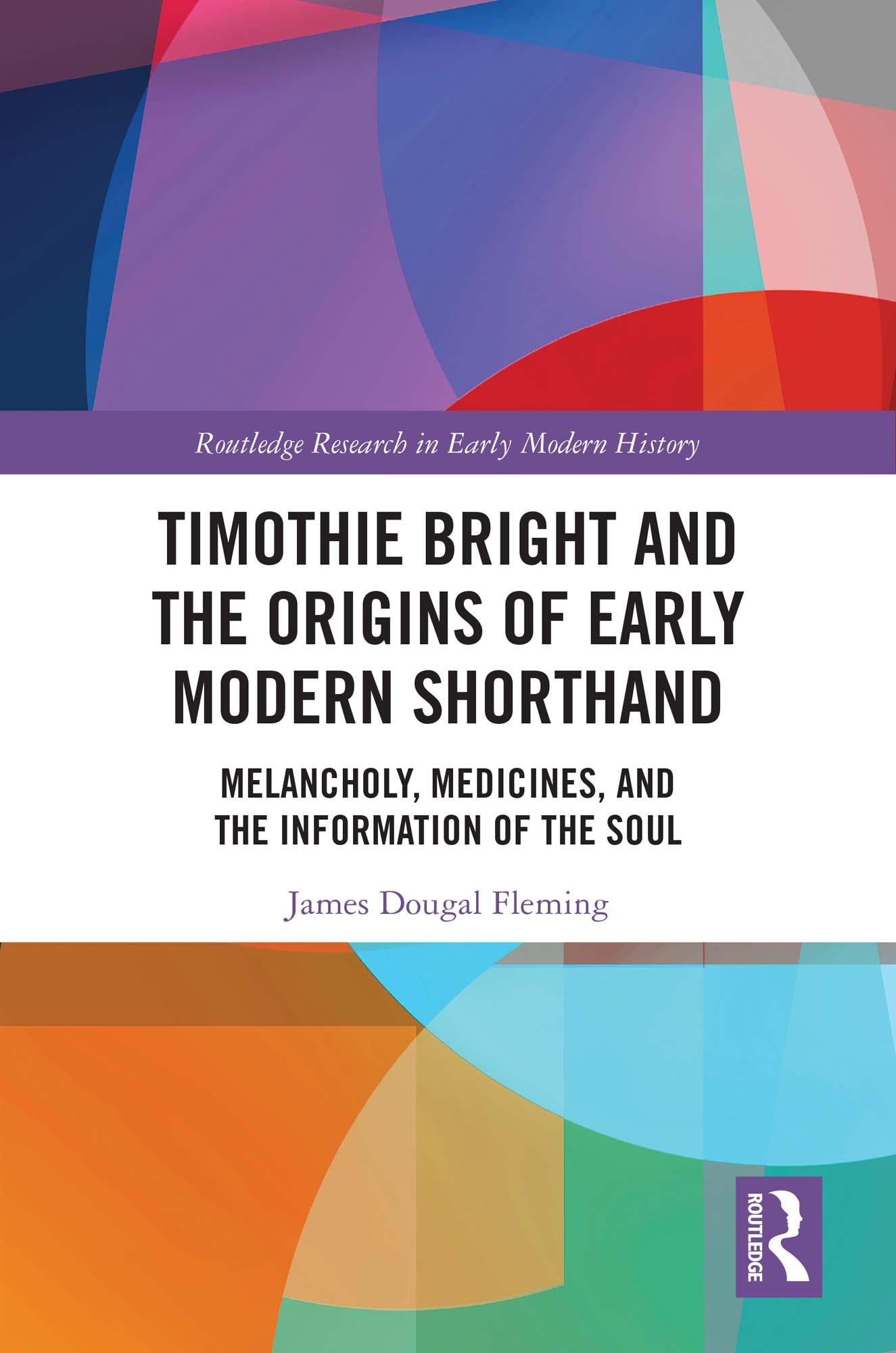
In Timothie Bright and the Origins of Early Modern Shorthand, J.D. Fleming brings together two areas of sixteenth-century intellectual history. One is the period emergence of artificial systems for verbatim shorthand notation—a crucial episode in the history of information. The other is the ancient medical discourse of melancholy humour, or black bile. Timothie Bright (1550–1615), physician and priest, prompts the juxtaposition. For he was the author, not only of the period’s original shorthand manual—Characterie (1588)—but also of the first book in English on the dark humour: The Treatise of Melancholy (1586).
Bright’s account of melancholy involves a cybernetic phenomenology of the human. Essentially, we are psyches (souls or minds). We are sealed off from our bodies, operating them as automata across an interface. Psychological presence, for Bright, is illusion and pathology. Engrossing performances or representations therefore bring great danger, and so does the doctrine of predestination—less for its content than its typical delivery. Painful preaching was indispensable in sixteenth-century English Protestantism. But it falls foul of Bright’s proscriptions. These are followed by his publication of the first known system for verbatim shorthand notation since antiquity, its technique heavily inflected toward a vocabulary of the pulpit. The passionate, oral performance of the inspired preacher receives an unprecedented textual preservative—and prophylactic. Bright’s technology of information serves his phenomenology of alienation.
This book will be of interest to students and scholars of the early modern period, the tradition of melancholy, and the history of information—as theory, and technology.
Before Memmo my notes were scattered across PDFs. Now a workspace pulls everything into one place — I see exactly what's still left to study.
Memmo's summaries are gold before exams. I don't have to re-read 800 pages two weeks before — just the important parts.
The AI chat has saved me the night before an exam more than once. I just keep asking until I get it — no waiting on a study group to reply.
The quizzes hit exactly what I need to know. Memmo tracks what I get stuck on — so I only practice what's worth it.
Flashcards with spaced repetition are magic. Memmo knows when I'm about to forget something and brings it back.
The AI podcasts are my favorite. I listen on my way to school and get a recap without sitting at a computer.

Handbok i kvalitativa metoder
281 kr

Hållbar utveckling: en introduktion för ingenjörer och andra problemlösare
334 kr

Brymans Samhällsvetenskapliga metoder
390 kr

Projektledning
491 kr

Den orättvisa hälsan: om socioekonomiska skillnader i hälsa och livslängd
326 kr

Vetenskapsteori för nybörjare
196 kr

Organizational Leadership
429 kr

På väg mot läraryrket
172 kr

Det sociala livet i skolan: Socialpsykologiska perspektiv
253 kr

Betygsättningens didaktik
151 kr

Personality
402 kr

Studying Leadership
404 kr

Managing Innovation
477 kr

Introduktion till samhällsvetenskaplig metod
347 kr

The Psychology of Sex and Gender
698 kr

Evidens och kunskap för socialt arbete
207 kr

Introduction to Leadership
605 kr