
Before Memmo my notes were scattered across PDFs. Now a workspace pulls everything into one place — I see exactly what's still left to study.
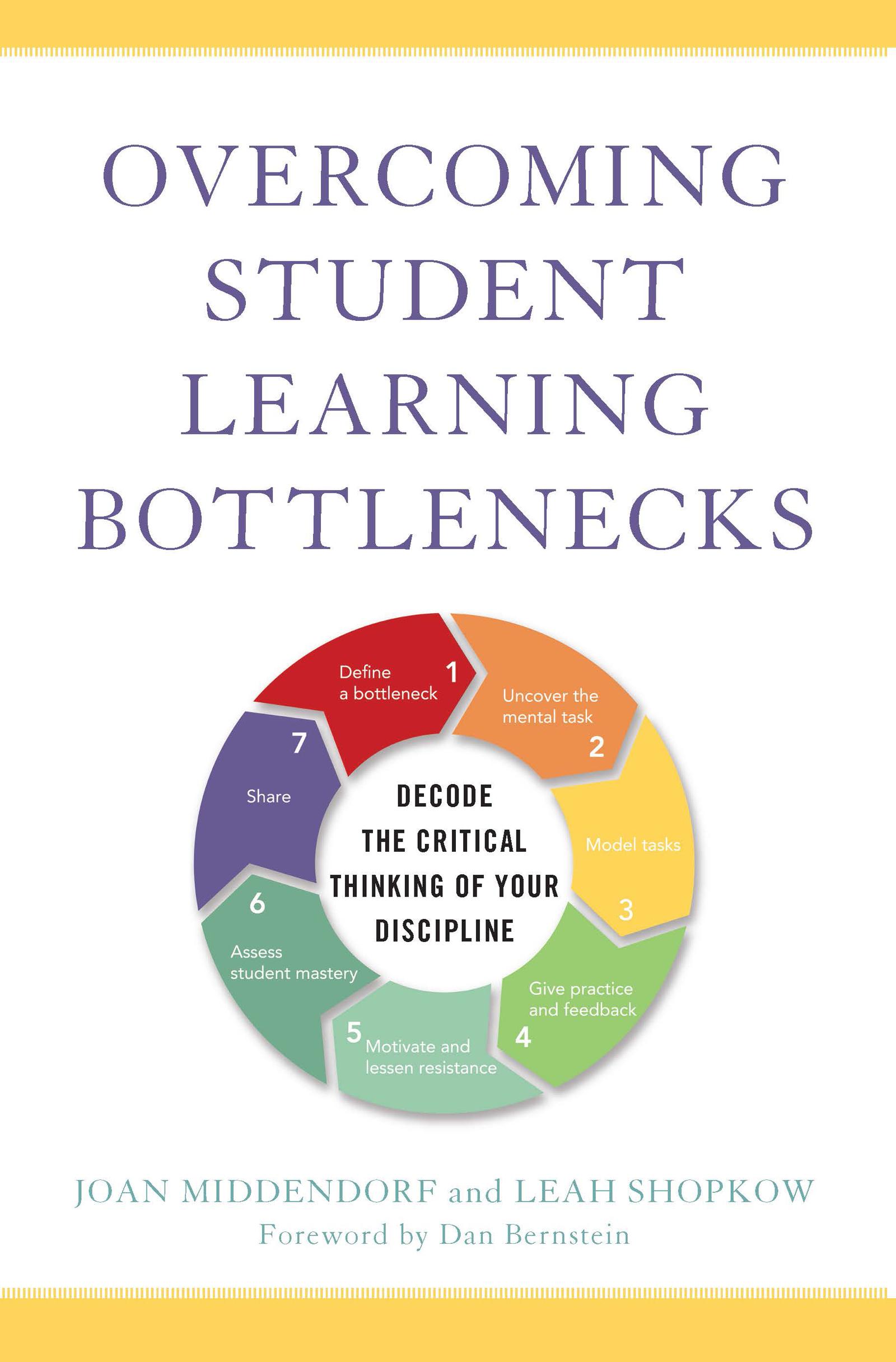
Decoding the Disciplines is a widely-used and proven methodology that prompts teachers to identify the bottlenecks – the places where students get stuck – that impede learners’ paths to expert thinking in a discipline. The process is based on recognizing the gap between novice learning and expert thinking, and uncovering tacit knowledge that may not be made manifest in teaching.Through “decoding”, implicit expert knowledge can be turned into explicit mental tasks, and made available to students. This book presents a seven-step process for uncovering bottlenecks and determining the most effective way to enable students to surmount them.The authors explain how to apply the seven steps of Decoding the Disciplines – how to identify bottlenecks, unpack the critical thinking of experts, teach students how to do this kind of thinking, and how to evaluate the degree to which students have learned to do it. They provide in-depth descriptions of each step and, at the end of each chapter, at least one exercise the reader can do on his or her own. Because the decoding process works well with groups, they also provide exercises for leading groups through the process, making available to informal groups as well as groups led by professional developers, the tools to transform their understanding of teaching and learning by getting the student view that they refer to as “the bottleneck perspective”. Because it focuses on the mental moves that underlie the cognitive competencies we want students to develop, spelling out what critical thinking consists of for any field, the methodology helps teachers to get beyond focus on content delivery and transmission and provides criteria to select from the bewildering array of teaching tools the methods most appropriate to what they are teaching.This is a book for faculty who want their students to develop disciplinary forms of reasoning, and are moreover interested in a methodology with the potential to transform and reinvigorate their teaching. It is particularly suitable for use in communities of practice, and should be indispensable for any one engaged in cross-disciplinary teaching, as it enables co-teachers to surface each other’s tacit knowledge and disciplinary assumptions.
Before Memmo my notes were scattered across PDFs. Now a workspace pulls everything into one place — I see exactly what's still left to study.
Memmo's summaries are gold before exams. I don't have to re-read 800 pages two weeks before — just the important parts.
The AI chat has saved me the night before an exam more than once. I just keep asking until I get it — no waiting on a study group to reply.
The quizzes hit exactly what I need to know. Memmo tracks what I get stuck on — so I only practice what's worth it.
Flashcards with spaced repetition are magic. Memmo knows when I'm about to forget something and brings it back.
The AI podcasts are my favorite. I listen on my way to school and get a recap without sitting at a computer.

Handbok i kvalitativa metoder
281 kr

Hållbar utveckling: en introduktion för ingenjörer och andra problemlösare
334 kr

Brymans Samhällsvetenskapliga metoder
390 kr

Projektledning
491 kr

Den orättvisa hälsan: om socioekonomiska skillnader i hälsa och livslängd
326 kr

Vetenskapsteori för nybörjare
196 kr

Organizational Leadership
429 kr

På väg mot läraryrket
172 kr

Det sociala livet i skolan: Socialpsykologiska perspektiv
253 kr

Betygsättningens didaktik
151 kr

Personality
402 kr

Studying Leadership
404 kr

Managing Innovation
477 kr

Introduktion till samhällsvetenskaplig metod
347 kr

The Psychology of Sex and Gender
698 kr

Evidens och kunskap för socialt arbete
207 kr

Introduction to Leadership
605 kr