
Before Memmo my notes were scattered across PDFs. Now a workspace pulls everything into one place — I see exactly what's still left to study.
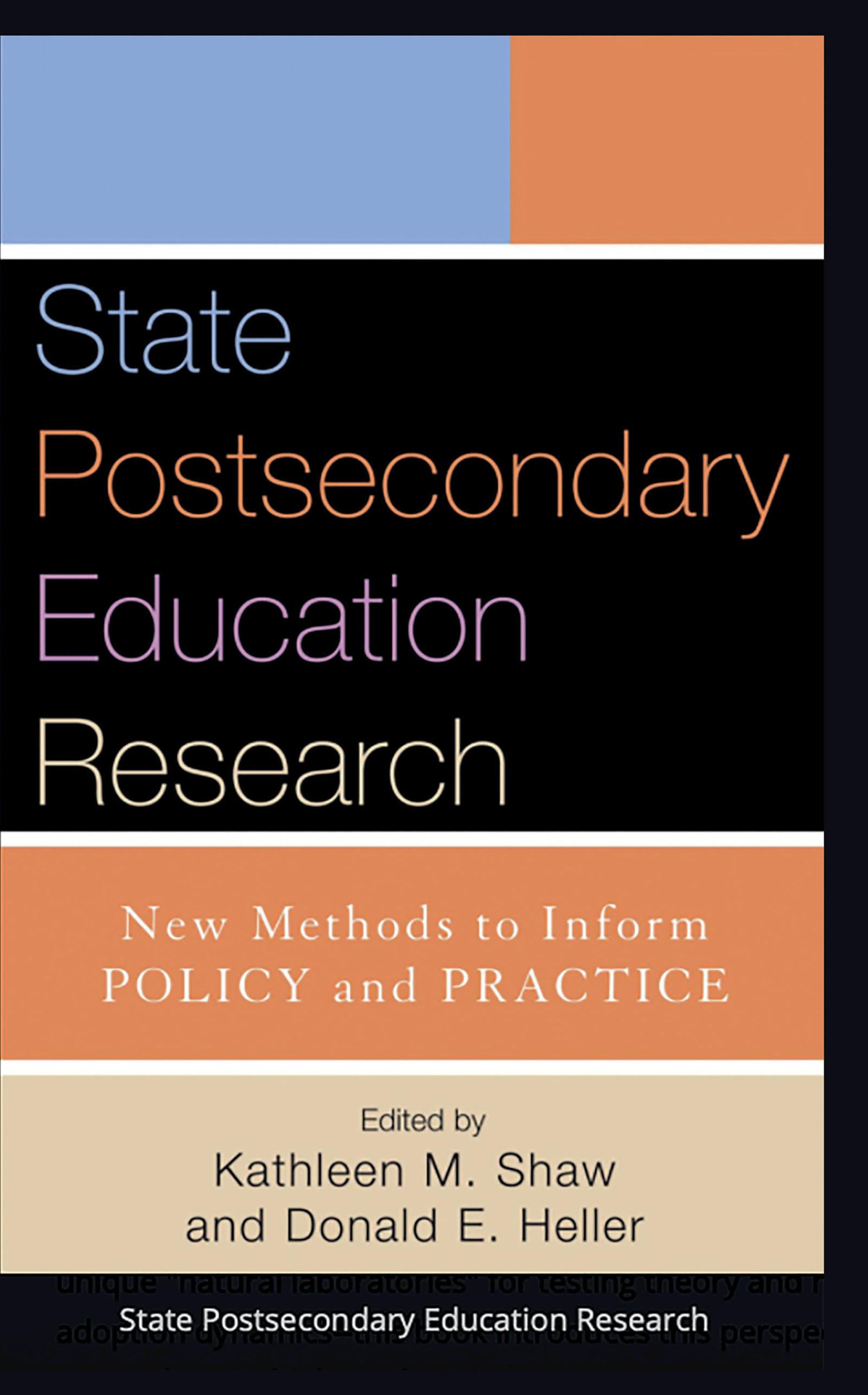
This is an opportune time for researchers in higher education to examine policy via cross-state comparative analyses. Momentous court, legislative and policy developments that impact state-level higher education policy are emerging at a rapid rate. The states have emerged as postsecondary policy innovators in the areas of student financing, institutional accountability, and student access.Following political scientists’ "rediscovery" of states as units of analysis--because they constitute unique "natural laboratories" for testing theory and hypotheses about political behavior and policy adoption dynamics--this book introduces this perspective as an increasingly important tool for researchers in higher education.State Postsecondary Education Research provides an in-depth examination of the challenges and opportunities inherent in conducting cross-state higher education policy research. The authors of each chapter use their individual research projects to demonstrate the array of methodological, theoretical, analytical, and political challenges inherent in conducting comparative state-level policy research. Among the innovative methods described is the use of pooled cross-sectional time-series analytic techniques and event history analysis--now widespread within the disciplines of economics and political science--to shift the unit of analysis from the state to the state-year, thus expanding greatly both the statistical power of the models being tested and the data-demands of those models.The goal is to introduce comparative state-level postsecondary policy research to a broader audience, and to contribute to discussions of both the challenges and the importance of this approach to higher education policy research.The book is intended as a resource for researchers in higher education policy and as a text for higher education policy courses. It may also appeal to scholars of educational policy as well as higher education policymakers.
Before Memmo my notes were scattered across PDFs. Now a workspace pulls everything into one place — I see exactly what's still left to study.
Memmo's summaries are gold before exams. I don't have to re-read 800 pages two weeks before — just the important parts.
The AI chat has saved me the night before an exam more than once. I just keep asking until I get it — no waiting on a study group to reply.
The quizzes hit exactly what I need to know. Memmo tracks what I get stuck on — so I only practice what's worth it.
Flashcards with spaced repetition are magic. Memmo knows when I'm about to forget something and brings it back.
The AI podcasts are my favorite. I listen on my way to school and get a recap without sitting at a computer.

Handbok i kvalitativa metoder
281 kr

Hållbar utveckling: en introduktion för ingenjörer och andra problemlösare
334 kr

Brymans Samhällsvetenskapliga metoder
390 kr

Projektledning
491 kr

Den orättvisa hälsan: om socioekonomiska skillnader i hälsa och livslängd
326 kr

Organizational Leadership
429 kr

Vetenskapsteori för nybörjare
196 kr

På väg mot läraryrket
172 kr

Det sociala livet i skolan: Socialpsykologiska perspektiv
253 kr

Betygsättningens didaktik
151 kr

Personality
402 kr

Studying Leadership
404 kr

Managing Innovation
477 kr

Introduktion till samhällsvetenskaplig metod
347 kr

The Psychology of Sex and Gender
698 kr

Evidens och kunskap för socialt arbete
207 kr

Introduction to Leadership
605 kr