
Before Memmo my notes were scattered across PDFs. Now a workspace pulls everything into one place — I see exactly what's still left to study.
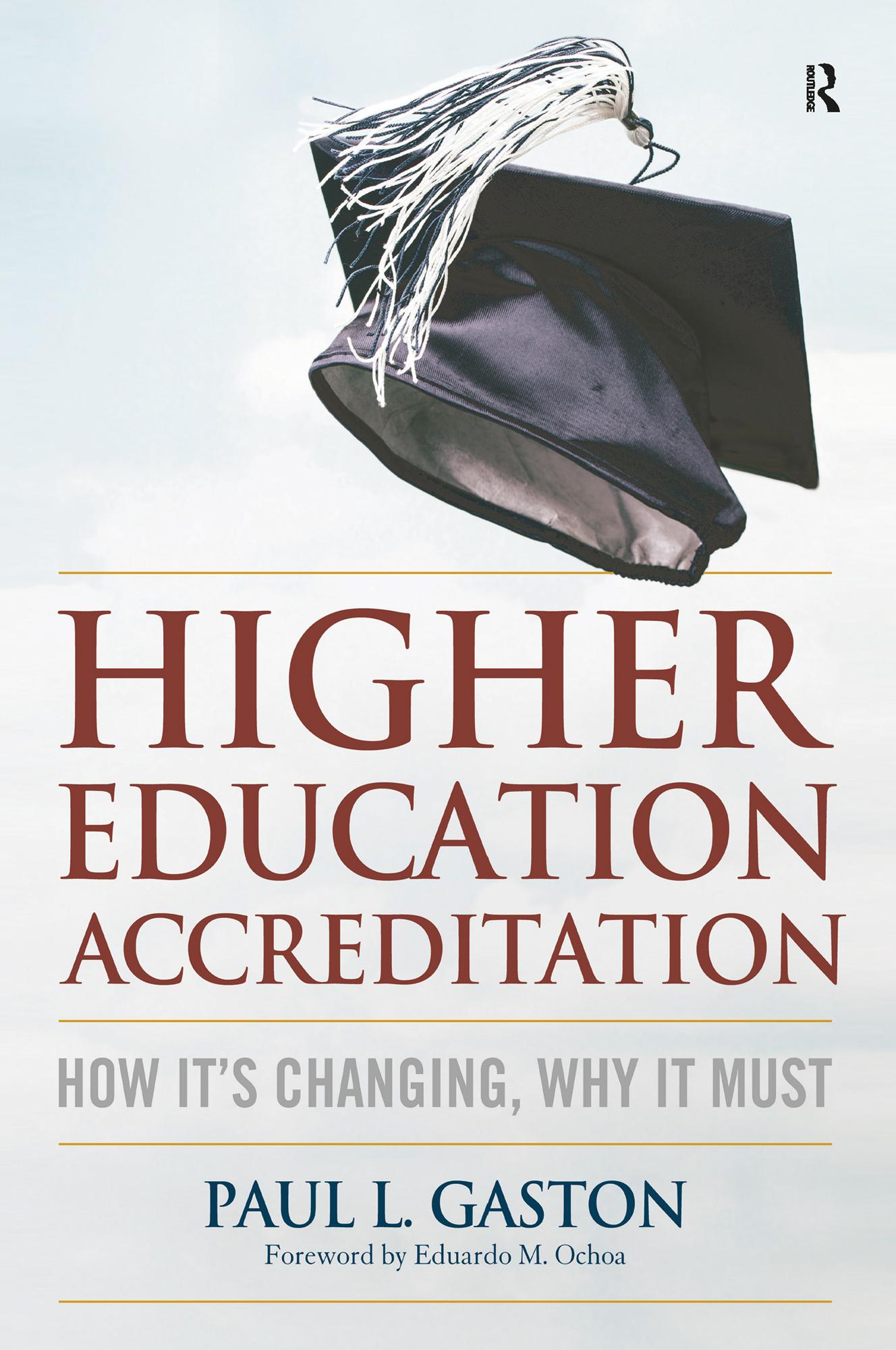
Is the accreditation system “broken” as claimed by successive Secretaries of Education and some recent reports? This book addresses this question head-on, asking whether accreditation is indeed in need of radical reform, and whether the agencies’ authority should be curtailed; or whether in fact the changes now underway – that accrediting agencies contend ensure rigorous and consistent standards and degrees that are a reliable gauge of student attainment – are moving the academy and the nation in the right direction. In a sweeping and ambitious book, Paul Gaston deploys his knowledge and experience as a peer reviewer for three regional accrediting agencies, a former board member and chair of the Association of Specialized and Professional Accreditors, and his involvement in the early stages of the Council for Higher Education Accreditation, to go beyond the polemics to explore whether a strategy that builds on the emerging values and good practices can achieve the substantive and positive improvements the public is demanding.As an introduction for readers new to the debate, he provides a brief overview of the development of accreditation, its terminology, and structure, describing how it currently works, and what it has achieved; and offers insight into the proliferation of the missions of accreditation – as well as the multiplicity of stakeholders with an interest in its outcomes – to question whether the mandate of accreditation should, as some contend, be expanded, or particular missions reassigned or abandoned. This established, he undertakes a dispassionate analysis of the arguments and recommendations of critics and supporters of the current direction of accreditation to identify common ground and explore constructive ways forward, paying specific attention to current and potential reforms of the three sectors of higher education accreditation: the seven regional accrediting associations, the national accreditors, and programmatic, or “specialized” accreditation. The book concludes by outlining a comprehensive approach to reform. His proposal would preserve practices that already work well while advancing important changes that can be incrementally implemented. The result would be a higher education accreditation structure more cost effective, more efficient, more transparent and accountable, and more responsive to institutional and public needs.
Before Memmo my notes were scattered across PDFs. Now a workspace pulls everything into one place — I see exactly what's still left to study.
Memmo's summaries are gold before exams. I don't have to re-read 800 pages two weeks before — just the important parts.
The AI chat has saved me the night before an exam more than once. I just keep asking until I get it — no waiting on a study group to reply.
The quizzes hit exactly what I need to know. Memmo tracks what I get stuck on — so I only practice what's worth it.
Flashcards with spaced repetition are magic. Memmo knows when I'm about to forget something and brings it back.
The AI podcasts are my favorite. I listen on my way to school and get a recap without sitting at a computer.

Handbok i kvalitativa metoder
281 kr

Hållbar utveckling: en introduktion för ingenjörer och andra problemlösare
334 kr

Brymans Samhällsvetenskapliga metoder
390 kr

Projektledning
491 kr

Den orättvisa hälsan: om socioekonomiska skillnader i hälsa och livslängd
326 kr

Organizational Leadership
429 kr

Vetenskapsteori för nybörjare
196 kr

På väg mot läraryrket
172 kr

Det sociala livet i skolan: Socialpsykologiska perspektiv
253 kr

Betygsättningens didaktik
151 kr

Personality
402 kr

Studying Leadership
404 kr

Managing Innovation
477 kr

Introduktion till samhällsvetenskaplig metod
347 kr

The Psychology of Sex and Gender
698 kr

Evidens och kunskap för socialt arbete
207 kr

Introduction to Leadership
605 kr