
Before Memmo my notes were scattered across PDFs. Now a workspace pulls everything into one place — I see exactly what's still left to study.
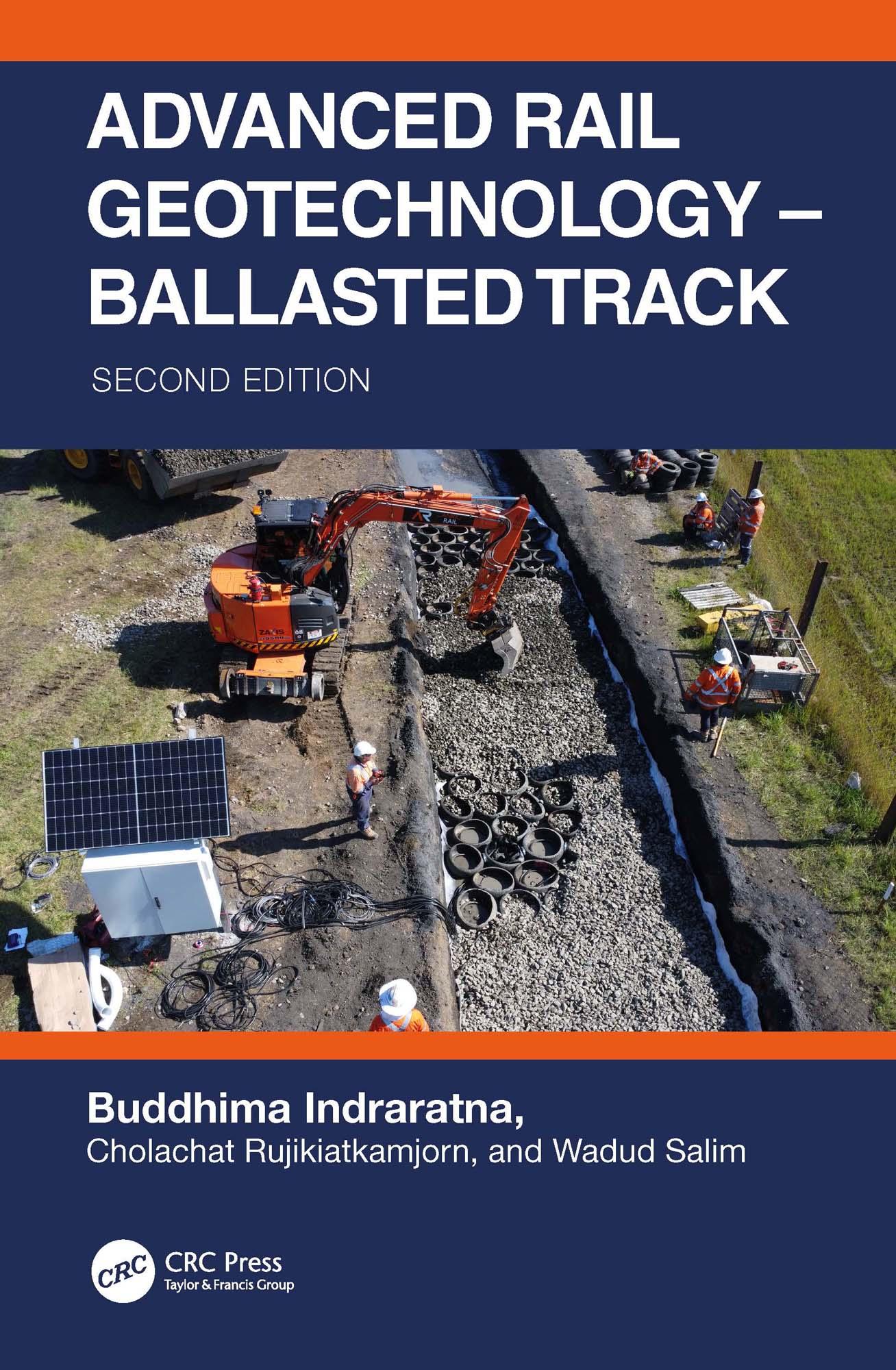
Ballast plays a vital role in transmitting and distributing the train wheel loads to the underlying track substructure. The load-bearing capacity, safe train speed, and the levels of noise and vibration, as well as passenger comfort depend on the behaviour of ballast through particle interlocking and the corresponding deformation of this granular assembly. Attrition and breakage of ballast occur progressively under heavy and continual cyclic loading, causing track deterioration and rail misalignment affecting safety, while exacerbating the intensity of track maintenance. In the absence of realistic computational models, the track substructure is traditionally designed using mostly empirical approaches.
In this book, the authors present the detailed information on the strength, deformation, and degradation aspects of fresh and recycled ballast under monotonic, cyclic, and impact loading using innovative geotechnical testing devices. A constitutive model for ballast incorporating particle breakage is presented representing a more realistic stress–strain response. The mathematical formulations and numerical models are validated using controlled experimental simulations and fully instrumented field trials. Revised ballast gradation is described to provide greater track resiliency and extended longevity. The book also provides a detailed description of geosynthetics for substructure improvement considering track deterioration caused by particle degradation, fouling, and impeded drainage. New to this second edition are extensive discussions on subgrade soil stabilisation, causes and mechanisms of soil fluidisation (mud pumping) under cyclic loading, and preventive and remedial measures to alleviate undue instability of ballast tracks.
This book should prove most beneficial for final-year civil engineering students and for postgraduate teaching and learning. It is an ideal supplement for practising railway engineers and researchers engaged in the challenging tasks of future track design for heavier and faster trains.
Before Memmo my notes were scattered across PDFs. Now a workspace pulls everything into one place — I see exactly what's still left to study.
Memmo's summaries are gold before exams. I don't have to re-read 800 pages two weeks before — just the important parts.
The AI chat has saved me the night before an exam more than once. I just keep asking until I get it — no waiting on a study group to reply.
The quizzes hit exactly what I need to know. Memmo tracks what I get stuck on — so I only practice what's worth it.
Flashcards with spaced repetition are magic. Memmo knows when I'm about to forget something and brings it back.
The AI podcasts are my favorite. I listen on my way to school and get a recap without sitting at a computer.

Handbok i kvalitativa metoder
281 kr

Hållbar utveckling: en introduktion för ingenjörer och andra problemlösare
334 kr

Brymans Samhällsvetenskapliga metoder
390 kr

Projektledning
491 kr

Den orättvisa hälsan: om socioekonomiska skillnader i hälsa och livslängd
326 kr

Organizational Leadership
429 kr

Vetenskapsteori för nybörjare
196 kr

På väg mot läraryrket
172 kr

Det sociala livet i skolan: Socialpsykologiska perspektiv
253 kr

Betygsättningens didaktik
151 kr

Personality
402 kr

Studying Leadership
404 kr

Managing Innovation
477 kr

Introduktion till samhällsvetenskaplig metod
347 kr

The Psychology of Sex and Gender
698 kr

Evidens och kunskap för socialt arbete
207 kr

Introduction to Leadership
605 kr