
Before Memmo my notes were scattered across PDFs. Now a workspace pulls everything into one place — I see exactly what's still left to study.
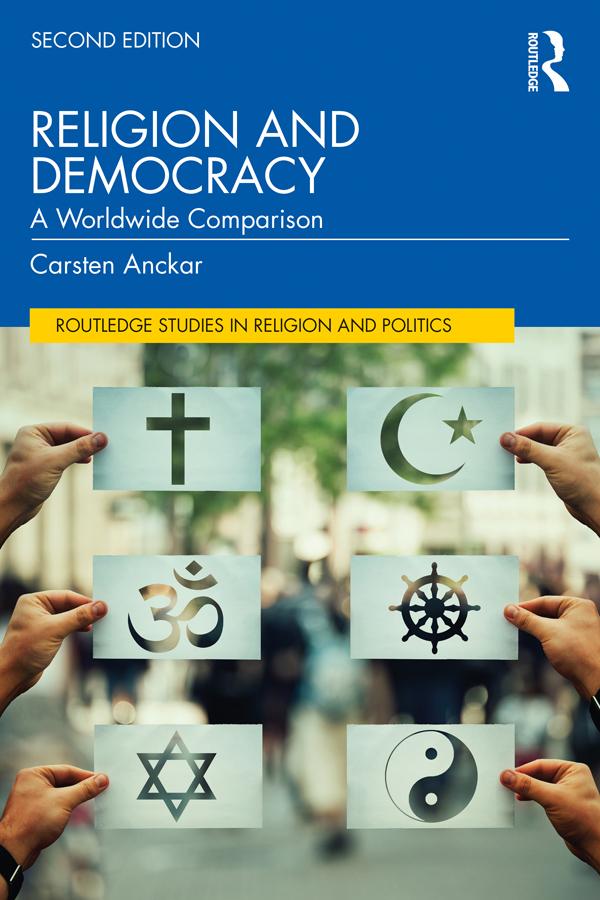
This fully updated new edition empirically assesses the relationship between religion and democracy, looking at global, regional, and individual countries’ perspectives.
Using a wide range of quantitative data, the author tests the validity of Huntington's claim that democracy and religion are tightly connected, and that western Christianity is the only religion capable of supporting democratic institutions. He evaluates both the broader assumptions that the introduction and the stability of a democratic form of government is dependent on the dominating religion in the country at the macro level, and the suggestion that, at the individual level, religious adherence is related to pro-democratic values. Examining religions including Christianity, Islam, Buddhism, Hinduism, Chinese folk religion, and Judaism, this book demonstrates that geographical and political contexts are more important than religious affiliation for explaining levels of, and attitudes towards, democracy.
As well as offering a broad empirical picture of the relationship between religion and democracy, this new edition delves deeper into the religion–state nexus, focusing particularly on events that have taken place during the last decade. The author explores how religion is used instrumentally by political leaders in different parts of the world. He also discusses the extent to which religious minorities are under increasing pressure in secularized environments; prospects for democracy in the MENA region a decade after the Arab Spring; the growing influence of evangelical Christianity in Latin America; and how increasing levels of religious conflict in Asia and the Pacific as well as in Sub-Saharan Africa pose a threat to the emergence and survival of democracy.
This book will be of great interest to students, academics, and researchers within the field of comparative politics, as well as journalists and various theological associations.
Before Memmo my notes were scattered across PDFs. Now a workspace pulls everything into one place — I see exactly what's still left to study.
Memmo's summaries are gold before exams. I don't have to re-read 800 pages two weeks before — just the important parts.
The AI chat has saved me the night before an exam more than once. I just keep asking until I get it — no waiting on a study group to reply.
The quizzes hit exactly what I need to know. Memmo tracks what I get stuck on — so I only practice what's worth it.
Flashcards with spaced repetition are magic. Memmo knows when I'm about to forget something and brings it back.
The AI podcasts are my favorite. I listen on my way to school and get a recap without sitting at a computer.

Handbok i kvalitativa metoder
281 kr

Hållbar utveckling: en introduktion för ingenjörer och andra problemlösare
334 kr

Brymans Samhällsvetenskapliga metoder
390 kr

Projektledning
491 kr

Den orättvisa hälsan: om socioekonomiska skillnader i hälsa och livslängd
326 kr

Vetenskapsteori för nybörjare
196 kr

Organizational Leadership
429 kr

På väg mot läraryrket
172 kr

Det sociala livet i skolan: Socialpsykologiska perspektiv
253 kr

Betygsättningens didaktik
151 kr

Personality
402 kr

Studying Leadership
404 kr

Managing Innovation
477 kr

Introduktion till samhällsvetenskaplig metod
347 kr

The Psychology of Sex and Gender
698 kr

Evidens och kunskap för socialt arbete
207 kr

Introduction to Leadership
605 kr