
Before Memmo my notes were scattered across PDFs. Now a workspace pulls everything into one place — I see exactly what's still left to study.
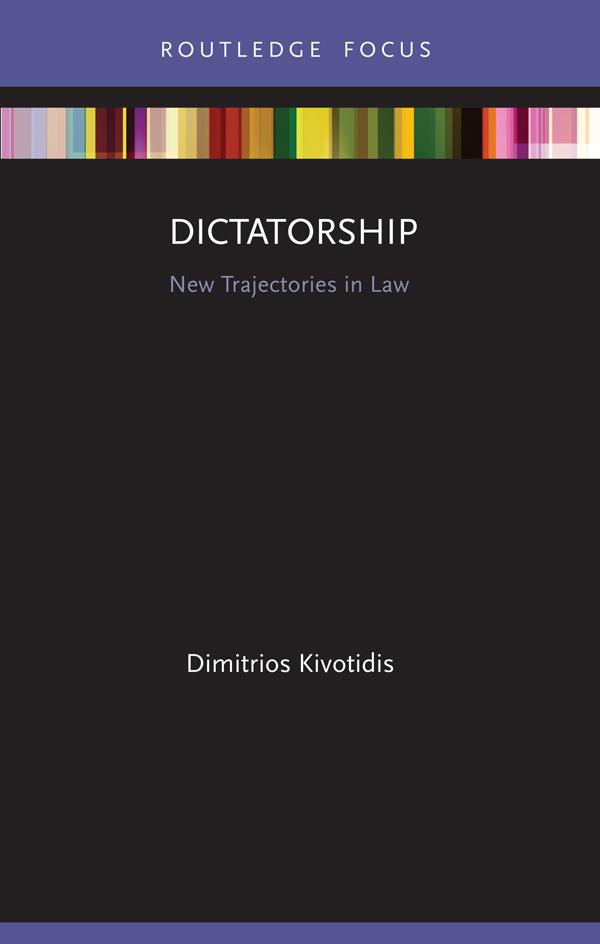
This book analyses the institution and concept of dictatorship from a legal, historical and theoretical perspective, examining the different types of dictatorship, their relationship to the law, as well as the analytical value of the concept in contemporary world.
In particular, it seeks to codify the main theories and conceptions of ‘dictatorship’, with the goal of unearthing their contradictions. The book’s main premise is that the concept of dictatorship and the different types of the dictatorial form have to be assessed and can only be understood in their historical context. On this basis, the elaborations on dictatorship of such diverse thinkers as Carl Schmitt, Donoso Cortes, Karl Marx, Ernst Fraenkel, Franz Neumann, Nicos Poulantzas, and V. I. Lenin, are discussed in their historical context: ‘classical and Caesaristic dictatorship’ in ancient Rome, ‘dictatorship’ in revolutionary France of 1789 and counterrevolutionary France of 1848, ‘fascist dictatorship’ in Nazi Germany, and ‘dictatorship of the proletariat’ in Russia of 1917. The book contributes to the theory of dictatorship as it outlines the contradictions of the different typologies of the dictatorial form and seeks to explain them on the basis of the concept of ‘class dictatorship’. The book’s original claim is that the dictatorial form, as a modality of class rule that relies predominantly on violence and repression, has been essential to the reproduction of bourgeois rule and, consequently, of capitalist social relations. This function has given rise to different types and conceptualisations of dictatorship depending on the level of capitalist development.
This book is addressed to anyone with an interest in law, political theory, political history and sociology. It can serve as core text for courses that seek to introduce students to the institution or theory of dictatorship. It may also serve as a reference text for post-graduate programs in law and politics, because of its interdisciplinary and critical approach.
Before Memmo my notes were scattered across PDFs. Now a workspace pulls everything into one place — I see exactly what's still left to study.
Memmo's summaries are gold before exams. I don't have to re-read 800 pages two weeks before — just the important parts.
The AI chat has saved me the night before an exam more than once. I just keep asking until I get it — no waiting on a study group to reply.
The quizzes hit exactly what I need to know. Memmo tracks what I get stuck on — so I only practice what's worth it.
Flashcards with spaced repetition are magic. Memmo knows when I'm about to forget something and brings it back.
The AI podcasts are my favorite. I listen on my way to school and get a recap without sitting at a computer.

Handbok i kvalitativa metoder
281 kr

Hållbar utveckling: en introduktion för ingenjörer och andra problemlösare
334 kr

Brymans Samhällsvetenskapliga metoder
390 kr

Projektledning
491 kr

Den orättvisa hälsan: om socioekonomiska skillnader i hälsa och livslängd
326 kr

Vetenskapsteori för nybörjare
196 kr

Organizational Leadership
429 kr

På väg mot läraryrket
172 kr

Det sociala livet i skolan: Socialpsykologiska perspektiv
253 kr

Betygsättningens didaktik
151 kr

Personality
402 kr

Studying Leadership
404 kr

Managing Innovation
477 kr

Introduktion till samhällsvetenskaplig metod
347 kr

The Psychology of Sex and Gender
698 kr

Evidens och kunskap för socialt arbete
207 kr

Introduction to Leadership
605 kr