
Before Memmo my notes were scattered across PDFs. Now a workspace pulls everything into one place — I see exactly what's still left to study.
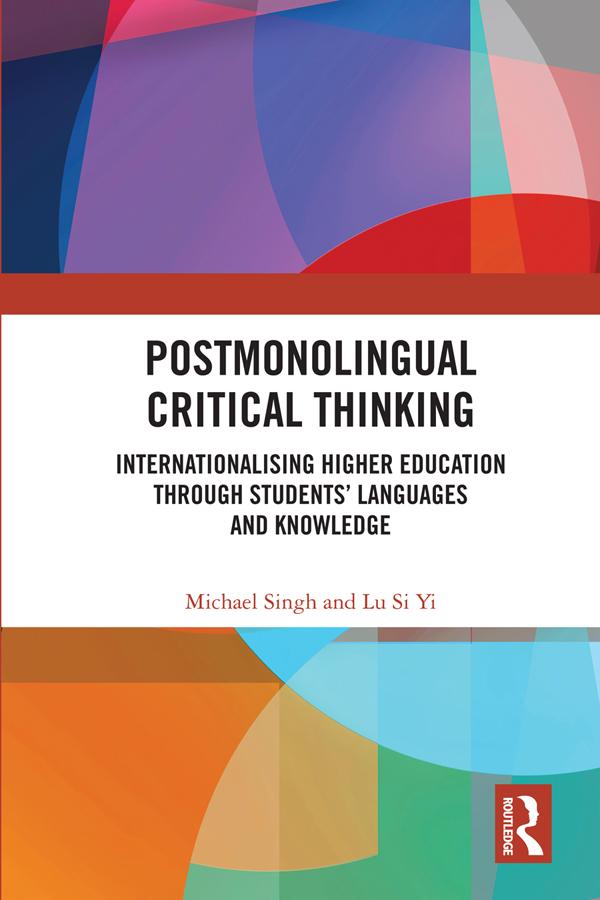
Maintaining English as the sole language of knowledge production and dissemination in universities that enrol students who speak multiple languages, and those students learning other languages, is questionable. This groundbreaking work calls into question the exclusive use of academic English in internationalising higher education teaching and research. By interrogating the dominant assumptions informing the monolingual mindset, Postmonolingual Critical Thinking indicates that academically literate students can capably use their repertoires of languages and knowledge for educational purposes. The case for students’ languages and knowledge having a place in English-medium universities is made through evidence of the uses of Zhōngwén, academic Chinese.
Proposing to broaden the scope of languages used for knowledge production and dissemination, this book highlights the educational potential of multilingualism. Postmonolingual Critical Thinking makes a unique proposal: that universities which recruit doctoral students from Asia create education policy practices that enable them to extend their multilingual capabilities. Arguing that by drawing on intellectual resources from their various languages, students construct knowledge of critical thinking in complex, interesting and potentially innovative ways, this book guides higher education institutions in putting this into practice. It outlines a pragmatic approach for universities to explore the potential of multipolar, multilingual education, while being attentive to the tensions posed by assertions of a monolingual mindset.
Postmonolingual Critical Thinking has the potential to create great change in a higher education sector which is mired by a monolingual approach to graduate training. This unique and thought-provoking book is essential reading for those in the fields of applied linguistics, comparative education, higher education, international studies, teacher education and translation studies.
Before Memmo my notes were scattered across PDFs. Now a workspace pulls everything into one place — I see exactly what's still left to study.
Memmo's summaries are gold before exams. I don't have to re-read 800 pages two weeks before — just the important parts.
The AI chat has saved me the night before an exam more than once. I just keep asking until I get it — no waiting on a study group to reply.
The quizzes hit exactly what I need to know. Memmo tracks what I get stuck on — so I only practice what's worth it.
Flashcards with spaced repetition are magic. Memmo knows when I'm about to forget something and brings it back.
The AI podcasts are my favorite. I listen on my way to school and get a recap without sitting at a computer.

Handbok i kvalitativa metoder
281 kr

Hållbar utveckling: en introduktion för ingenjörer och andra problemlösare
334 kr

Brymans Samhällsvetenskapliga metoder
390 kr

Projektledning
491 kr

Den orättvisa hälsan: om socioekonomiska skillnader i hälsa och livslängd
326 kr

Vetenskapsteori för nybörjare
196 kr

Organizational Leadership
429 kr

På väg mot läraryrket
172 kr

Det sociala livet i skolan: Socialpsykologiska perspektiv
253 kr

Betygsättningens didaktik
151 kr

Personality
402 kr

Studying Leadership
404 kr

Managing Innovation
477 kr

Introduktion till samhällsvetenskaplig metod
347 kr

The Psychology of Sex and Gender
698 kr

Evidens och kunskap för socialt arbete
207 kr

Introduction to Leadership
605 kr